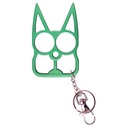
Alley Prowler Feline Impact Keychain Defender - Green Steel
13 sold in last 24 hours
This self-defense keychain is simple: solid steel, two finger rings, and cat-ear impact points that turn your natural punch into a focused strike. The bright green finish makes it easy to spot on crowded keys or in a bag, while the smooth edges keep it comfortable in daily carry. Slip your fingers through the eye holes, let the flat body rest against your palm, and you’ve got a discreet impact tool that feels as natural as clenching your keys.
What This Self-Defense Keychain Actually Does
The Alley Prowler Feline Impact Keychain Defender - Green Steel is a straightforward self-defense tool: it lets you hit harder, with more focus and control, using a motion you already know—clenching your fist. There’s no battery, no trigger, no learning curve. You slip your fingers through the eye-ring holes, the flat steel plate fills your palm, and the pointed cat ears turn that grip into a compact impact weapon you can carry every day.
If you’re looking at pepper spray, a stun gun for self defense, or other personal protection tools, this keychain sits in the category of simple, always-available backup: it’s legal more places than a stun gun, needs no charging, and works even under stress because the motion is so familiar. It’s not a magic shield, but it does give you a stronger, more protected hand if you ever need to strike to create an opportunity to escape.
Design Built for Real-World Personal Protection
Real self-defense isn’t about gadgets; it’s about what you can actually access and use under pressure. This impact self-defense keychain is designed for that reality. The flat cat-shaped steel body gives your fist structure, helping spread impact across your palm so your hand takes less of the shock. The eye-ring holes fit two fingers, anchoring the tool so it doesn’t slip if you make contact.
Where a stun gun for self defense might fail because of dead batteries, distance, or clothing, this kind of impact tool works at the closest range—when someone is already within arm’s reach. It doesn’t replace a stun gun or pepper spray; it complements them as a last-ditch, up-close option you can still use if other tools aren’t accessible in time.
Solid Steel Construction You Can Trust
The body is cut from steel, not plastic. That matters. Steel gives you weight, rigidity, and durability, so the pointed ear tips stay defined and the frame doesn’t flex when you strike. The matte green coating helps resist minor corrosion from sweat and pocket carry without turning this into a flashy, tactical-looking object.
Smoothly beveled edges around the finger rings and cutouts reduce hot spots so you can train with it or carry it daily without it chewing up your knuckles or pockets. It’s simple, but that simplicity is what makes it reliable.
Grip That Locks Into Your Hand
The two large eye-ring holes are sized for a natural grip—slide your index and middle finger through, curl your hand, and the lower rectangular section seats against your palm. The pointed cat ears extend above your knuckles, turning a basic punch into a focused impact. That grip geometry is intentional: it keeps the tool aligned with your bones instead of twisting under impact.
Because this is a passive tool—no moving parts, no buttons—you can pre-grip it while walking to your car or crossing a dark lot without drawing attention. On a keyring, it just looks like a novelty cat charm until you slide your fingers through the eye holes.
Carry Reality: How This Keychain Rides Day to Day
Personal protection gear only helps if it’s actually on you. This self-defense keychain is built around that reality. It includes a standard keyring plus a small swivel clasp, so you can clip it to keys, a purse strap, a belt loop, or an internal bag ring. The flat profile and compact size make it pocket-friendly; it won’t print loudly or snag in most everyday setups.
Compared to a stun gun for personal protection, which often needs its own holster or pocket and regular battery checks, this impact tool is more like a seatbelt: low-maintenance, always there, and only obvious when you need it. Many people pair a stun gun for self defense with a physical keychain tool like this for layered protection—distance tool first, impact tool if someone closes the gap.
Discreet but Easy to Find
The bright green finish is intentional: it’s easy to spot on a crowded keyring or at the bottom of a bag, which matters when you’re under stress and don’t have the fine motor control to search carefully. At the same time, the playful cat outline keeps it from reading as a weapon at a glance, especially when it’s mixed with regular keys and charms.
How This Type of Self-Defense Tool Actually Works
Tools like this don’t do the work for you—they amplify what your body is already doing. When you strike with your bare fist, the force spreads across your knuckles and soft tissue. With this impact keychain, the pointed ears concentrate that force into a smaller area, making each strike more likely to cause pain and disruption, which can create an opening for you to break contact and move away.
Unlike a stun gun, there’s no requirement for electrical contact, no question of amperage versus voltage, and no concern about thick clothing blocking effectiveness. The trade-off is that you must be physically engaged with the threat—this is for close-range self-defense, not deterrence at a distance.
Any responsible self-defense instructor will tell you: your tool is only part of the equation. Awareness, boundary setting, and basic movement matter just as much. This keychain is designed to integrate into that broader personal protection approach as a simple, reliable force-multiplier in your hand.
What People Ask Before Buying a Stun Gun for Protection
How effective are stun guns for self defense?
Stun guns can be effective for self defense, but only when used in the right context, with the right expectations. They’re pain-compliance tools, not guaranteed “one-touch knockouts.” For a stun gun for self defense to work well, you need solid contact on the body (ideally areas with less clothing), enough contact time—usually several seconds—and sufficient amperage to disrupt muscle control, not just a high marketing voltage number.
They shine when you have time to prep and present the tool early, as someone approaches too close. They’re less useful if you’re already grabbed or don’t have the stun gun in hand. That’s where something like this self-defense keychain comes in: it’s always on your keys, requires zero power, and works at the moment of physical contact. Many people choose both: a stun gun for personal protection at the edge of their space, and an impact tool as a backup when distance is gone.
Does voltage or amperage matter more in a stun gun?
Amperage matters far more than voltage in a stun gun. Voltage mostly helps the current jump gaps (like clothing or air); it’s the amperage—the amount of current—that affects how strongly the stun gun can interfere with muscle control. Those “10 million volt” claims are almost entirely marketing theater. In realistic terms, a usable stun gun for personal protection operates at relatively low amperage, but with enough current and contact time to create intense pain and temporary disruption.
If you’re comparing models, focus on honest amperage ratings, real-world testing, contact quality (wide, solid electrodes), and build reliability rather than the biggest voltage number on the box. A reliable, well-built unit with modest advertised voltage will outperform a flimsy “million volt” stun gun for self defense in actual use.
Is this stun gun legal to carry in my state?
Stun gun laws vary widely by state and sometimes by city. Some states treat a stun gun much like other defensive tools, while others require permits or ban them in certain locations (schools, government buildings, public transit). Before you carry any stun gun for self defense, you should check your state statutes and, ideally, local ordinances—often listed under “electronic control devices,” “conducted energy weapons,” or “stun gun” specifically.
By contrast, a self-defense keychain like this steel cat impact tool is legal in more areas but can still fall under local weapon or “knuckle” laws. The practical move: look up your state and city code, search both “stun gun” and “metal knuckles” or “self-defense keychain,” and when in doubt, ask a local attorney or law enforcement liaison. Knowing the rules is part of real personal protection.
Putting It All Together: A Realistic Protection Setup
Whether you ultimately carry a stun gun for personal protection, pepper spray, this impact keychain, or some combination, the goal is the same: tools you can actually access, understand, and use. The Alley Prowler Feline Impact Keychain Defender - Green Steel earns its spot because it’s simple, sturdy, and always along for the ride.
Clip it to your keys, practice slipping your fingers through the eye holes a few times, and pay attention to how it seats in your hand. Combine that with basic awareness—head up, scanning, giving yourself space—and any other legal tools you choose, and you’re not just carrying gear; you’re building a calm, informed self-defense plan you can actually execute if you ever need it.