
Android Signal Tactical OTF Knife - Black/Red
9 sold in last 24 hours
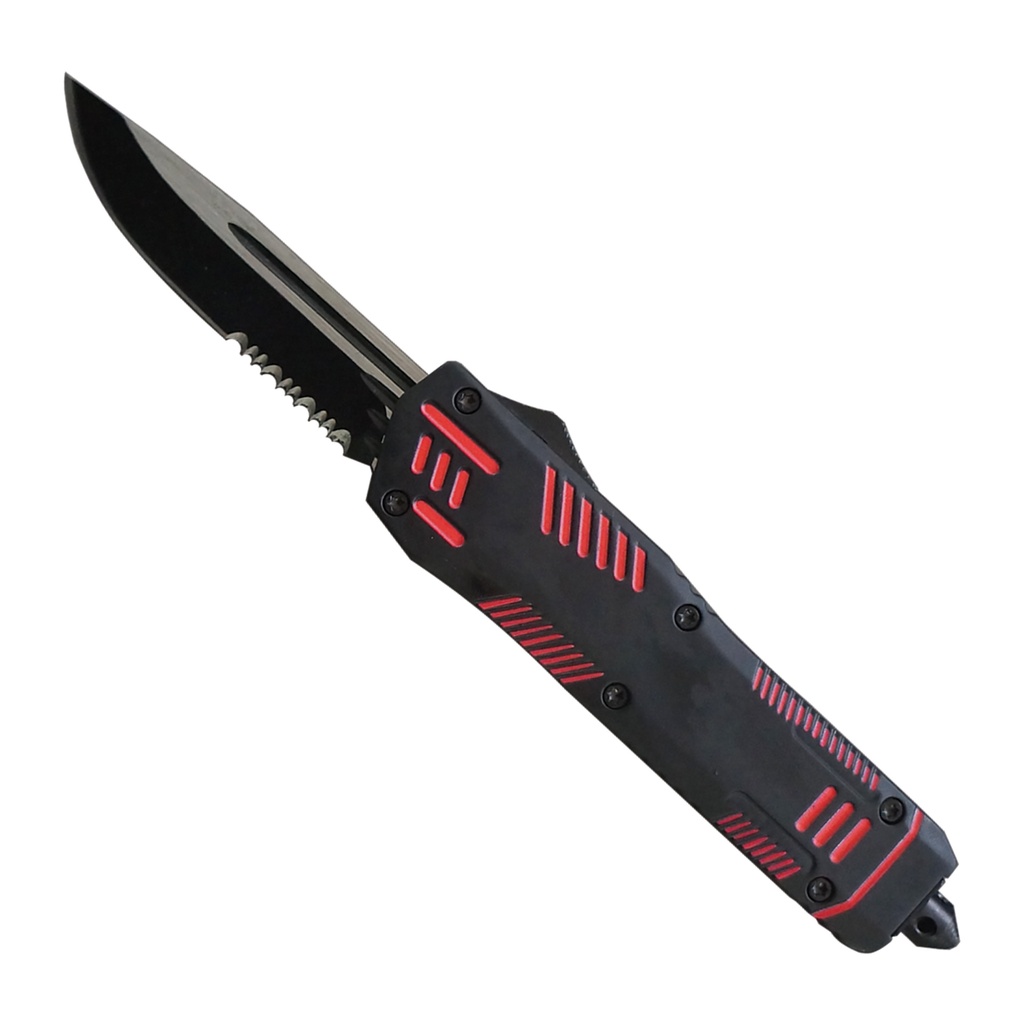
You don’t unfold this knife, you trigger it. The Android Signal Tactical OTF Knife snaps the spear point blade forward with a bold red slide, then retracts just as cleanly with true double-action control. Matte black steel with partial serration handles rope, webbing, and boxes, while the glass breaker and pocket clip keep it ready at the edge of your hand. This is a modern OTF built for people who want fast, mechanical precision in a black-and-red tactical package.
Android Signal Tactical OTF Knife - Black/Red
The Android Signal Tactical OTF Knife is built for people who care more about reliable mechanics and blade control than flashy gimmicks. This double-action out-the-front knife gives you fast deployment, solid lockup, and a practical spear point blade with partial serration in a compact, pocket-ready package. It looks futuristic, but the purpose is simple: clean, repeatable access to a usable edge when you actually need it.
What This OTF Knife Actually Does Well
This isn’t a wall-hanger or a movie prop. The Android Signal is a working OTF knife designed around three priorities: consistent deployment, secure grip, and real-world cutting performance. The 3.375-inch matte black spear point blade comes out the front of the 5.5-inch handle in a straight line, driven by a firm red slide. That means you can index the knife in your pocket, thumb the slider, and bring a usable blade into play without unfolding, flipping, or changing your grip.
The partial-serrated edge gives you a good balance: plain edge near the tip for controlled cuts and finer work, serrations closer to the handle for biting through tougher material like nylon straps, cord, or thicker cardboard. At 9 inches overall and 8.42 ounces, it rides like a solid tactical tool rather than a featherweight toy, which translates into better control once it’s in your hand.
How Double-Action OTF Knives Work in Practice
Out-the-front knives use an internal track and spring system to drive the blade forward and back along the handle’s long axis. On the Android Signal Tactical OTF Knife, the red side-mounted slide is your control hub. Push it forward and the internal spring sends the blade out until it locks into place. Pull it back and the blade retracts safely into the handle.
That double-action mechanism means you’re not fighting a separate lock or trying to fold the blade with your fingers in the way. Under stress, simpler is always better: one motion to extend, one motion to retract. The design also helps keep the blade aligned with the handle, which many people find more intuitive than a side-folding knife when working in tight spaces or awkward angles.
Build Quality: Where This OTF Knife Earns Trust
Aluminum Chassis with Real-World Grip
The handle uses a matte-finished aluminum body with angular cuts and red inlaid grooves that are more than just visual flair. Those machined lines and textures give your fingers reference points, especially when your hands are wet, cold, or gloved. You can feel the orientation of the knife before you even look at it, which is exactly what you want in a practical everyday carry tool.
Four visible body screws tie the handle together, signaling a serviceable construction instead of a sealed, disposable shell. The glass breaker at the butt adds a single-purpose impact point for emergencies like striking a car window, but it also reinforces the spine end of the handle.
Blade Geometry and Edge Layout
The spear point blade profile is a good compromise between piercing and general utility. You get a centered tip for controlled point work and a long enough primary edge for slicing tasks. The partial serration is positioned where you can lean into it with your strongest grip, letting you saw through fibrous material with more power and less fatigue.
The matte black finish reduces reflection and visually blends with the handle, giving the knife a continuous, low-glare profile. It’s not a cosmetic gloss piece; it’s tuned for functional use where you don’t need a mirror polish catching the light.
Carry Reality: How the Android Signal Rides and Deploys
Everyday carry is where a lot of knives fail. The Android Signal Tactical OTF Knife is sized and configured to actually live in your pocket, not in a drawer. At 5.5 inches closed, it fits comfortably in most front pockets without printing like a huge block. The pocket clip keeps it anchored at a consistent height so your hand finds it the same way every time.
The red side-mounted slide is positioned so you can draw, orient, and deploy with one hand. You don’t have to rotate the handle or adjust your grip: your thumb naturally lands on the control. That matters when you’re opening the knife while holding something in your other hand—boxes, straps, or even just a door.
The 8.42-ounce weight will feel substantial, which many users prefer in a tactical OTF. The extra mass helps the knife sit still in your pocket and gives a planted feel in the hand, especially during heavier cutting tasks or when using the glass breaker.
OTF Knife Safety and Control Features
Automatic and OTF knives always raise safety questions, and those are worth respecting. This double-action system is tuned so the slide requires deliberate pressure, which reduces accidental deployment in the pocket. It’s not a hair trigger; you have to mean it.
Like most quality OTF designs, if the blade meets significant resistance on the way out, it will typically fail to fully lock and can be reset by retracting and redeploying. That’s a built-in safety characteristic of the mechanism: it’s designed to prioritize control over brute-force extension.
Used correctly—with the blade deployed only when you’re actually cutting and retracted when you’re not—the Android Signal Tactical OTF Knife is no more risky than any other locking knife. The key is clear habits: draw, deploy, cut, retract, reclip.
Who This OTF Knife Makes Sense For
This knife is a good fit if you want a modern, mechanical-feeling tool that prioritizes speed and linear deployment over tradition. It suits tactical EDC users, night-shift workers, and anyone who prefers a straight-line out-the-front knife to a folder for accessing a blade in confined spaces, vehicles, or tight work environments.
If you’re drawn to the black-and-red, Android-like styling, that’s a bonus—but underneath the aesthetics, you’re still getting a practical layout: usable blade length, partial serration where it’s most effective, glass breaker, and a grip shape that actually locks into your hand.
What People Ask Before Buying a Stun Gun for Protection
How effective are stun guns for self defense?
Stun guns work by delivering electrical current through contact, disrupting muscle control and pain perception in the area you hit. Their real-world effectiveness depends far more on amperage (current), where you make contact, and how long you can maintain that contact than on any big voltage number on the package. Against a single, unarmed aggressor at close range, a quality stun gun used decisively to large muscle groups can create a window to break contact and escape. They’re less effective at distance, against multiple attackers, or if you can’t maintain contact for at least a few seconds, which is why most self-defense instructors recommend stun guns as one tool in a broader personal protection plan, not a magic fix.
Does voltage or amperage matter more in a stun gun?
Voltage is what gets the current through clothing and into the body; amperage is what actually does the work once it’s there. Most of the “millions of volts” marketing you see is hype—past a certain threshold, higher voltage doesn’t make a stun gun meaningfully more effective. What matters more is controlled, safe amperage in the effective range, a broad contact area so current actually passes through tissue, and enough battery capacity to maintain that output consistently. When you’re comparing stun guns for self defense, prioritize build quality, contact design, and real-world test data over impressive-sounding voltage numbers.
Is this stun gun legal to carry in my state?
Stun gun laws vary widely by state and sometimes by city or county. Some states treat stun guns much like other defensive tools with minimal restrictions, others require permits or limit where you can carry them (schools, government buildings, etc.), and a few locales impose outright bans or heavy regulation. Before you buy a stun gun for personal protection, check both your state statutes and any local ordinances: search for terms like “stun gun,” “electronic control device,” or “conducted energy weapon.” If you travel, remember that what’s legal at home may not be legal where you’re headed, so build a habit of checking current laws rather than assuming they’re the same everywhere.
Carrying with Purpose
Choosing the Android Signal Tactical OTF Knife is about preferring a controlled, straight-line deployment in a package that feels as precise as it looks. It’s a tool you can set up the same way every day: clipped in the same pocket, oriented the same direction, with the red slide exactly where your thumb expects it to be.
Paired with honest knowledge about other personal protection tools like stun guns—how they actually work, where they’re strong, and where they’re limited—you end up with a more realistic, calmer approach to everyday readiness. Gear is only as good as your understanding of it, and this knife is built to reward deliberate, practiced use instead of impulse buys and marketing claims.
| Blade Length (inches) | 3.375 |
| Overall Length (inches) | 9 |
| Closed Length (inches) | 5.5 |
| Weight (oz.) | 8.42 |
| Blade Color | Black |
| Blade Finish | Matte |
| Blade Style | Spear Point |
| Blade Edge | Partial-Serrated |
| Blade Material | Steel |
| Handle Finish | Matte |
| Handle Material | Aluminum |
| Button Type | Slide |
| Theme | None |
| Double/Single Action | Double |
| Pocket Clip | Yes |