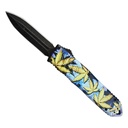
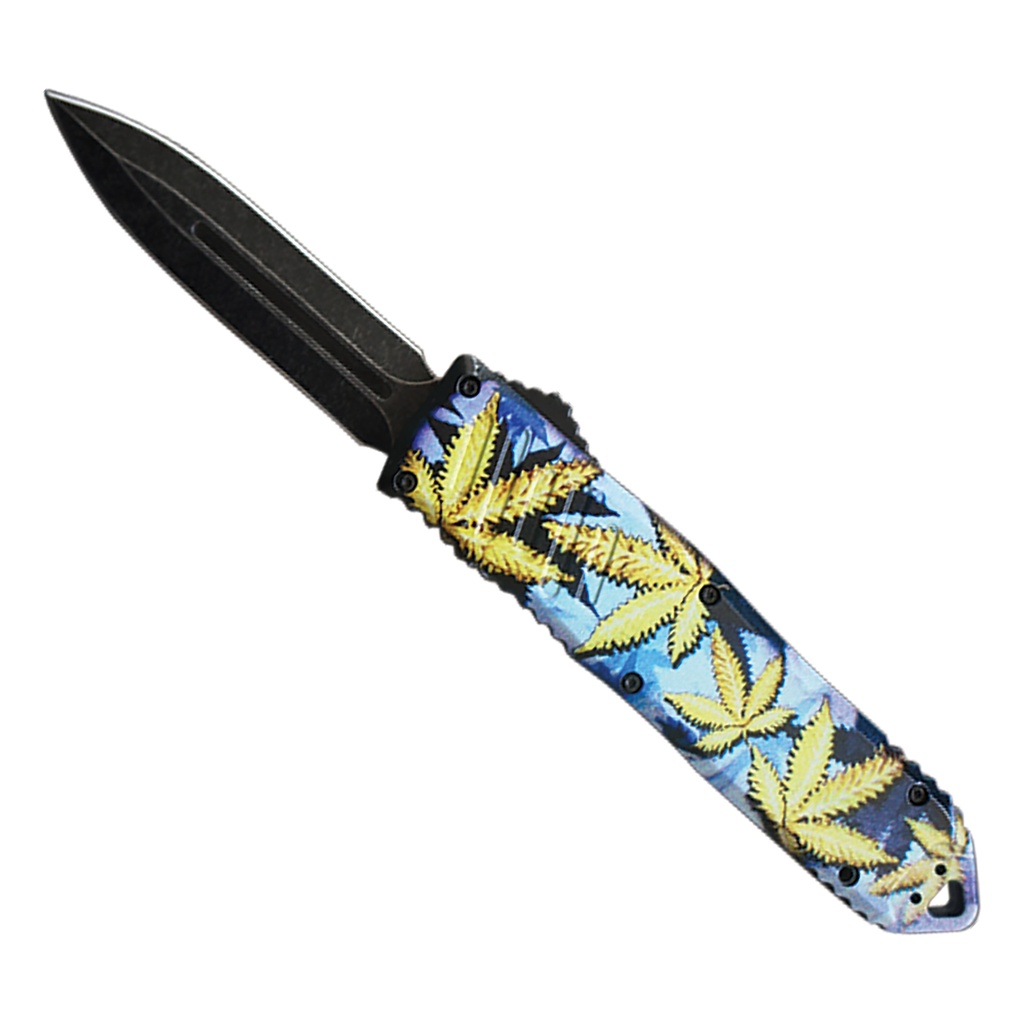
Canopy Strike Symmetry OTF Knife - Stonewash Steel
5 sold in last 24 hours
The Canopy Strike Symmetry OTF Knife pairs a stonewash double-edge dagger blade with a bold emerald leaf handle that refuses to blend in. A reliable double-action slider sends the blade snapping out and back with clean, confident travel. Glossy aluminum scales, deep jimping, and a glass-breaker pommel keep it practical, while the cannabis artwork makes it a conversation piece. Pocket clip carry, centered symmetry, and everyday-ready steel make this an eye-catching OTF that still works when it’s time to cut, pry, or punch through.
What This OTF Knife Actually Is: A Bold, Functional Everyday Cutter
This isn’t a gimmick blade that only looks wild in photos. The Canopy Strike Symmetry OTF Knife - Stonewash Steel is a double-action out-the-front knife built around real everyday cutting tasks, wrapped in a loud cannabis-themed handle that clearly doesn’t apologize for being seen. You’re getting a stonewash double-edge dagger blade, aluminum handle with full graphics, pocket clip, and glass-breaker tip in a compact, pocketable format.
Instead of tactical cosplay or fake combat claims, this OTF knife delivers what most people actually use a knife for: opening packages, cutting cord, quick utility work, and having a ready edge when you need it. The cannabis leaf art just means it’ll be the first knife people notice when you pull it out.
How This Double Edge OTF Knife Works
This is a double-action out-the-front mechanism. That means the same slider on the handle both deploys and retracts the blade. Push the slider forward and the internal spring-driven carrier sends the stonewash dagger blade out the front of the handle until it locks. Pull the slider back and the mechanism recocks and draws the blade safely back inside.
The dagger profile is symmetrical, with two sharpened edges meeting at a centered point. A fuller along the blade reduces a bit of weight and adds visual structure. The stonewash finish helps hide scratches from daily use, so the knife keeps looking intentional even after it’s seen some work.
Double-Action Slider You Can Feel Engage
The side-mounted slider is textured so you can find it without looking. It offers noticeable resistance on purpose—enough that it won’t fire accidentally in your pocket, but still smooth enough to deploy quickly when you actually intend to use it. That positive feedback through your thumb tells you the blade is fully locked out or fully retracted.
Symmetry That Feels Natural in Either Hand
Because the blade is double-edge and centered, the knife doesn’t care whether you’re using it in your right or left hand. The overall profile is straight and balanced, so indexing the point is easy even in low light—you can feel the orientation without needing to rotate it into a “correct” position like with some single-edge blades.
Build Quality: Stonewash Steel and Glossy Aluminum That Can Be Carried, Not Just Displayed
The standout here is the combination of a real working stonewash steel blade with a glossy, cannabis-themed aluminum handle. This isn’t a fragile printed shell—it’s full aluminum scales secured with multiple screws and textured jimping along the edges for grip.
The blade steel is finished in stonewash, which does two things: it tones down glare and it masks the inevitable fine scratches from cardboard, tape, and everyday tasks. You don’t have to baby it to keep it looking decent.
Grip, Jimping, and Control
Even with the glossy handle artwork, the knife adds physical traction where it matters. Jimping along the spine and handle edges gives your fingers purchase when you’re pulling, pushing, or twisting through a cut. That matters more in real use than any coated texture that only works when your hands are perfectly dry.
Glass-Breaker Pommel With Lanyard Option
The pointed pommel is shaped as a glass-breaker, which can be used in emergencies against vehicle glass or as a focused impact point. A lanyard hole gives you another carry and retention option if you prefer a wrist loop or decorative fob for faster retrieval.
Everyday Carry Reality: How This OTF Knife Rides and Draws
The Canopy Strike Symmetry OTF Knife is designed to live in a pocket, on a pocket edge, or clipped to a bag. A dedicated pocket clip holds it in a predictable position so you know exactly where the slider will be the moment you grab it. That consistency is what makes an OTF actually convenient to carry.
The cannabis artwork means this is not a low-visibility piece. It’s better suited for casual environments, off-duty carry, or as a lifestyle statement in a collection than for formal or uniformed contexts. But for festival walks, shop work, or everyday urban carry, it’s both functional and unapologetically expressive.
Deployment Under Stress
Under stress, fine motor skills degrade. An out-the-front knife like this simplifies deployment to one motion: grip, thumb to slider, push forward. There’s no flipping, no wrist snap, no two-handed opening. As long as your thumb finds the slider, the blade is either going out or coming back in.
Where This OTF Knife Fits in a Real Use Toolkit
For many people, this knife will be part utility tool, part personality piece. The double-edge dagger profile is best for piercing and light slicing tasks—opening boxes, cutting plastic straps, breaking down packaging, trimming material, and general daily cutting. It is not a heavy prying tool, and like any OTF mechanism, the internal track and carrier prefer clean, straight-in, straight-out use rather than twisting the blade deep while deployed.
If you already carry a more subdued blade for work, this can be your off-hours or collection knife—the one you show friends because it looks like nothing else in your rotation. If this is your primary carry, the main tradeoff to be aware of is visibility: the cannabis graphics start conversations, which some people want and others don’t.
What People Ask Before Buying a Stun Gun for Protection
How effective are stun guns for self defense?
Stun guns can be effective for self defense when used with realistic expectations and good technique. They are contact weapons, which means you must be close enough to touch the attacker with the electrodes and maintain contact for at least a second or two. Their real stopping power comes from amperage (current) disrupting muscular control and pain compliance, not the big “million volt” numbers in marketing. A well-built stun gun with adequate current, good contact area, and a reliable switch can create a valuable break in an assault—time to escape or transition to another option—but it’s not a magic force field. Training where to target (hips, thighs, shoulders) and how to protect the device from being grabbed matters as much as the hardware.
Does voltage or amperage matter more in a stun gun?
Amperage matters more in a stun gun than voltage. Voltage is mainly about how easily the electrical charge can jump the gap between electrodes and penetrate clothing; after a certain point, raising the advertised voltage doesn’t translate into more real-world effect. Amperage (current) is what actually affects the body—too little and it just hurts, enough and it can disrupt muscle control. Most consumer stun gun makers inflate voltage numbers because they sound impressive, but few talk clearly about current, contact time, and electrode design. When you’re comparing stun guns for self defense, look for honest specs, solid build quality, and a design that lets you keep pressure on the target area without fumbling, rather than chasing the highest “million volt” claim.
Is this stun gun legal to carry in my state?
Stun gun legality in the United States is highly state- and city-dependent, and it changes over time. Some states allow stun guns and TASER-style devices with few restrictions; others require permits, and a few local jurisdictions ban them outright or limit carry in certain locations (schools, government buildings, etc.). Before you buy a stun gun for personal protection, check both your state law and any major city ordinances where you live or travel. Look for terms like “electronic control device,” “conducted energy weapon,” or “stun gun” in the statutes. If you carry under a professional role (security, bail enforcement, etc.), your policy may also add requirements. When in doubt, talk to a local attorney or law enforcement agency’s non-emergency line and verify the current rules rather than guessing.
Walking Away Prepared: Matching the Right Tool to Your Reality
Whether you’re drawn to the Canopy Strike Symmetry OTF Knife for its cannabis art, its quick out-the-front deployment, or as a distinctive piece in a broader everyday carry kit, the value is in knowing exactly what it is and isn’t. It’s a compact, double-edge OTF with a stonewash steel blade, reliable slider, and pocket-ready hardware—not a prying bar, not a hidden tactical advantage, and not invisible in polite company.
Pair that clarity with the same mindset you’d use choosing a stun gun for self defense: ignore the hype, understand the mechanism, respect the legal landscape, and carry in a way that fits your actual day. With that approach, your gear stops being a collection of toys and becomes a set of tools you can trust—and explain—without needing any inflated claims.
| Blade Color | Silver |
| Blade Finish | Stonewash |
| Blade Style | Dagger |
| Blade Edge | Plain |
| Blade Material | Steel |
| Handle Finish | Glossy |
| Handle Material | Aluminum |
| Theme | Marijuana Leaf |
| Pocket Clip | Yes |