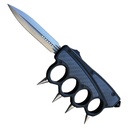
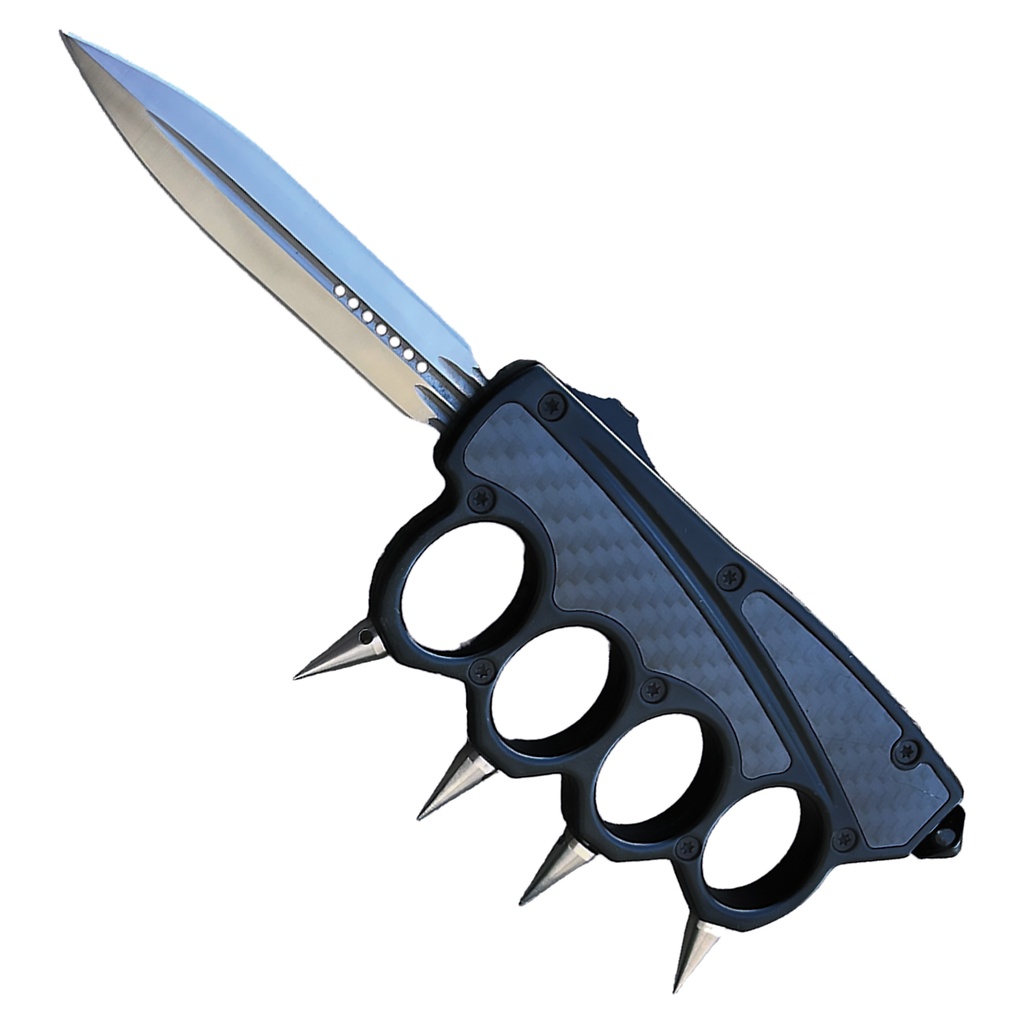
Carbon Veil Knuckle-Guard OTF Knife - Black Carbon Fiber
10 sold in last 24 hours
The Carbon Veil Knuckle-Guard OTF Knife is built for confident, controlled close-quarters use. A double-edged dagger blade deploys straight out the front with a side-mounted slide, while the four-finger knuckle frame locks your grip and adds impact capability with pointed strike accents. Matte black zinc alloy and carbon fiber inlays keep the profile serious and modern. Packed in a full-zip nylon case, it moves easily from collection to go-bag as a decisive tactical OTF knife.
Carbon Veil Knuckle-Guard OTF Knife – What It’s Really Built For
The Carbon Veil Knuckle-Guard OTF Knife - Black Carbon Fiber is not a pocket-friendly everyday utility piece. It’s a purpose-built, out-the-front dagger with an integrated knuckle guard designed for close-quarters control, intimidation, and decisive defensive use when things have already gone wrong. The knuckle frame, strike spikes, and straight-line OTF deployment all point to one role: a tactical backup tool you stage deliberately, not something you casually clip to your jeans.
How This Out-the-Front Knife Actually Works
This OTF knife uses a side-mounted thumb slide to deploy and retract the blade along the same axis as your grip. When you push the slide forward, the internal spring system drives the dagger blade out through the front of the handle, locking it into place at full extension. Pull the slide back and the mechanism retracts the blade into the handle, keeping it shielded until you choose to bring it into play.
The benefit of this out-the-front format is alignment. In a stress event, fine motor skills drop. A straight-line deployment from the knuckle brace to the blade tip means less fumbling to orient an opening folder. You already know where the blade will emerge—dead center from the top of the frame—so your hand, wrist, and blade all stay in line.
Double-Edged Dagger Profile
The blade is a matte-finished, silver, double-edged dagger. Both edges are plain ground (no serrations), with a central groove and lightening holes near the spine. That profile is optimized for thrust and controlled penetration, not for cardboard duty or camp chores. If you’re looking for a general-purpose EDC knife, you’d pick a different tool. If you want a dedicated defensive-style blade, the dagger format makes sense.
Mechanism and Control Under Stress
The side slide is placed where your thumb naturally falls along the handle spine. That lets you drive the blade out while maintaining a firm, four-finger wrap in the knuckle guard. Under adrenaline, gross motor movements—like shoving a slide forward—beat tiny buttons or fiddly flippers. The tradeoff: this is a larger, more conspicuous package than a discreet pocket folder, so it’s realistically a bag, vehicle, or kit knife rather than a jeans-pocket companion.
Knuckle-Guard Design and Practical Use
The most defining feature of this OTF knife is the full knuckle-guard handle. Four finger holes form a rigid brace in front of your knuckles, with pointed strike accents beneath each ring. That structure does three things at once: locks your grip, protects your fingers, and adds a secondary impact option even before the blade is deployed.
Grip Security and Retention
With your fingers threaded through the guard, the handle doesn’t just sit in your hand—it’s anchored to it. That matters in chaotic, close-range encounters where hands get wet, you collide with hard surfaces, or someone tries to grab or strip the tool from you. A standard straight handle can be pried out or knocked free more easily; a knuckle-guard frame resists that, because your entire hand is part of the structure.
The carbon fiber-patterned inlay isn’t just cosmetic. The change in texture gives your palm and fingers reference points, so you can feel when your grip is set, even in low light. Combined with the matte zinc alloy frame, you get a hold that’s solid without being overly abrasive on your skin.
Impact and Deterrence
Before the blade ever leaves the handle, the knuckle guard with its pointed strike accents offers a force-multiplier for strikes. That doesn’t make this a toy or a prop; it makes it a tool that can be used in a layered way. First as an impact implement, then—if absolutely necessary—as a blade. The visual profile alone is a deterrent for many situations where presence and apparent capability matter.
Build Quality and Carry Reality
The Carbon Veil pairs a zinc alloy frame with carbon fiber-style inlays and a steel dagger blade. Multiple Torx screws secure the handle scales, which is exactly what you want in an out-the-front knife: a serviceable body that can be tightened or maintained if the mechanism develops play over time.
There is no pocket clip. That’s an honest design choice that tells you how this OTF knife is meant to be carried: in its included nylon case, in a bag, glovebox, range kit, or dedicated gear compartment. This isn’t the knife you drop loose into a front pocket and forget; it’s the one you stage with intention so you know exactly where it is and what role it fills.
Nylon Case and Staged Carry
The full-zip nylon case keeps the knife protected from debris and casual contact. For practical carry, that suggests a few realistic use patterns:
- Go-bag or vehicle kit: Stored where you can reach it if you need a serious defensive blade.
- Range or training bag: As part of a dedicated self-defense or tactical kit.
- Home staging: In a fixed, known location where access is controlled and intentional.
Because of its knuckle-guard profile and dagger blade, you should also think about legal context (more on that below) before deciding how and where to stage it.
Who This OTF Knife Makes Sense For
This knife is best suited for collectors of tactical gear, self-defense enthusiasts who understand the implications of carrying a knuckle-guard dagger, and individuals building a dedicated defensive kit where a serious, presence-heavy tool is appropriate. It’s not an all-around utility knife. It’s not a subtle office carry. It’s a specialized out-the-front knife with a clear bias toward defensive and close-quarters roles.
If you want something you can use for daily cutting tasks, look at a more neutral blade style and a slimmer handle. If you want a knife that makes a statement, locks into your hand, and prioritizes control and deterrence over discretion, the Carbon Veil fits that role.
What People Ask Before Buying a Stun Gun for Protection
How effective are stun guns for self defense?
A handheld stun gun for self defense is a pain-compliance tool, not a magic off switch. Its real-world effectiveness comes from amperage (current), contact time, and where you make contact—not the “million volt” claims printed on packaging. Used properly on exposed areas and held in place for several seconds, a quality stun gun can disrupt movement, create intense pain, and open a window to break contact and escape. Used briefly through heavy clothing, its effect may be limited. That’s why professionals treat a stun gun as one layer in a protection plan, not their only option.
Does voltage or amperage matter more in a stun gun?
Voltage gets the headlines; amperage does the work. High voltage helps the stun gun arc through clothing and across small gaps, but once contact is made, it’s the current (amperage) and how long it flows that determines how strongly the device affects muscle function and pain response. Many “X million volt” claims are pure marketing theater. When you’re evaluating the best stun gun for personal protection, look for honest amperage ratings, solid internal build quality, and a design that lets you maintain firm contact for several seconds under stress.
Is this stun gun legal to carry in my state?
Stun gun legality varies widely by state and, in some cases, by city. Some states allow a stun gun for self defense with almost no restrictions for adults. Others require permits, limit carry in certain locations (schools, government buildings, airports), or ban specific models. The only responsible approach is to check your current state and local laws before buying or carrying any stun gun for personal protection. Look specifically at terms like “electronic control device,” “conducted energy weapon,” and “stun gun” in your jurisdiction’s statutes, and remember that laws change—verify with a current, official source rather than assuming older information is still accurate.
Carrying With Intention, Not Illusion
Whether you’re considering a stun gun for self defense or a dedicated tactical OTF knife like the Carbon Veil, the same principle applies: tools don’t create safety by themselves. Skills, awareness, and honest understanding of what your gear can and cannot do matter more than any marketing claim.
This knife gives you a locked-in knuckle-guard grip, a fast, straight-line dagger deployment, and a presence-heavy profile that fits a specific defensive role. If you choose to add it to your kit, carry it deliberately, within your local laws, and as part of a broader personal protection plan that includes training and realistic expectations. That combination—good tools, clear thinking, and practiced skills—is what turns gear into genuine capability.
| Closed Length (inches) | 5.25 |
| Blade Color | Silver |
| Blade Finish | Matte |
| Blade Style | Dagger |
| Blade Edge | Plain |
| Blade Material | Steel |
| Handle Finish | Matte |
| Handle Material | Zinc Alloy |
| Theme | Carbon Fiber |
| Pocket Clip | No |
| Sheath/Holster | Nylon Case |