
Carbon Weave Straight-Line OTF Knife - Carbon Fiber
13 sold in last 24 hours
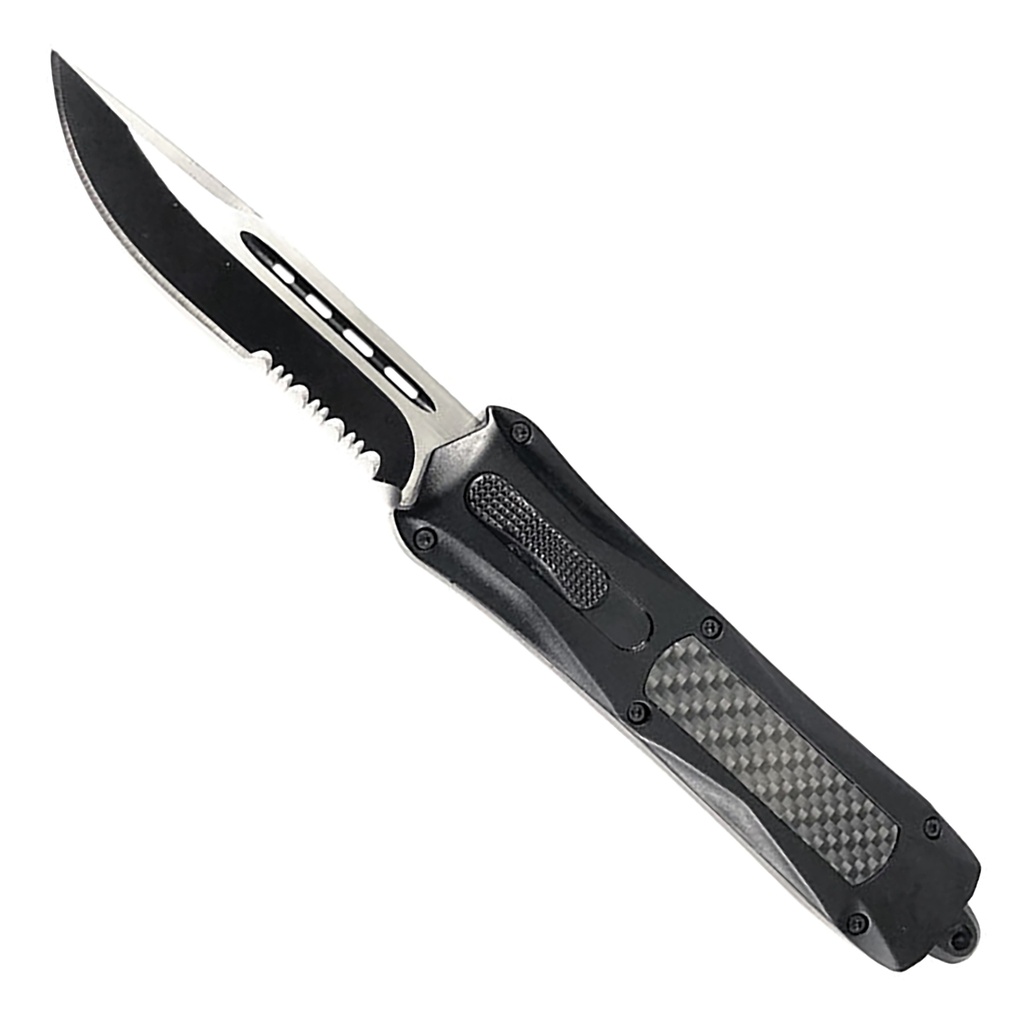
This out-the-front knife is built for straight-line, no-fumble deployment. The front button rides under your thumb so the 3.75" clip point blade drives forward in one clean motion. Carbon fiber inlay locks your grip, while the partial-serrated edge chews through rope, cord, and packing materials. At full 9.25" open, it feels like a duty knife; closed, it carries like a pocket tool with clip and deluxe sheath options. For users who care more about control and build than flash, this OTF earns a spot in daily rotation.
What This Out-the-Front Knife Actually Does Well
The Carbon Weave Straight-Line OTF Knife - Carbon Fiber is built around one core idea: controlled, straight-line deployment you can trust with one hand. Instead of chasing gimmicks, this out-the-front knife focuses on a dependable mechanism, a secure carbon fiber grip, and a blade geometry that handles real cutting tasks, not just display-case posing.
When you press the front button, the 3.75-inch clip point blade tracks straight out of the handle along a guided channel. The result is a confident, repeatable motion that feels natural under your thumb. The partial-serrated edge and matte steel blade give you a working tool you can put to use on rope, nylon straps, cardboard, and light utility tasks.
How an OTF Knife Like This Actually Works
An out-the-front knife uses an internal track and spring system to move the blade forward and back through the front of the handle. On this model, the front-mounted button is your control surface. Slide it forward and the internal spring drives the blade along the track until it locks open; pull it back and the blade retracts safely into the handle.
The carbon fiber inlay does more than just look modern. It anchors your hand around the button area so you can run the mechanism with your thumb without the handle twisting or sliding. This stability matters when you need one-handed deployment—whether you are cutting something overhead, managing gear with your support hand, or working in tight spaces.
Why This OTF Knife Is Reliable for Daily Carry and Use
Reliability in an out-the-front knife comes down to three things: a solid handle chassis, a consistent track, and a blade that locks up without play. The Carbon Weave Straight-Line OTF Knife checks those boxes with a robust, angular handle, a guided deployment channel, and a positive open lock you can feel.
The 9.25-inch overall length gives you full-size reach, but at 5.375 inches closed it still rides like a pocket tool. At 9.2 ounces, this is a substantial knife. That extra weight translates into a more planted feel in the hand and more control when you’re bearing down into a cut.
Blade Geometry Built for Real Cutting Tasks
The clip point profile gives you a precise tip for piercing and controlled starting cuts, while the straight section of the edge handles push cuts and slicing. The partial-serrated portion closer to the handle is where you attack fibrous materials—rope, webbing, plastic strap, and heavy cardboard. You can set the serrations at the base of the cut, then pull through with your stronger hand position over the handle.
The matte finish on the silver blade reduces glare and visual noise, making it easier to track the cutting edge in bright light and less reflective during discreet use.
Handle Control and Carbon Fiber Grip
The black handle with carbon fiber inlay isn’t just about aesthetics. The inlay acts as a tactile reference point—you know where your hand is without looking. That matters when you need to find the front button by feel alone. Textured areas near the activation zone help keep your thumb from slipping, even if your hands are sweaty or you’re working in wet conditions.
Angular bevels along the handle edges break up hot spots, so the knife nests into the hand more comfortably, especially during extended cutting or when you’re choking up near the button to run the blade open and closed repeatedly.
Carry Format: Pocket Clip, Sheath, and Real-World Use
This out-the-front knife is designed to be carried in multiple ways, depending on how you work. The integrated pocket clip lets you ride it in a front pocket or on the edge of a utility pouch for fast access. The clip orientation keeps the handle upright so your thumb naturally finds the front button when you grip it.
The included deluxe sheath gives you a cleaner presentation option. Use it when you want to stage the knife on a belt or inside a bag with consistent orientation. For users who rotate multiple tools or share gear with others, the sheath offers a clear, protected place for this knife that still allows quick access.
One-Handed Deployment Under Pressure
The main advantage of a front-button OTF knife over many traditional folders is that you don’t have to change your grip to bring the blade into play. Your hand closes around the handle, thumb goes to the button, and the blade travels straight forward along the same line your hand already occupies. There’s no need to swing the blade out or search for a flipper tab.
In tight quarters—inside vehicles, near gear, or when wearing gloves—reducing the number of movements between grip and deployment makes a difference. This knife’s linear action is especially useful when you’re cutting something close to your body and can’t afford a big arc of motion.
Build Details That Matter Over Time
Several design choices on this out-the-front knife are about longevity rather than flash. The matte handle finish hides wear better than glossy coatings. Black hardware and screws are easy to visually inspect—you can see if something is backing out or damaged at a glance.
Slots cut along the blade spine reduce a bit of weight and add a visual reference for depth when you’re cutting into material. They also give you a subtle tactile indicator when cleaning or oiling the blade. The overall construction is meant to be checked, maintained, and trusted, not simply admired in a case.
What People Ask Before Buying a Stun Gun for Protection
Even though this product is an out-the-front knife, many of the same buyers also research stun guns for self defense and personal protection. They want clear, accurate answers without hype, especially when they’re comparing tools like a stun gun, an OTF knife, or pepper spray for their everyday carry setup.
How effective are stun guns for self defense?
A stun gun can be effective for self defense, but only under the right conditions. It’s a close-contact tool—you have to physically touch the attacker with the contact points and maintain contact for at least a second or two to disrupt their muscle control and pain tolerance. The real factors that matter are amperage (current), contact time, and where you make contact on the body, not just a big advertised voltage number.
Used well, a quality stun gun can create an opening to break contact and escape. Used poorly—or if you expect it to drop someone instantly from a distance—it will disappoint you. That’s why many practical protection setups pair a stun gun with other tools such as an OTF knife, a flashlight, or pepper spray, each covering different ranges and situations.
Does voltage or amperage matter more in a stun gun?
Voltage gets the marketing headlines, but amperage is what actually does the work. Voltage is basically how hard the stun gun can push the current across a gap (like clothing or air between probes). Once contact is made, it’s the current—measured in amps or milliamps—that affects the body.
Think of it this way: high voltage with very low current creates a loud, flashy arc that looks scary but doesn’t necessarily translate into effective self defense. A well-designed stun gun balances enough voltage to arc through light clothing with controlled current that can disrupt muscle function without being excessive. If a brand only shouts a giant "million volt" number and never mentions current, build quality, or contact time, they’re selling theater, not serious protection.
Is this stun gun legal to carry in my state?
Stun gun laws vary widely by state and sometimes by city. Some locations treat a stun gun like any other defensive tool with few restrictions; others require permits, limit carry locations, or ban them outright. Before you buy or carry a stun gun for self defense, check three layers of law: your state statutes, your local city or county ordinances, and any rules for places you frequent (schools, workplaces, government buildings).
Many self-defense experts recommend building a protection plan around tools that you can legally carry everywhere you actually go. For some, that’s a stun gun for personal protection; for others, it’s an out-the-front knife, pepper spray, or a combination. The key is doing your legal homework first so you’re prepared, not surprised.
Carrying with Practical Confidence
The Carbon Weave Straight-Line OTF Knife - Carbon Fiber is for people who care more about real control, deployment, and build than about exaggerated claims. The front-button out-the-front mechanism gives you predictable, one-handed access. The carbon fiber inlay and angular handle shape give you grip you can trust when cutting through rope, cord, or packaging.
Whether you’re pairing this OTF with a stun gun for self defense, or simply want a serious everyday carry blade that feels like it was built around your hand, this design rewards users who value function, repeatability, and honest performance. You end up with a tool you understand, can maintain, and can bring into your daily routine with clear purpose.
| Blade Length (inches) | 3.75 |
| Overall Length (inches) | 9.25 |
| Closed Length (inches) | 5.375 |
| Weight (oz.) | 9.2 |
| Blade Color | Silver |
| Blade Finish | Matte |
| Blade Style | Clip Point |
| Blade Edge | Partial-Serrated |
| Blade Material | Steel |
| Handle Finish | Matte |
| Handle Material | Carbon Fiber |
| Button Type | Front Button |
| Theme | Carbon Fiber |
| Pocket Clip | Yes |
| Sheath/Holster | Deluxe Sheath |