Curved Guard Heritage Arming Sword - Black Leather
11 sold in last 24 hours
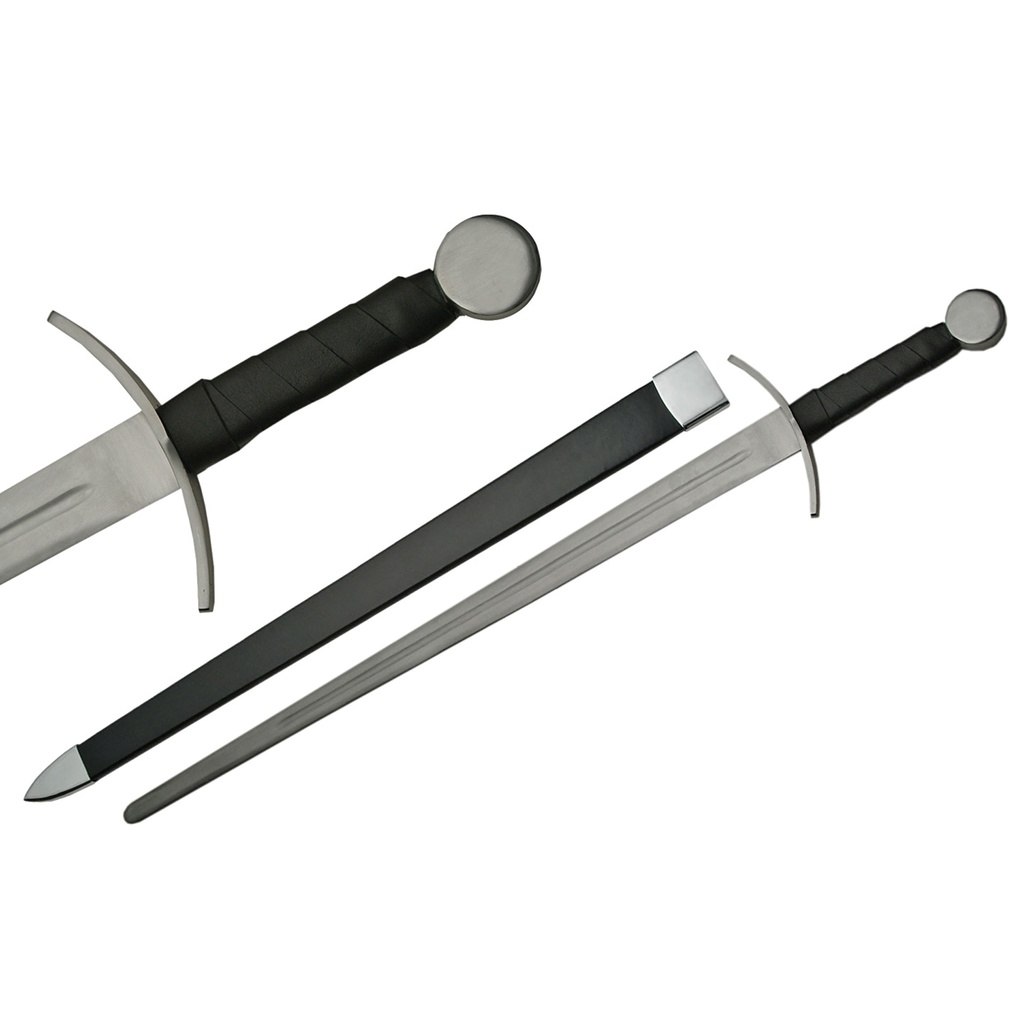
This battle-ready medieval sword keeps the focus on function, not fantasy. A 33-inch double-edged blade with central fuller runs full tang into a curved steel guard and disc pommel, giving real-world strength and balance. The black leather-wrapped grip and matching sheath complete a clean, knightly profile suited to reenactment, stage combat, or serious display. At 40 inches overall, it feels alive in hand—responsive, solid, and ready for work.
Curved Guard Heritage Arming Sword – Built for Real Use, Not Just the Wall
The Curved Guard Heritage Arming Sword - Black Leather is a medieval-style sword designed to feel like a working weapon, not a fragile costume prop. With a full-tang, double-edged blade and solid steel fittings, it’s built for reenactment, stage combat choreography, and commanding display where strength and balance matter more than flashy decoration.
What Makes This Medieval Sword “Battle Ready”
In the sword world, “battle ready” should mean more than just a sharp edge. It’s about construction. This medieval arming sword uses a full tang, meaning the steel of the blade runs all the way through the handle, secured by theguard and pommel. That’s what gives it the real-world strength to handle controlled cuts, parries, and stage work without feeling like it might rattle apart.
The 33-inch straight blade features a central fuller (the groove down the center). Historically, this helps reduce weight while keeping rigidity, so the sword tracks well without feeling tip-heavy. At 40 inches overall, the proportions match classic one-handed medieval arming swords carried by knights and soldiers from the 11th–15th centuries.
Full Tang Construction for Real-World Durability
Because the tang runs the full length of the grip, the load from strikes, blocks, and quick direction changes is carried through solid steel, not just a narrow rat-tail weld. That’s the difference between a wall hanger and a practical reenactment or stage sword. The disc pommel and curved crossguard lock that tang in place, giving the hilt assembly a reassuring solidity in hand.
Balanced for Control Under the Disc Pommel
The round disc pommel does more than complete the medieval look. It serves as a counterweight, bringing the point of balance back toward the hilt. The result is a sword that feels responsive and controllable rather than clumsy or blade-heavy—exactly what you want for choreography, drilling footwork, or flowing cuts in reenactment scenarios.
Clean Medieval Aesthetics with Black Leather and Satin Steel
This sword leans into a minimalist, working-weapon aesthetic. The satin-finished blade, curved steel crossguard, and disc pommel echo the look of historical arming swords without ornate engraving or fantasy styling. The black leather-wrapped handle provides texture and grip, and the matching black leather sheath completes the old-world profile.
The leather wrap gives your hand secure purchase in gloves or bare-handed training, and the subtle ridging in the grip helps with orientation—so you can feel, without looking, how the sword is indexed in your hand. That matters when you’re turning through cuts, stepping, and adjusting guard positions.
Matching Leather Sheath for Carry and Display
The included black leather sheath (or scabbard) features steel fittings at the throat and tip, tying visually into the guard and pommel. For reenactors, this gives you a cohesive belt carry and draw. For display, the sword and sheath together create a complete, historically flavored silhouette that looks intentional on a wall or in a stand, not pieced together.
Practical Uses: Reenactment, Stage Combat, and Collection
This medieval arming sword is built for people who want something between a blunt training stick and a hyper-decorated replica. Its proportions and full-tang build make it suitable for:
- Historical reenactment: A visually authentic sidearm with real steel weight and presence.
- Stage and film utility: A clean, versatile medieval look that reads clearly on camera or under lights.
- Collection and display: A serious-feeling sword that looks like it could have been carried by a working knight, not just a fantasy hero.
Whether you’re drilling simple cuts and guards, blocking for choreographed fights, or rounding out a medieval kit, the emphasis here is reliability and control rather than ornament.
Handling Reality: How This Sword Feels in Hand
At 33 inches of blade, this is a one-handed sword that still offers reach. The straight, double-edged profile and fuller give you a predictable, honest feel in motion. You don’t get unexpected flex or wobble when you change direction, and the curved crossguard provides a tactile reference for hand placement as well as basic hand protection.
The 40-inch overall length, combined with the disc pommel’s counterbalance, encourages a fencing-style grip: fingers locked around the leather-wrapped handle, wrist free to guide the point. That makes it a solid choice for learning traditional arming sword mechanics—diagonal cuts, thrusts, and shield-side coordination—without the distraction of oversized fantasy forms.
Why a Simple Arming Sword Design Works So Well
The arming sword is a classic for a reason. Its straight double edge, modest length, and simple guard adapt to many roles: sidearm for a knight, primary weapon for a foot soldier, or utility weapon in a medieval kit. That same simplicity makes this sword easy to integrate into reenactment sets and stage productions. It doesn’t lock you into a particular character or culture; it just reads clearly as “medieval sword.”
Care, Maintenance, and Safe Use
This is a real steel sword, not plastic or foam, and should be handled with the same respect you’d give any live blade. Keep the blade lightly oiled when stored, especially if displayed in the sheath, to minimize the risk of rust. The leather wrap and sheath will benefit from occasional conditioning to prevent drying and cracking over time.
For training and stage work, use appropriate protective gear and follow your group’s safety rules. Even if you blunt or tape the edges for contact work, the weight and momentum of a steel blade can injure. Treat it as a functional tool: transport it discreetly, store it securely, and check local regulations if you plan to carry it to events or public spaces.
What People Ask Before Buying a Medieval Sword
Is this sword suitable for contact sparring?
This sword is described as battle ready and uses full-tang construction, which supports durability. However, safe contact sparring usually requires a purpose-built training blade with known hardness, appropriate edge thickness, and blunt tips that meet your club or organization’s standards. Think of this as a robust reenactment, stage, and display sword rather than a dedicated fencing trainer. If you plan to use it for heavy contact, confirm specifications and follow your group’s rules.
Is the edge sharp from the factory?
Many battle-ready medieval swords ship with either a working edge or a semi-sharpened edge that can be finished by the user. If you intend to use it for cutting practice on targets, you may refine the edge. If it’s for reenactment or stage, you may keep it dulled or further blunt it for safety. Always handle it as though sharp and store it where children and untrained users cannot access it.
What’s the advantage of a full tang in a medieval sword?
A full tang means the blade steel extends as a solid piece through the grip, connected securely to the pommel. This spreads impact forces along the entire hilt. Swords with narrow welded tangs or purely decorative construction are far more likely to loosen, rattle, or even fail at the hilt. For reenactors, stage performers, and serious collectors, full tang construction is one of the key indicators that a sword is more than just a wall decoration.
How should I display this sword safely?
For display, wall mounts, vertical stands, or horizontal racks all work well. The included black leather sheath allows for a more traditional look, with the sword sheathed and belt-ready. Whatever method you choose, make sure it’s anchored securely and out of casual reach. If the edge is kept sharp, consider a display that discourages casual handling—especially in homes with children or frequent visitors.
Choosing a Medieval Sword with Confidence
When you’re choosing a medieval sword for reenactment, stage utility, or a serious collection, construction and handling matter more than elaborate decoration. The Curved Guard Heritage Arming Sword - Black Leather focuses on the essentials: full-tang build, clean medieval lines, useful proportions, and a cohesive leather-and-steel look.
You end up with a sword that feels like it belongs on a knight’s belt, moves cleanly in practice, and holds its own as a centerpiece on your wall. No drama, no overblown claims—just a solid, functional medieval arming sword you can understand, maintain, and use with confidence.