Flow-Locked Precision Balisong Trainer - Green Anodized
6 sold in last 24 hours
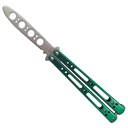
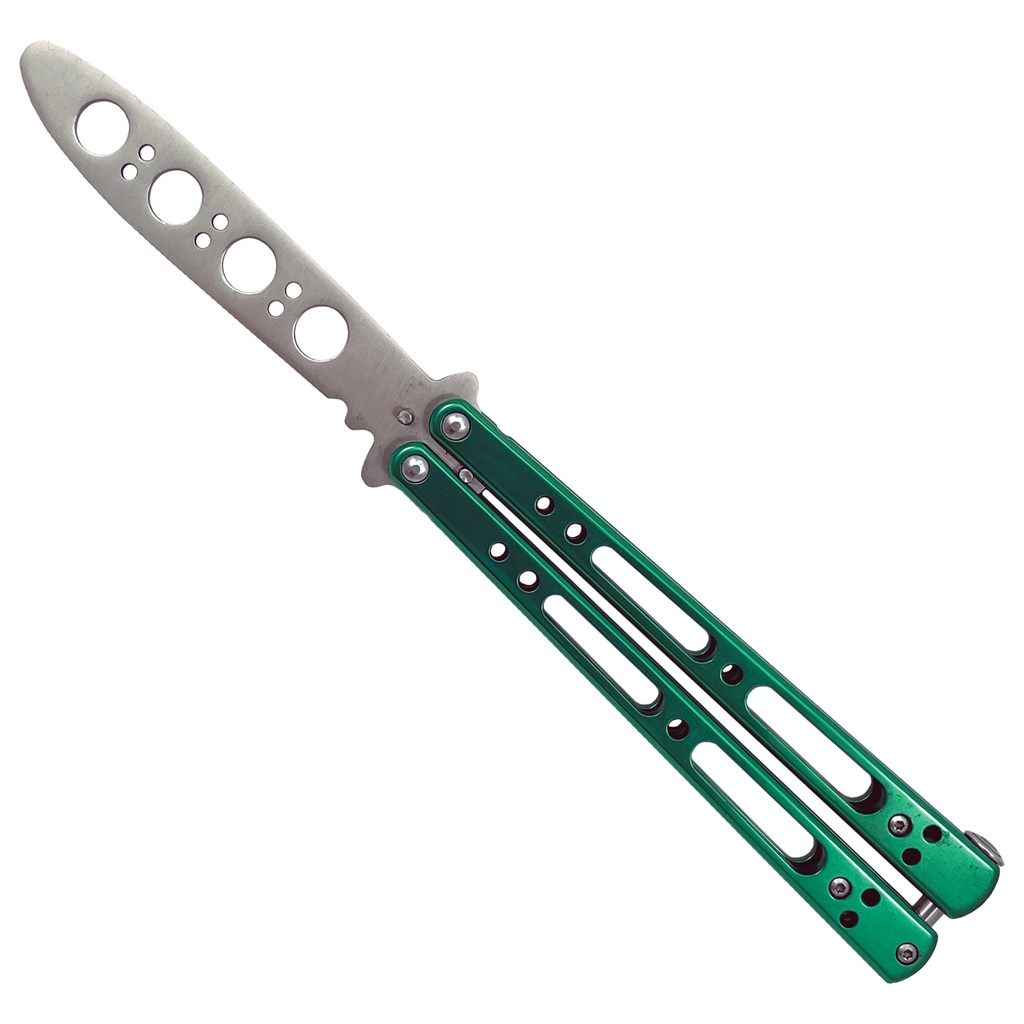
This balisong trainer is built to turn awkward flips into clean, confident flow. The dull, holed trainer blade keeps every rep safe, while the green anodized handles add grip and visibility as you drill. A spring-loaded latch snaps open and shut without fighting you, so you can focus on rhythm, not hardware. At 9.125 inches open with a balanced 4.78 oz weight, it feels like a real butterfly knife in hand—minus the risk—letting you build real flipping skill the smart way.
What This Balisong Trainer Actually Does for Your Practice
The Flow-Locked Precision Balisong Trainer - Green Anodized is built for one clear purpose: letting you practice butterfly knife tricks with real weight and motion, without the risk of cutting yourself. It gives you the size, balance, and handling of a live balisong, but with a blunt trainer blade that’s made for safe repetition, not slicing. This is how you build real flipping skill without bandages becoming part of your training plan.
How a Balisong Trainer Works (And Why This One Feels Real)
A balisong trainer uses the same basic mechanism as a live butterfly knife: two handles rotate around a pivot to open and close around a central blade. The difference here is the blade itself. Instead of a sharpened edge, you get a matte silver steel trainer blade with a plain, dull edge and multiple holes along the spine. Those holes reduce weight and help tune the balance so it feels like a functional balisong in motion, but it stays safe against your fingers during missed catches and fumbles.
At 9.125 inches open and 5.5 inches closed, this trainer lives in the same size range as a full-size butterfly knife. That matters. If your trainer is too light or too small, your timing and muscle memory won’t transfer cleanly when you eventually pick up a live blade. The 4.78 oz weight gives you enough heft for momentum-based tricks while still being manageable for longer practice sessions.
Build Quality That Supports Serious Flipping Sessions
This isn’t a novelty fidget toy; it’s a balisong trainer designed for repeatable practice. The green anodized metal handles are cut with elongated slots to reduce excess weight and help the knife pivot smoothly around its center. Anodizing adds a bit of surface hardness and a consistent finish, which helps the handles resist wear from drops, table taps, and long sessions of opening and closing.
Spring-Loaded Latch for Cleaner Transitions
The spring latch at the base of one handle is a key detail. On cheaper trainers, a loose or sticky latch can snag your hand, slam shut mid-trick, or just slow down your flow. Here, the spring-loaded latch snaps into position and pops clear when you want it out of the way. That means cleaner transitions between open and closed drills, and fewer interruptions when you’re trying to build rhythm.
Balanced Trainer Blade for Realistic Motion
The matte silver trainer blade uses multiple round cutouts to trim weight and fine-tune balance. Too front-heavy, and the knife feels clumsy. Too light, and you lose the satisfying momentum that helps carry rollovers, fans, and aerials. This blade is shaped and weighted to mirror the feel of a real balisong blade without the sharpened edge, so your practice reps translate better to a live knife later on.
Carry and Use: Where This Trainer Fits in Your Day
At 5.5 inches closed, this balisong trainer rides like a typical pocket knife. It doesn’t have a clip, which many flippers actually prefer for practice—nothing to catch on your hand or interfere with handle movement. It slips easily into a pocket, bag, or desk drawer, ready for quick reps during downtime.
The vivid green anodized handles make it easy to spot if you drop it during an aerial or it slides off a table. That color also quietly signals that this is a trainer, not a covert weapon. In shared spaces—home, dorms, or training groups—that visual distinction can keep misunderstandings down and conversations simple: this is for skill-building, not self-defense.
Why Choose a Trainer Instead of Jumping Straight to a Live Balisong
If you’re new to butterfly knives, starting with a trainer is the practical choice. Missed catches, mistimed openings, and awkward grip changes are normal when you’re learning. With a trainer blade, those mistakes cost you pride, not skin. This lets you focus on mechanics: grip changes, handle indexing, latch control, and consistent opening paths.
A well-balanced trainer like this one also lets experienced flippers push speed and complexity without worrying that one fatigue-induced mistake will end the session in a sink full of cold water and bandages. You can treat it as a conditioning tool—running long practice sets, drilling new combos, or warming up before picking up a live blade.
What People Ask Before Buying a Stun Gun for Protection
How effective are stun guns for self defense?
Effectiveness in a stun gun for self defense depends on three main factors: amperage, contact time, and where you make contact. Voltage mostly determines how easily the current jumps into the body; amperage is what actually disrupts muscle and nerve signals. A well-designed stun gun with sufficient current, pressed firmly into the torso, hip, or thigh for several seconds, can create pain, disorientation, and short-term loss of coordination. It is a close-contact tool, not a magic-distance stopper—something you use when a threat is already on top of you, ideally alongside strong verbal boundaries and movement skills.
Does voltage or amperage matter more in a stun gun?
Amperage matters more. High “million volt” numbers are mostly marketing. Once voltage is high enough to arc through clothing and skin oils, more voltage doesn’t make a meaningful real-world difference. Amperage, on the other hand, is the measure of how much electrical current is actually flowing into the target. Within safe device ranges, higher effective current and a decent contact area usually mean more disruption. If you’re comparing stun guns for self defense, look for honest specs, solid build quality, and good electrode placement rather than being dazzled by massive voltage numbers with no context.
Is this stun gun legal to carry in my state?
Stun gun legality in the United States is highly state- and city-specific, and it changes over time. Some states treat a stun gun similarly to other self-defense tools with minimal restrictions, while others require permits, restrict carry in certain locations, or ban specific formats. Before you buy a stun gun for personal protection, check your state statutes and local ordinances, and look for any permitting or age requirements. When in doubt, consult current state law, your local police department’s non-emergency line, or an attorney familiar with weapons regulations in your area.
Carrying and Training With Intention
Whether you’re flipping this balisong trainer to build coordination or researching a stun gun for self defense, the pattern is the same: tools don’t create skill, practice does. The Flow-Locked Precision Balisong Trainer - Green Anodized gives you a safe, realistic platform for drilling the mechanics of a butterfly knife until they’re smooth and repeatable. Paired with honest information about how real self-defense tools work—what they can and cannot do—you end up more capable, more confident, and less dependent on marketing claims.
If you treat this trainer as a deliberate practice tool, you’ll develop the timing, control, and awareness that make any blade or self-defense implement easier to handle. Calm, informed, and methodical beats flashy hype every time.
| Blade Length (inches) | 3.875 |
| Overall Length (inches) | 9.125 |
| Closed Length (inches) | 5.5 |
| Weight (oz.) | 4.78 |
| Blade Color | Silver |
| Blade Finish | Matte |
| Blade Style | Trainer |
| Blade Edge | Plain |
| Blade Material | Steel |
| Handle Finish | Anodized |
| Handle Material | Metal |
| Theme | None |
| Latch Type | Spring |
| Is Trainer | Yes |