Frontier Contrast Field Hunting Knife - White Bone & Rosewood
3 sold in last 24 hours
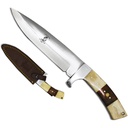
A fixed blade hunting knife built for real field work, the Frontier Contrast carries a 7-inch stainless drop point on a true full tang for strength and control. The white bone and rosewood handle fills the hand with secure, natural grip while the exposed tang and lanyard hole add backup options. At 12 inches overall and riding in a stitched leather belt sheath, it moves cleanly from field dressing to camp chores—classic materials, honest build, ready to be the knife you actually use.
What This Fixed Blade Hunting Knife Is Built to Do
The Frontier Contrast Field Hunting Knife - White Bone & Rosewood is a full-tang fixed blade designed as a primary field knife for hunting and camp work. At 12 inches overall with a 7-inch stainless drop point blade, it’s made to handle real cutting tasks: breaking down game, slicing, light chopping, and general camp utility. The classic bone-and-wood handle and leather sheath aren’t decoration—they’re proven materials chosen for control, durability, and comfort when you’re actually using the knife, not just admiring it.
Fixed Blade Hunting Knife Design That Prioritizes Control
This knife is a traditional fixed blade hunting knife in both proportions and feel. The full tang runs the length of the handle, which means the blade and handle are one continuous piece of steel. For a hunting knife, that’s your main durability insurance: no folding joints, no uncertain weak spots, just a solid spine you can trust when you twist in a cut or bear down through joint and gristle.
The 7-inch drop point profile is long enough to reach and glide, but not so oversized that it becomes clumsy around detail work. A drop point blade puts the tip in line with the center of the knife, giving you a controlled point for starting cuts, piercing hide, and fine work along bone without feeling like the knife wants to dive or slip off line.
Full-Tang Strength for Real Field Use
For a hunting knife, full tang is more than a spec line—it’s how you avoid failures when the work gets awkward. Splitting the rib cage, working around joints, or bracing the spine with your thumb for careful cuts all demand a blade that won’t flex away from the handle. With the steel exposed at the pommel and running clear through both handle scales, this knife is built for that kind of leverage and torque.
Handle Geometry That Locks Into the Hand
The contrasting white bovine bone and rosewood handle doesn’t just look good; it creates a natural, tactile reference in the hand. The polished scales are shaped to fill the palm without hot spots, while the subtle guard at the front keeps your hand from sliding forward onto the blade during wet or bloody work. The mosaic pin in the rosewood section adds a touch of craft without sacrificing function—the scales are solidly pinned for long-term reliability.
Why This Knife Works as a Primary Hunting and Camp Tool
When you choose a hunting knife, you’re really choosing what you’ll trust when you’re tired, cold, and trying not to waste meat or cut yourself. This fixed blade is sized and built to be that primary tool, not a backup. The 7-inch blade length gives you enough reach for long slices along a carcass, but the dropped point and straight spine provide solid indexing for thumb-over-spine control.
The stainless steel construction gives you an advantage in the field: it’s more forgiving of imperfect cleaning and wet environments than high-carbon blades. You still should wipe and dry it, but you’re less likely to be punished for one long day where you just get back to camp late and crash. For a practical hunting knife, that’s a real-world benefit.
Leather Sheath Carry That Matches How Hunters Actually Move
The included leather sheath rides on the belt, where a hunting knife belongs if it’s going to be used all day. The stitched construction and snap-retention strap keep the fixed blade secure as you move through brush, climb into blinds, or work around camp. A belt-mounted hunting knife carry is faster than digging into a pack, and leather is quiet—no hard plastic rattle when you’re trying not to advertise your presence.
Lanyard-Ready Exposed Tang for Extra Security
At the butt, the exposed tang with lanyard hole gives you a simple option for additional retention. For hunters dressing game over water, on steep ground, or in cold-weather gloves, a lanyard can be the difference between a dropped knife and an annoying but recoverable fumble. It’s a small detail, but it shows the knife is meant to be used, not just displayed.
Build Quality Details That Matter in a Hunting Knife
With any fixed blade hunting knife, the real test is how it feels and behaves in hand. The Frontier Contrast balances its 7-inch blade with a 5-inch handle, giving you enough handle length to shift grips—from a choked-up pinch hold for detail work near the tip, to a more relaxed hammer grip for slicing and light chopping. At around 14 ounces, it has enough weight to track steadily through cuts without feeling like a club.
The polished blade finish cleans easily after game processing, while the plain edge keeps sharpening simple. No serrations to snag on hide or clog with tissue—just a continuous cutting edge you can sweep across a stone or field sharpener. The bone and rosewood scales are pinned tight to the tang, and the slight contouring lets the knife seat into your palm in a repeatable way, shot after shot and cut after cut.
How This Knife Fits Into a Practical Hunting Kit
A realistic hunting kit often includes more than one blade: a primary fixed blade hunting knife like this, maybe a smaller caping knife, and possibly a saw. The Frontier Contrast is meant to be the one that lives on your belt and does 80–90% of the cutting. It can handle field dressing, skinning, quartering, and general camp tasks like food prep, cord cutting, and light wood work for kindling and stakes.
Because it’s a straightforward fixed blade, there’s minimal maintenance complexity. No moving parts, no springs, no locks to fail in the cold. Wipe it, dry it, touch up the edge, and it’s ready to go again. For hunters who hunt hard a few days a year and then store gear for months, that simplicity is an asset.
What People Ask Before Choosing a Fixed Blade Hunting Knife
How long should a hunting knife blade be?
Most practical hunting knife blades fall between 3.5 and 7 inches. This knife sits at the upper end with a 7-inch blade, which is ideal if you want one primary knife to handle both field dressing and camp chores. The length gives you efficient slicing and reach for larger game, while the drop point keeps it controllable for detail cuts.
Is a full tang really that important in a hunting knife?
For a working fixed blade, full tang is the most reliable construction. Because the steel runs all the way through the handle, you reduce the chance of the blade loosening, shifting, or breaking at a narrow joint. If you ever need to apply torque, twist in a joint, or baton lightly through small wood, a full-tang hunting knife like this holds up better than partial-tang or hidden-tang designs in the same price range.
How should I carry a fixed blade hunting knife safely?
On the belt in a secure sheath is still the best method for a full-size fixed blade hunting knife. The included leather sheath is designed for exactly that: thread your belt through, seat the knife fully, and snap the retention strap. That carry keeps the blade protected, the edge covered, and the handle immediately accessible without rummaging in a pack.
What kind of maintenance does this knife need?
For stainless steel, basic maintenance is enough: rinse or wipe off blood and debris, dry the blade thoroughly, and occasionally apply a thin coat of oil if you’re storing it for a while. The bone and rosewood handle scales benefit from being kept reasonably dry and occasionally wiped clean, but they don’t require constant attention. Sharpen the plain edge when you notice it sliding instead of biting—regular light sharpening beats infrequent heavy regrinds.
Carrying This Knife With Practical Confidence
This fixed blade hunting knife is built to be the tool you actually carry and use, not a display piece that never leaves the drawer. The full-tang construction, 7-inch drop point blade, and leather belt sheath all point in the same direction: reliable, straightforward field performance. If your goal is a traditional, honest hunting knife that feels at home from the trailhead to the skinning rack to the campfire, the Frontier Contrast Field Hunting Knife - White Bone & Rosewood fits that role cleanly and without drama.
| Blade Length (inches) | 7 |
| Overall Length (inches) | 12 |
| Weight (oz.) | 14 |
| Blade Color | Silver |
| Blade Finish | Polished |
| Blade Style | Drop Point |
| Blade Edge | Plain |
| Blade Material | Stainless Steel |
| Handle Finish | Polished |
| Handle Material | Bovine Bone & Rosewood |
| Theme | None |
| Handle Length (inches) | 5 |
| Tang Type | Full |
| Pommel/Butt Cap | Exposed tang |
| Carry Method | Sheath |
| Sheath/Holster | Leather |