Tombstone Lawman Spring-Assisted Pocket Knife - Wyatt Earp Print
14 sold in last 24 hours
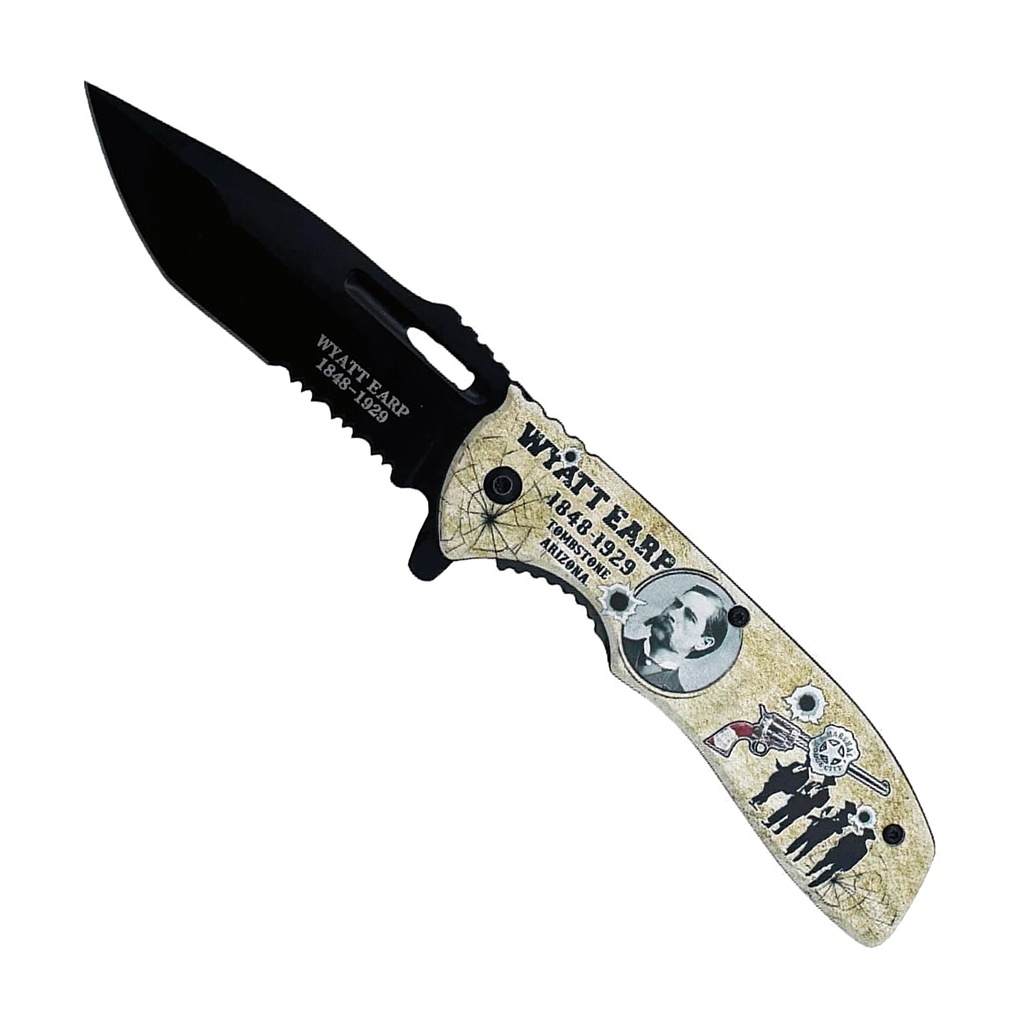
The Frontier Lawman Quick-Deploy Assisted Pocket Knife rides that line between Western collectible and real working gear. Wyatt Earp artwork on printed aluminum scales sets the tone, while a black-coated, partially serrated drop point blade handles the actual cutting. Spring-assisted deployment, liner lock, and pocket clip make it an easy everyday carry choice. At 8.5" overall with a 4" blade, it has enough reach for utility tasks without feeling bulky, making it a ready-to-merchandise Western statement that still earns its pocket space.
Frontier-Inspired Assisted Pocket Knife That Actually Works
The Frontier Lawman Quick-Deploy Assisted Pocket Knife isn’t just wall art in blade form. It’s a spring-assisted pocket knife built for real everyday cutting tasks, wrapped in Wyatt Earp-themed Western graphics that make it stand out in the case. You get a black-coated, partially serrated drop point blade, printed aluminum handle scales, and a pocket-ready format that balances display appeal with functional EDC performance.
How This Assisted Pocket Knife Is Built for Real Use
This knife is designed as a practical assisted opening pocket knife first, Western collectible second. The 4-inch stainless steel blade gives you enough length for everyday utility jobs while staying manageable in the hand. At 8.5 inches overall and about 5 ounces, it rides light enough for daily carry but doesn’t feel flimsy when you put it to work.
The blade shape is a classic drop point with partial serrations. The plain edge section handles cleaner push cuts and slicing, while the serrated section bites into rope, plastic banding, and tougher fibrous materials. For a buyer, that means one knife that covers both box-opening and quick utility cutting without needing two separate tools.
Spring-Assisted Deployment You Don’t Have to Wrestle With
The spring-assisted mechanism is tuned for reliable, predictable opening. Use the large thumb hole and spine cutouts to start the motion; the spring finishes it. Under everyday conditions—work gloves, cold fingers, quick access—you’re not wrestling the blade open. That makes it more likely you’ll actually use it, not just carry it.
Liner Lock and Pocket Clip for Confident EDC
A liner lock keeps the blade securely in place once deployed. It’s a simple, proven lock style that’s easy to understand and quick to disengage one-handed. The pocket clip anchors the knife along the pocket edge, keeping it accessible and oriented the same way every time. That predictability matters more for real-world carry than any exotic lock type.
Wyatt Earp Artwork: Western Story, Modern Knife
The handle scales carry full Wyatt Earp-themed artwork: portrait, dates, Tombstone callout, revolver graphic, and silhouetted figures over a distressed map-style background. For display and gifting, that Western lawman story is obvious at a glance. For retail, it merchandises cleanly in both Western and tactical-style displays.
But the art doesn’t get in the way of use. The printed aluminum handle still offers a solid, stable grip. Jimping along the spine and inner handle gives your thumb and fingers real traction when you’re applying cutting pressure. The curved ergonomic handle shape supports a natural grip rather than forcing you into a single hand position.
Printed Aluminum Handle: Light, Rigid, Easy to Carry
Aluminum scales keep weight down while staying rigid enough for everyday cutting and prying tasks that come up in normal EDC use. The print process locks the Wyatt Earp art into the handle surface, so it reads as a finished piece rather than a sticker or overlay. That’s important for both longevity and perceived quality when a customer first handles it.
Carry and Everyday Use: Where This Knife Fits
Closed, this assisted pocket knife sits at about 4.5 inches—compact enough for jeans pocket carry without dominating your pocket. The pocket clip keeps it oriented for quick draw, and the spring-assisted mechanism means you’re only one motion away from a working blade.
In practical terms, this knife works well as:
- Everyday carry blade for opening boxes, cutting cord, and general utility
- Western-themed gift for fans of frontier history and cowboy culture
- Statement piece in a shop that still passes the “would I actually use this?” test
It’s not trying to be a combat knife or survival tool; it’s a practical assisted pocket knife that leans into its Western identity without sacrificing basic function.
Build Quality Details That Matter Day to Day
The black blade coating isn’t just for looks—it helps reduce glare and provides a bit of extra surface protection against the day-to-day scuffs and light corrosion EDC knives see. The partial serrations are positioned toward the rear of the edge so you can still use the forward portion of the blade for controlled cuts and detailed work.
Spine cutouts and the large thumb hole reduce a bit of weight, but more importantly, they give you multiple opening options and tactile indexing points. Under quick use, you can feel where the blade starts and the handle ends without needing to look at it. That small ergonomic detail often matters more than exotic steels in real-world use.
Comfort and Control Under Real Grip
The curved handle shape and jimping work together to keep the knife anchored in hand when you’re bearing down on a cut. Aluminum can feel slick on some knives, but the printed texture, combined with the contouring, adds subtle friction. That makes this Western-themed piece more than just a display knife—there’s enough control built in for honest work.
What People Ask Before Buying a Stun Gun for Protection
Even though this product is an assisted pocket knife, many buyers shopping in the same category also research stun guns for personal protection and self defense. The questions below address the most common concerns from practical protection buyers looking at a stun gun for self defense alongside a knife like this.
How effective are stun guns for self defense?
A stun gun for self defense can be effective in specific situations, but only if you understand its limits. A stun gun is a close-contact tool: you must physically touch the attacker with the contact points and maintain contact for at least a second or two to create real disruption. Short “spark and pull away” touches mostly cause pain and surprise; longer contact increases muscle lock and disorientation.
They work best as part of a broader personal protection plan: awareness, distance management, and a clear decision about when you’re willing to use force. A stun gun is not a magic “drop anyone instantly” device, and anyone claiming that without context is selling hype, not safety.
Does voltage or amperage matter more in a stun gun?
Voltage gets all the headline space, but amperage is what actually matters for effectiveness. Those “millions of volts” numbers are mostly marketing—very high voltage is used to jump the current across air gaps and clothing, but it’s the amount of current (amperage), delivered over time and across a real contact area, that affects the body.
In practical terms, a well-designed stun gun for self defense focuses on safe but effective current output, reliable electronics, and a contact design that actually transfers energy into the target, not just makes noise and sparks. If you’re comparing models, prioritize build quality, contact design, and user-friendly controls over the biggest voltage number on the package.
Is this stun gun legal to carry in my state?
Laws around carrying a stun gun for personal protection vary widely by state and sometimes by city. Some states treat stun guns much like other self-defense tools with age restrictions; others require permits, and a few heavily restrict or ban civilian possession in certain areas.
The only reliable approach is to check your current state and local regulations before you buy or carry. Look for your state’s statutes on “electronic control devices” or “stun guns,” and verify whether there are restrictions on where you can carry (schools, government buildings, public events) and how old you must be. When in doubt, consult official state resources or an attorney rather than relying on hearsay.
Carrying with Confidence: Knife, Stun Gun, or Both
Whether you’re drawn to the Frontier Lawman Quick-Deploy Assisted Pocket Knife for its Wyatt Earp artwork, its everyday cutting ability, or as part of a broader personal protection setup that might include a stun gun for self defense, the goal is the same: carry tools you understand and can actually use.
This knife gives you reliable spring-assisted deployment, a practical partially serrated blade, and a Western-themed handle that feels good in hand instead of just looking good on the shelf. Paired with honest information about how stun guns work—and what really matters, like amperage, contact time, and build quality—you’re better equipped to build a self-defense kit that matches your life, not a marketing brochure.
The result is quiet confidence: a knife you’ll actually carry, informed expectations about a stun gun for personal protection if you choose one, and a clearer sense of how your gear fits into your overall safety plan.
| Blade Length (inches) | 4 |
| Overall Length (inches) | 8.5 |
| Closed Length (inches) | 4.5 |
| Weight (oz.) | 5 |
| Blade Color | Black |
| Blade Finish | Coated |
| Blade Style | Drop Point |
| Blade Edge | Partial-Serrated |
| Blade Material | Stainless Steel |
| Handle Finish | Printed |
| Handle Material | Aluminum |
| Theme | Wild West |
| Pocket Clip | Yes |
| Deployment Method | Spring-assisted |
| Lock Type | Liner lock |