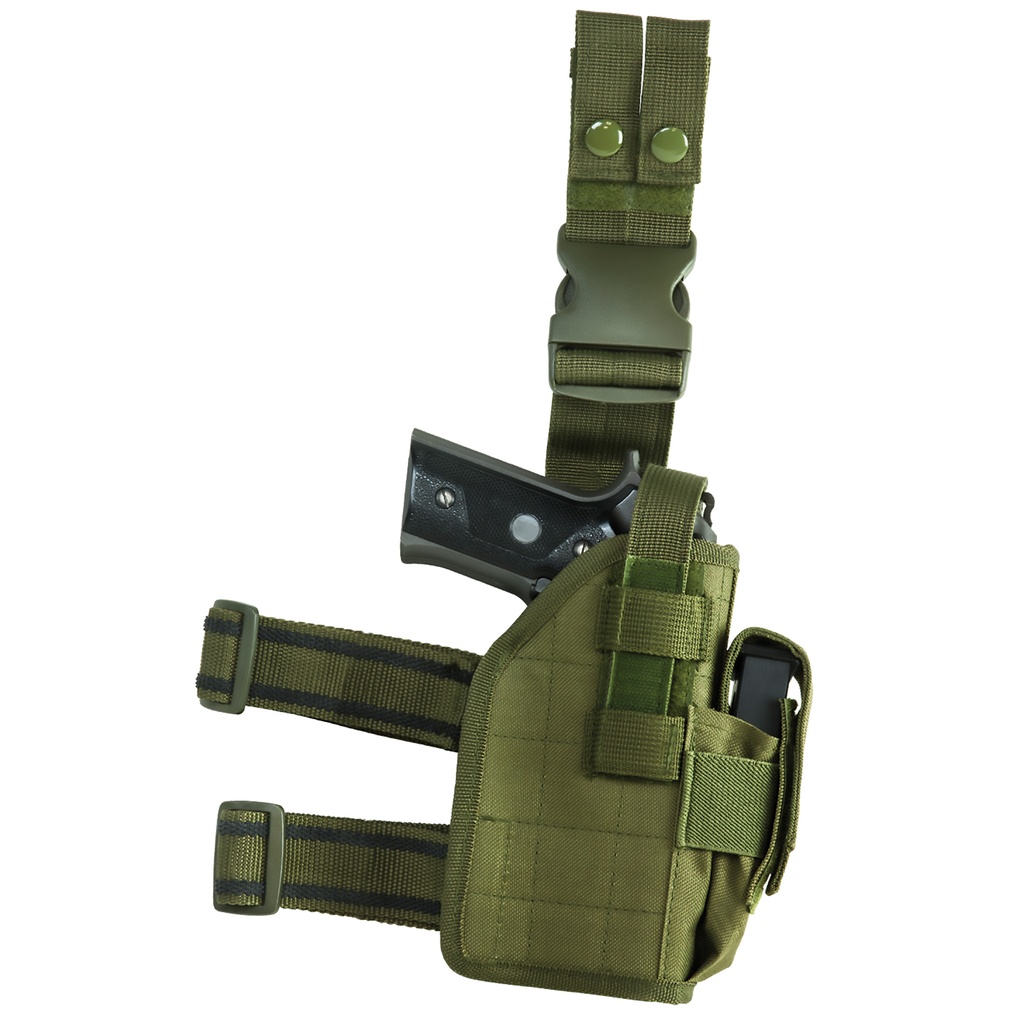
Grid-Lock Stability Tactical Holster - OD Green
14 sold in last 24 hours
This drop leg holster is built for people who actually move. The Grid‑Lock Stability Tactical Holster anchors to your belt, then locks to your thigh with dual rubberized straps so your draw point stays put. A stiff PVC shell and internal insert keep the holster open for clean reholstering, while an adjustable thumb break and front magazine pouch keep your sidearm and spare secure. Right‑handed, universal pistol fit makes it a practical choice for range days, duty rigs, or tactical training.
Grid-Lock Stability Tactical Holster - OD Green
The Grid-Lock Stability Tactical Holster - OD Green is built for one purpose: keeping your sidearm exactly where you expect it to be when you’re moving, kneeling, or going to ground. This is a right-handed, universal drop leg holster designed for people who actually train, actually run drills, and actually care where their gun sits under stress.
Instead of dangling, flopping, or riding up, this holster uses a belt anchor, dual rubberized thigh straps, and a stiffened shell to create a stable, repeatable draw point on your leg. If you’ve ever had a cheap drop leg rig migrate around your thigh during a course of fire, you already understand why that matters.
Why a Stable Drop Leg Holster Matters for Personal Protection
For personal protection and self-defense, consistency is everything. Whether you’re running a duty belt, training with a sidearm, or using this holster for range and tactical work, you need to be able to:
- Get your hand on the grip in the same place every time
- Clear retention without fighting the holster
- Draw and reholster without the holster collapsing or shifting
This drop leg holster is designed around those realities. The height-adjustable drop lets you set the pistol where your hand naturally falls from your belt line. The rubberized thigh straps resist slipping and riding up, so the holster doesn’t spin, sag, or migrate mid-movement. The result is a consistent platform you can actually train with—and trust.
Build Quality: How the Grid-Lock Holster Stays Put
Most buyers don’t need more gear—they need gear that works as advertised. The Grid-Lock Stability Tactical Holster focuses on structure and retention, not gimmicks.
Stiff PVC Shell with Internal Support
The holster body uses a PVC shell with a stiff insert, which does two important things:
- Keeps the mouth of the holster open for smoother reholstering
- Prevents the holster from collapsing against your leg under strap tension
That stiffness is what gives you a consistent draw stroke and prevents the gun from binding or catching as you clear leather (or in this case, PVC). For training and protection use, this repeatability matters more than cosmetic features.
Grid-Reinforced Stitching and Nylon Webbing
The front grid stitch pattern and box-stitched nylon webbing aren’t just for looks. They reinforce the holster body and strap attachment points, so the platform doesn’t twist under load. When you crank the straps down to lock the rig to your thigh, that reinforcement spreads the stress instead of letting seams creep or tear out over time.
Carry Reality: How This Drop Leg Holster Rides and Adjusts
A drop leg holster is only useful for self-defense or duty work if it fits your body and your draw. This one gives you meaningful adjustments without overcomplicating the setup.
- Height-adjustable vertical strap: Dial in how low the holster rides from your belt. Too low and it flops; too high and it interferes with your belt or armor. This lets you find the sweet spot.
- Dual rubberized thigh straps: Two wide straps wrap the leg, each with anti-slip rubberized bands, to keep the holster from rotating or sliding down when you run, climb, or kneel.
- Quick-connect buckles: Large side-release buckles make it easy to get the holster on or off without tearing apart your whole belt rig.
The overall effect is a stable platform that feels more like a fixed part of your kit than an add-on that might or might not be where you left it after a sprint.
Retention and Access: Securing the Pistol Without Fighting It
Retention in a holster for protection is a balance: enough security that the gun doesn’t bounce out, but not so much that you’re wrestling webbing while adrenaline is spiking.
- Adjustable thumb-break snap: The primary retention system is a thumb-activated strap over the back of the slide and grip. You can tune the length for different pistols, keeping tension where you want it.
- Universal fit structure: The holster body is designed to accept a wide range of mid-size to full-size semi-auto pistols. It’s not a molded custom fit, but the adjustable strap and structure give practical retention across common designs.
- Front magazine pouch: A built-in mag pouch with a hook-and-loop flap keeps a spare magazine secure and accessible. For self-defense or range work, that extra reload is a practical addition.
Right-handed orientation keeps the draw intuitive for the majority of users, especially those training to transition between belt-mounted and leg-mounted setups.
Where a Drop Leg Holster Excels in Self-Defense and Training
This isn’t a concealed carry holster. It’s a tactical drop leg platform meant for open carry scenarios: range days, training courses, airsoft/paintball, security work, or roles where you’re already running a belt with other gear.
Situations where this holster shines:
- Wearing body armor or a plate carrier that blocks belt holsters
- Running a duty belt crowded with pouches where a belt holster would be squeezed out
- Training environments where a visible, accessible sidearm is required
- Scenarios where kneeling or going prone makes a lower-riding holster more practical
For personal protection in those environments, what matters is that your sidearm remains secure yet accessible and that your draw point doesn’t shift. That’s exactly what the Grid-Lock design is built around.
What People Ask Before Buying a Stun Gun for Protection
Even though this product is a drop leg holster, many buyers looking at self-defense gear are also researching stun guns for self defense and other protection tools. These are the questions that come up most often when people consider adding a stun gun to their kit alongside a holster like this.
How effective are stun guns for self defense?
A stun gun can be effective for self-defense in close quarters if you understand what it actually does and what its limits are. A direct-contact stun gun uses electrical current to cause pain, muscle contraction, and confusion at the point of contact. It doesn’t knock people across the room; that’s movie physics. Effectiveness depends on:
- Amperage (current), not just voltage: Voltage helps the current jump through clothing, but it’s the current that causes pain and muscle disruption.
- Contact time: A quick touch may startle. One to three seconds of solid contact is more likely to create enough pain and distraction to let you break away.
- Target area: Large muscle groups or areas with lots of nerves (thigh, hip, shoulder) tend to be more effective.
Used realistically—as a close-range tool to create a window to escape—a quality stun gun can be a useful part of a self-defense plan, but it’s not a magic stop button.
Does voltage or amperage matter more in a stun gun?
Most stun gun marketing shouts about “millions of volts,” but voltage numbers are mostly hype once you’re past the threshold needed to arc through clothing. What matters more for protection is:
- Amperage (current): This is what actually affects the body—too low and it’s just annoying, high enough and it causes intense pain and muscle lock-up.
- Contact area: Larger or well-designed contact points deliver current more effectively.
- Power source quality: A decent battery and internal circuitry matter more than a flashy “million volt” label.
In plain terms: once a stun gun has enough voltage to arc, further voltage is marketing. Look for honest information about amperage, build quality, and real-world testing instead of chasing the biggest voltage number on the package.
Is this stun gun legal to carry in my state?
Stun gun laws are evolving, and they differ widely by state and sometimes by city. Many states treat a stun gun for self defense as a legal defensive tool for adults, but some require permits, restrict carry in certain locations, or ban them outright in specific jurisdictions. Before you buy or carry a stun gun:
- Check your state statutes on electronic control devices or stun guns
- Look for local (city or county) ordinances that may add extra rules
- Confirm whether there are age restrictions, permit requirements, or location bans (schools, government buildings, etc.)
This drop leg holster itself is generally legal in most places as gear, but any weapon or stun gun you carry in it must comply with your local laws. When in doubt, verify with an updated state resource or a qualified legal professional.
Carrying with Confidence: Building a Practical Protection Setup
If your goal is practical personal protection, your gear needs to match how you actually move and train. The Grid-Lock Stability Tactical Holster - OD Green gives you a stable, repeatable way to carry a sidearm on your thigh, with a spare magazine ready and retention that makes sense under stress.
Combined with an honest understanding of how tools like a stun gun for self defense really work—current over voltage, contact time over Hollywood effects—you can build a defensive setup that’s based on reality, not marketing. The more you train with your gear, the more each piece, from holster to handheld protection tools, becomes something you can run confidently when it counts.
The bottom line: set your rig up correctly, adjust the drop and straps to your body, practice your draw and reholster, and treat every tool, whether a firearm or a stun gun, as something that buys you time and space to get to safety—not as a guarantee. That mindset, paired with stable, reliable equipment, is what real preparedness looks like.