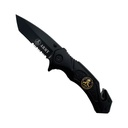
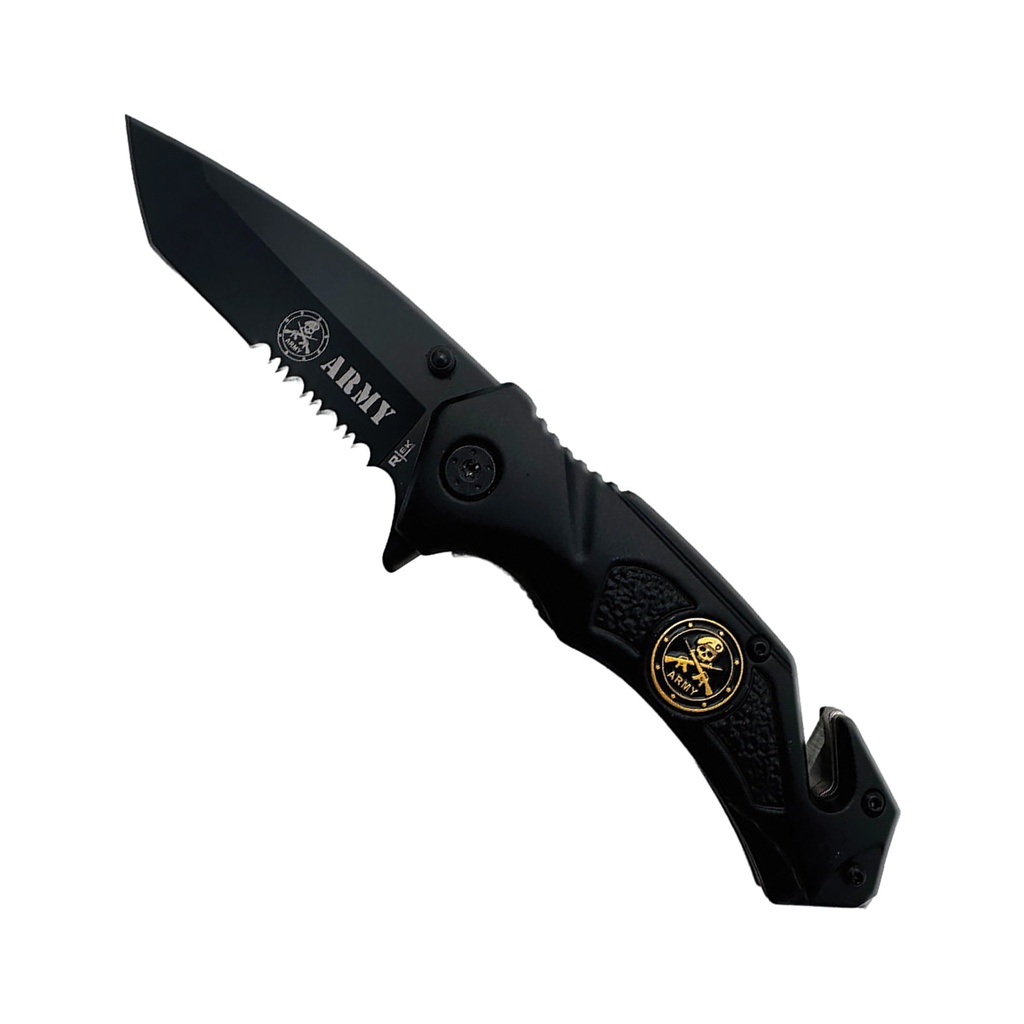
Honor Medallion Quick-Deploy Rescue Knife - Matte Black
7 sold in last 24 hours
This spring-assisted rescue knife is built for the moment you hope never comes. A matte black 3.5-inch partially serrated clip point blade snaps open fast and locks solid with a liner lock you can trust. The integrated seatbelt cutter and glass breaker turn the handle into a compact rescue system, while the inset Army medallion honors service without shouting. One-handed opening, a pocket clip, and stainless steel construction make it a practical EDC choice for anyone who wants a dependable, Army-tribute rescue tool on hand.
What This Rescue Knife Actually Does When Seconds Matter
The Honor Medallion Quick-Deploy Rescue Knife - Matte Black is built for one job: give you a fast, reliable cutting and breaching tool when a situation turns bad. It’s not a wall-hanger and it’s not a toy. This is a spring-assisted rescue knife designed to cut a jammed seatbelt, break a window, and handle everyday cutting tasks without drama.
At 8 inches overall with a 3.5-inch partially serrated clip point blade, it rides like a regular EDC folder but adds the tools you want in a real emergency: a glass breaker, a dedicated seatbelt cutter, and fast one-handed deployment. The Army medallion and ARMY blade etch make it a quiet tribute to service while still being a fully capable working knife.
How the Spring-Assisted Rescue Mechanism Works
This is a spring-assisted folding knife, not an automatic. That matters. You start the opening with a thumb stud; once you nudge it past a certain point, the internal spring takes over and snaps the blade into full lockup. It’s fast, but it still requires deliberate input from you—better for pocket carry and typically more acceptable in stricter knife jurisdictions than full autos.
The liner lock engages behind the tang when the blade opens. That thin strip of metal inside the handle is what keeps the blade from folding back on your fingers. On this knife, the lock geometry and positive detent give you a clear "open" feel: you’ll know when it’s fully deployed. Under stress, that tactile feedback matters more than flashy styling.
Partially Serrated Blade for Mixed Cutting Tasks
The clip point profile gives you a controllable tip for detail work, while the partial serrations near the handle do the hard work on fibrous material. In plain language: the plain edge handles boxes, cord, and daily utility; the serrations bite into seatbelts, webbing, and tough fabric when you can’t waste time sawing.
Glass Breaker and Seatbelt Cutter as an Integrated System
The glass breaker at the butt is designed to focus your impact into a small point, helping you punch through tempered side windows in vehicles. The recessed seatbelt cutter lets you slide the strap into the slot and pull, keeping the sharp edge away from the person you’re freeing. Together, they turn this knife into a compact rescue system rather than just another folder with a logo.
Build Quality That Backs Up the Army Tribute Theme
Plenty of knives get a military logo slapped on and call it a day. This one backs the Army tribute visuals with practical hardware. The stainless steel blade offers a good balance of edge retention, corrosion resistance, and toughness for real-world EDC and vehicle carry. The matte black finish cuts glare and keeps the look low-profile rather than flashy.
The metal handle gives you durability and weight that feels grounded in the hand. Textured sections improve grip without being abrasive on pockets. The inset Army medallion is not just painted on—it’s a physical emblem set into the handle, which is more resistant to wear than simple print or decal treatments.
Secure Liner Lock and Solid Lockup
The liner lock is the backbone of this design. When you open the blade, the liner moves into place behind it, preventing closure until you intentionally push the lock back. For a rescue knife, this is critical; you may be cutting at awkward angles, reaching into a vehicle, or working in tight spaces. A weak or sloppy lock is the failure point; on this platform, lock engagement is firm and easy to verify visually and by feel.
Pocket Clip for Consistent Carry
With any tool you plan to use under pressure, where and how you carry it matters as much as what it can theoretically do. The pocket clip keeps this knife in a consistent position—tip-down, along the seam of your pocket or on a gear panel—so your hand finds it the same way every time. That predictability is what turns a rescue knife from "good idea" into actual preparedness.
Real-World Carry: EDC Utility Meets Rescue Readiness
This knife is sized and configured to work as both an everyday carry knife and a dedicated vehicle or duty-gear rescue tool. At 4.5 inches closed, it’s compact enough for daily pocket carry but substantial enough that you can run it in gloves. The spring-assisted opening helps when your fine motor skills are compromised by stress, cold, or adrenaline.
For many people, the practical play is to clip this in a consistent spot: front pocket if you’re using it as EDC, or mounted in a vehicle or on a vest or bag strap if you primarily want it as a rescue tool. Either way, practice the draw and opening a few dozen times under calm conditions. Muscle memory built now pays off when seconds stretch out in an actual emergency.
Why This Knife Works as a Practical Protection and Rescue Tool
Protection and self-defense are not only about direct confrontation. A big part of real-world safety is having the right tool when someone is trapped, restrained, or stuck in a dangerous situation—such as a vehicle after a collision. This knife fits that niche well.
The partially serrated blade can cut away clothing or gear, the seatbelt cutter frees someone from a jammed restraint without exposing them to the main blade, and the glass breaker lets you access a vehicle quickly if doors won’t open. As a self-defense adjunct, it’s a solid EDC cutting tool that stays low-key, with the Army tribute elements signaling service and respect rather than aggression.
What People Ask Before Buying a Stun Gun for Protection
Even though this product is a rescue knife, many buyers researching personal protection also look at stun guns for self defense. Below are practical answers that cut through common stun gun misconceptions so you can build a complete protection plan.
How effective are stun guns for self defense?
A stun gun for self defense can be effective, but only within its limits. It’s a contact tool, not a distance weapon. You must physically touch the attacker with the electrodes and maintain contact for at least one to three seconds to disrupt their muscle control and pain response. The real-world effectiveness depends on amperage (current), contact time, and where you make contact—large muscle groups and hips/torso are better than arms or extremities. Stun guns work best as part of an overall protection plan, not as your only option.
Does voltage or amperage matter more in a stun gun?
Voltage gets the marketing headlines, but amperage does the actual work. Once a stun gun has enough voltage to arc through clothing and skin oil—usually far below the "million volts" you see in ads—more voltage mostly becomes marketing theater. What matters most is controlled, safe amperage that can disrupt neuromuscular signals without causing lasting injury, plus good contact area and a power system that can maintain that current output. A well-designed stun gun for self defense will be honest about this and focus on build quality and reliability rather than inflated voltage numbers.
Is this stun gun legal to carry in my state?
Stun gun legality is highly state- and sometimes city-specific. Some states treat a stun gun for self defense like any other defensive tool with minimal restriction; others require permits, restrict carry in certain locations, or ban them outright. Before you buy, check three levels: state law, local city or county ordinances, and any specific rules for where you work or study (such as campuses or federal facilities). Laws also change, so rely on up-to-date official sources or qualified legal guidance, not just old forum posts.
Carrying with Competence: Knife and Stun Gun Together
If you’re building a protection setup that includes both a rescue knife and a stun gun for self defense, think in terms of roles. The knife is your utility and rescue tool: cutting, breaching, emergency extraction. The stun gun is your close-contact defensive tool: pain compliance and temporary disruption. Different holsters, different pockets, and different draw strokes help you access the right tool on purpose instead of by accident.
Choose carry positions you can reach under stress, and practice drawing each tool separately. For the knife, that means cleanly deploying the spring-assisted blade and engaging the liner lock. For the stun gun, that means safe grip, disabling any safety switch, and understanding where to target and how long to maintain contact. The goal is calm, competent use—not drama. With that mindset, the Honor Medallion Quick-Deploy Rescue Knife - Matte Black becomes one part of a thoughtful, layered personal protection plan.
| Blade Length (inches) | 3.5 |
| Overall Length (inches) | 8.0 |
| Closed Length (inches) | 4.5 |
| Blade Color | Black |
| Blade Finish | Matte |
| Blade Style | Clip Point |
| Blade Edge | Partial-Serrated |
| Blade Material | Stainless Steel |
| Handle Finish | Matte |
| Handle Material | Metal |
| Theme | Army Tribute |
| Pocket Clip | Yes |
| Deployment Method | Spring-assisted |
| Lock Type | Liner lock |