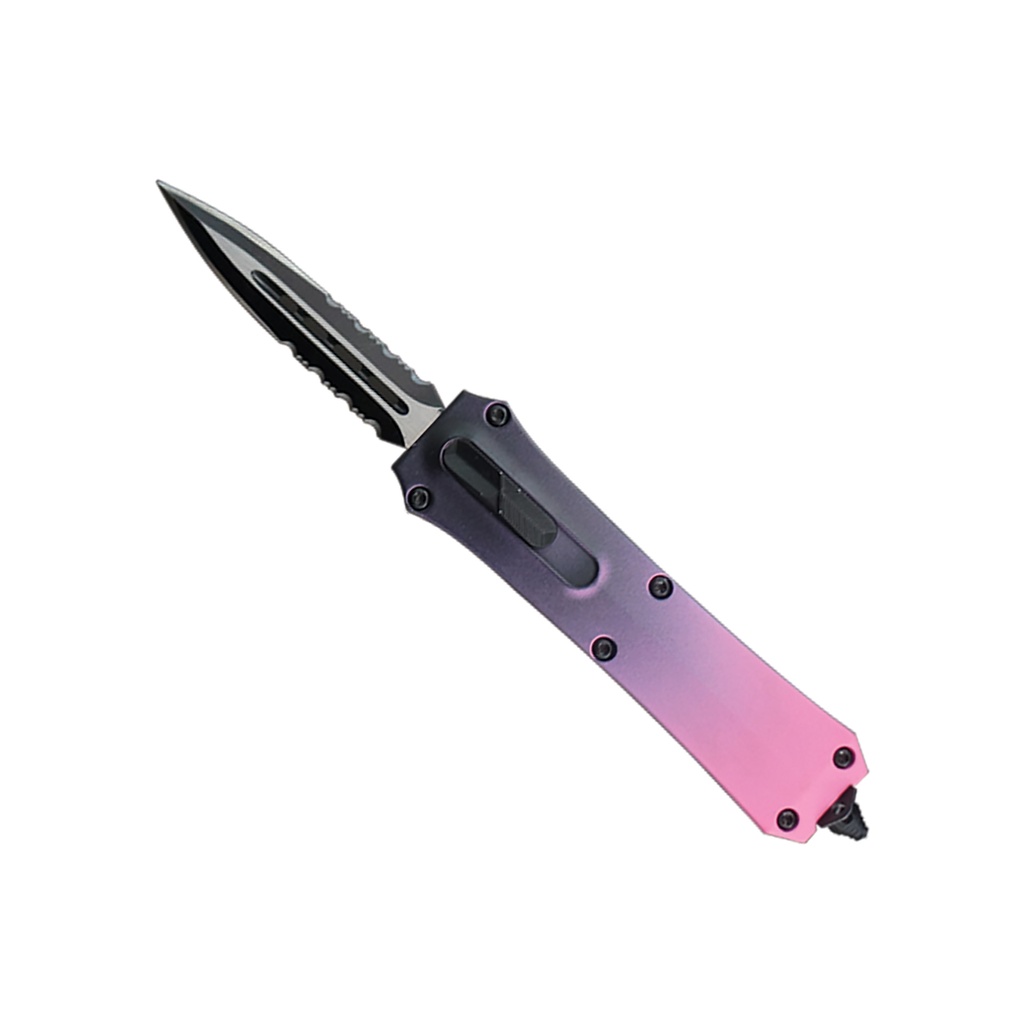

Horizon Shift Gradient OTF Blade - Blue Pink Aluminum
12 sold in last 24 hours
A front-switch OTF knife built for quick, no-fuss use. The Horizon Shift Gradient OTF Blade launches its 2.75" matte black dagger blade with a straight-line slide of your thumb, then locks solid for cutting, slicing, or light prying. Partial serrations bite into rope and straps, while the blue-to-pink aluminum handle gives secure grip and standout style. A glass-breaker pommel and deep-carry pocket clip finish it as a compact, ready EDC that disappears in pocket but shows up ready to work.
What the Horizon Shift Gradient OTF Blade Actually Does
The Horizon Shift Gradient OTF Blade is a compact out-the-front knife built for everyday use, quick access, and controlled cutting tasks. It’s not a showpiece you baby or a massive combat blade you never carry. This is the knife you clip into your pocket and forget about until you need to open a package, cut cord, scrape, or get a precise tip on target quickly. The front-switch deployment gives you straight-line, predictable action you can run by feel once it’s familiar.
At 7 inches overall with a 2.75-inch matte black dagger blade, this knife sits in a sweet spot: small enough for comfortable EDC, long enough to give real reach and control on day-to-day cuts. The blue-to-pink gradient aluminum handle is more than just style—aluminum keeps it durable and light, while the smooth but contoured body gives consistent control in forward or reverse grip.
How This OTF Knife Works in Real Carry
This is a single-action OTF knife with a front switch. That means the blade deploys out the front of the handle when you drive the switch forward in a straight line. The internal spring handles the work, but you control the start and stop with that linear thumb motion. Once locked out, the blade is held in place for cutting, puncturing, and slicing typical EDC materials.
Because it’s single-action, you slide the blade out with the switch and then reset it manually before the next deployment. That design trades a bit of speed on retraction for a simpler mechanism and a confident, decisive launch each time you deploy. It’s the kind of system that rewards familiarity—you’ll quickly learn exactly how much pressure you need on the switch and how the lock engages.
Build Quality That Makes This OTF Worth Carrying
With any OTF knife, reliability comes down to three things: the track the blade rides in, the switch and spring assembly, and the handle’s ability to stay rigid under use. The Horizon Shift Gradient OTF Blade leans on proven construction elements: a matte-finished steel dagger blade running in an aluminum handle body, Torx hardware holding everything snug, and a switch positioned on the front spine where your thumb naturally lands.
Blade Geometry and Edge Configuration
The dagger profile gives you a narrow, piercing tip and symmetrical point alignment. That matters when you’re cutting in tight spaces or starting a puncture cut—like opening heavy plastic packaging or initiating a cut into thick cardboard. The partial-serrated edge on one side of the blade gives you a dedicated section for biting into rope, webbing, or fibrous material without sacrificing a clean slicing edge on the rest of the blade.
The matte black finish on the steel blade cuts glare and makes wear less visually obvious. You can use it hard without every scuff shouting at you. For someone who actually uses an OTF knife as a tool, that’s a practical advantage—this knife stays looking functional, not trashed, even after real work.
Handle, Clip, and Glass Breaker Details
The blue-to-pink gradient aluminum handle is both the visual hook and a functional shell. Aluminum offers a solid strength-to-weight ratio and won’t swell or warp with moisture. The smooth matte finish is comfortable in hand, and the straight handle profile makes indexing easy—you feel blade orientation without needing to look.
A deep-carry pocket clip keeps the knife riding low and out of sight until needed. The clip position lines up the front switch where your thumb can hit it clean on the draw. At the pommel, a glass-breaker tip gives you a focused impact point for emergency window breaking or using the end of the knife as a striking tool without risking the blade edge.
Everyday Use: Where This OTF Knife Excels
Out-the-front knives are about access and control. This one is tuned for realistic everyday use rather than drama. The 4.25-inch closed length and 4.56-ounce weight mean it disappears in your pocket or bag, so you actually carry it instead of leaving it at home. When it’s time to use it, the straight-line front switch gives one consistent motion you can run even with cold or gloved hands.
For daily tasks, the combination of a sharp primary edge and partial serrations covers most cutting jobs: cardboard, tape, plastic strapping, light cord, and improvised scraping. The dagger profile helps when you need precise tip placement—like cutting shrink-wrap away from a surface you don’t want to scratch.
Carry Format and Practical Deployment
How a knife carries often matters more than how it looks on a table. The Horizon Shift Gradient OTF Blade is set up for front pocket or waistband carry with its side-mounted pocket clip. The clip tension keeps it secure during normal movement but still draw-friendly when you need it.
The front switch sits on the handle spine, which is key. When you draw the knife in a standard grip, your thumb naturally lands right behind the switch. There’s no hunting for a button on the side or changing grip to deploy. You draw, orient, and run the switch forward in one consistent sequence. That matters when your attention is on the task, not the tool.
What People Ask Before Buying a Stun Gun for Protection
How effective are stun guns for self defense?
A stun gun for self defense works by delivering electrical current through contact points on the device into the attacker’s body. The realistic effects depend on three key factors: amperage (current), contact time, and where you make contact. Short, glancing touches usually cause pain and flinch reflexes. Longer contact on major muscle groups can create stronger muscular disruption and a chance to break contact and escape.
Unlike what voltage marketing suggests, stun guns are not magic force fields. They’re close-contact tools. You need to be close enough to drive the stun gun into the target and keep it there for at least one to three seconds for stronger effects. That’s why how you carry the stun gun, how secure your grip is, and whether you’ve practiced accessing it quickly often matter more than the printed “million volt” claim on the side.
Does voltage or amperage matter more in a stun gun?
Amperage matters far more than voltage in a stun gun for personal protection. Voltage is mainly about how well the current can jump the gap at the contact points—it gets the electricity into the body. Once it’s there, amperage is what does the real work. Higher current (within safe design limits) is what creates muscle disruption and pain. That’s why two stun guns with wildly different voltage claims can feel very similar in real use if their amperage and contact design are close.
When you’re choosing the best stun gun for personal protection, pay attention to build quality, contact area, grip, switch placement, and how easily you can carry and deploy it. Those factors are predictable performance indicators. A solidly built, moderate-voltage unit with a well-designed contact head and good current delivery is more trustworthy than a flimsy “10 million volt” device with weak contacts and poor ergonomics.
Is this stun gun legal to carry in my state?
Stun gun legality in the United States is highly state- and sometimes city-specific. Some states allow stun guns and TASER-style devices with minimal restriction; others require permits, limit carry locations, or restrict certain models. A few municipalities have their own rules even if the state is generally permissive.
The practical approach is straightforward: before buying a stun gun for self defense, check three sources—your state statutes (often under weapons or electronic defense devices), your local city or county ordinances, and any relevant case summaries or state police guidance. Many states now treat stun guns as defensive tools, but assumptions can get you in trouble. Confirm first, then choose the best stun gun to carry that fits both your local law and your realistic carry habits.
Carrying Tools with Realistic Expectations and Skill
Whether you’re choosing an OTF knife like the Horizon Shift Gradient OTF Blade or a stun gun for personal protection, the same principles apply: understand what the tool actually does, how it really works, and where its limits are. An OTF knife gives you fast, controlled access to a sharp edge for everyday tasks. A stun gun for self defense gives you close-range, contact-based disruption that can create a window to escape if you’ve practiced using it.
If you carry either tool, build a small habit around it. Practice drawing and deploying your OTF knife safely at home with an empty hand. If you choose a stun gun, rehearse accessing it from your bag or pocket, activating it, and driving it toward a training target. Skill and familiarity matter more than specs on a product page. Set yourself up to be the person who isn’t impressed by inflated voltage numbers, but who understands their tools and uses them well.
| Blade Length (inches) | 2.75 |
| Overall Length (inches) | 7 |
| Closed Length (inches) | 4.25 |
| Weight (oz.) | 4.56 |
| Blade Color | Black |
| Blade Finish | Matte |
| Blade Style | Dagger |
| Blade Edge | Partial-Serrated |
| Blade Material | Steel |
| Handle Finish | Matte |
| Handle Material | Aluminum |
| Button Type | Switch |
| Theme | Gradient |
| Double/Single Action | Single |
| Pocket Clip | Yes |