Live Demo Dual-Use Security Alarm Display - Black Stand
13 sold in last 24 hours
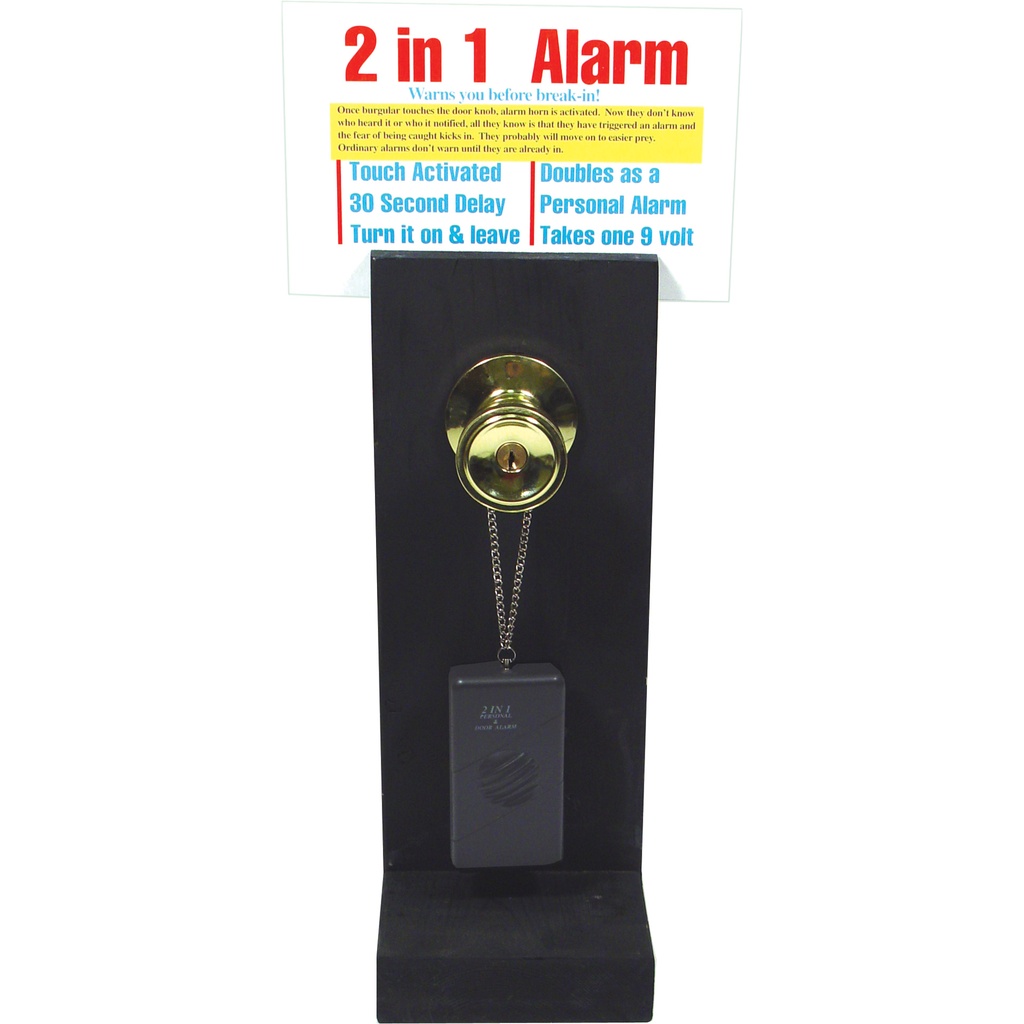
This point of sale display turns your 2-in-1 alarm into a live, touch-activated demo that sells protection without the hard sell. The mock door knob, hanging alarm, and bold header sign show how the unit works as a door security alarm and personal alarm in seconds. Just power it with a 9-volt battery, switch it on, and after the 30-second delay customers can trigger it themselves—hearing the real alarm they’ll rely on at home or on the go.
What This 2-in-1 Alarm Display Actually Does for Your Customers
This isn’t a gimmick stand; it’s a practical way to show real protection in action. The Live Demo Dual-Use Security Alarm Display turns a standard 2-in-1 alarm into a hands-on experience, so customers can see and hear exactly how it works for door security and personal protection before they buy. No hype, no scare tactics—just a clear demonstration of what the alarm actually does.
Mounted on a tall black stand with a realistic door knob, the live unit hangs on a small chain, ready to be powered by a simple 9-volt battery. Once switched on, it arms after a 30-second delay and becomes touch-activated. That means customers trigger the same loud alarm they’ll rely on in their own homes or when carried as a personal alarm.
How This Alarm Display Helps Customers Understand Real-World Protection
People buying security products—whether a simple alarm, a stun gun for self defense, or a full home system—want one thing: to know what it will actually do under real conditions. This 2-in-1 alarm point of sale display answers that in a straightforward way. It lets them feel the door knob, see the chain-mounted alarm, and hear the live alert that will scare off a casual intruder or draw attention if used as a personal alarm.
Instead of abstract promises, the display gives a concrete, sensory demo. A customer touches the alarm, it fires, and they immediately judge whether that level of sound and responsiveness matches their idea of practical protection. That kind of clarity is what converts browsers into confident buyers.
How the 2-in-1 Alarm System Actually Works
Although this product is a point of sale display, it’s built around a real working 2-in-1 alarm. Here’s the practical breakdown:
- Power: Runs on a standard 9-volt battery for easy replacement and predictable performance.
- Arming delay: After you switch the alarm on, there’s a 30-second delay before it becomes touch-activated. This gives you time to position it on a doorknob or in a bag without constant triggering.
- Activation: Once armed, a touch or disturbance activates the alarm, producing a loud sound designed to startle and attract attention.
- Dual use: It can function as a simple door security alarm or be carried as a personal alarm to draw help in a public setting.
The display’s mock door knob and chain show the door alarm configuration clearly. Staff can then explain how the same unit doubles as a personal alert, giving customers a two-for-one protection tool.
Build Quality and Retail Durability
In a retail environment, anything that can be touched will be touched constantly. This display is built with that reality in mind, keeping the alarm secured and functional while surviving everyday handling.
Stable Stand and Clear Signage
The tall rectangular black stand provides a solid base that won’t tip easily when curious customers test the alarm. The large white header sign with bold red “2 in 1 Alarm” text and blue/red callouts explains the key functions at a glance—touch activation, delay time, and dual-use capability—so staff don’t have to repeat the same script all day.
Secure Demo Mounting
The brass-colored door knob and hanging chain keep the demo unit exactly where it needs to be: visible, accessible, and secure. Customers can interact with the alarm without removing it from the display, reducing loss and keeping the point of sale layout consistent.
Why a Live Demo Sells More Personal Protection Products
When customers look at any self-defense or security tool—whether an alarm, a stun gun for self defense, or a more advanced system—they’re really asking two questions: Will this work for me? and Can I use it easily under stress? A live demo stand answers both at once.
With this 2-in-1 alarm display, customers don’t have to imagine how loud the alarm is, how it hangs on a door, or how sensitive the touch activation might be. They feel the knob, they touch the alarm, it sounds, and the answer is immediate. That hands-on experience builds more trust than any printed decibel number or marketing line.
From Curiosity to Confident Purchase
The display naturally draws attention—visual contrast from the white header, the realistic door knob, and the hanging alarm invite interaction. Once someone triggers the alarm, you’ve moved from passive interest to an engaged conversation about personal protection. That’s where you can connect this simple tool to their real concerns: apartment safety, dorm rooms, travel, or walking to the car at night.
What People Ask Before Buying a Stun Gun for Protection
Even though this product showcases a 2-in-1 alarm, many customers considering alarms are also researching whether to add a stun gun for personal protection. These are the practical questions they bring up most often.
How effective are stun guns for self defense?
A stun gun for self defense is a contact tool—it has to touch the attacker to matter. Its effectiveness comes from delivering enough current (amperage), over enough contact time, to disrupt muscle control and pain tolerance. In real terms, that means you need to:
- Get solid contact on a major muscle group or torso area,
- Maintain that contact for several seconds, and
- Train enough to deploy it under stress.
They can be effective, but they’re not magic wands. Like this 2-in-1 alarm, they work best as part of a layered protection plan that includes awareness, avoidance, and simple tools that draw attention.
Does voltage or amperage matter more in a stun gun?
Most packaging screams about “millions of volts,” but voltage is largely marketing. Once you hit the threshold needed to arc across the stun gun’s contacts, more advertised voltage doesn’t equal more real stopping power. What matters is:
- Amperage (current): This is what actually affects the body.
- Contact time: A brief tap hurts; several seconds can disable.
- Contact area and probe placement: Bigger, better contact equals better effect.
Honest stun gun makers focus on reliable current delivery and solid build quality, not inflated voltage numbers. The same plain logic that makes a live alarm demo credible—show, don’t exaggerate—applies here too.
Is this stun gun legal to carry in my state?
Stun gun and personal protection laws vary by state and sometimes by city. Some places allow open carry with few restrictions, others require permits, and a few jurisdictions restrict or ban civilian stun guns entirely. Before you add a stun gun for self defense alongside alarms and other tools, check:
- Your state statutes on electronic control devices or stun guns,
- Any local city or county ordinances, and
- Rules for schools, public buildings, and transportation.
Retailers should also confirm what can be sold and displayed locally. The advantage of this 2-in-1 alarm display is that sound-based alarms are widely legal and easy to recommend, even where stun guns are tightly regulated.
Practical Takeaway: A Clear, Honest Demonstration of Protection
The Live Demo Dual-Use Security Alarm Display doesn’t rely on buzzwords or inflated specs. It gives customers exactly what serious buyers want from any personal protection tool: a realistic, no-nonsense look at how it actually works.
With a stable stand, bold header sign, real door knob, and touch-activated 2-in-1 alarm powered by a simple 9-volt battery, you give shoppers a calm, informed way to evaluate their options. They leave knowing what this alarm can and cannot do—and that clarity is what keeps them coming back to you for the rest of their self-defense and home security gear.