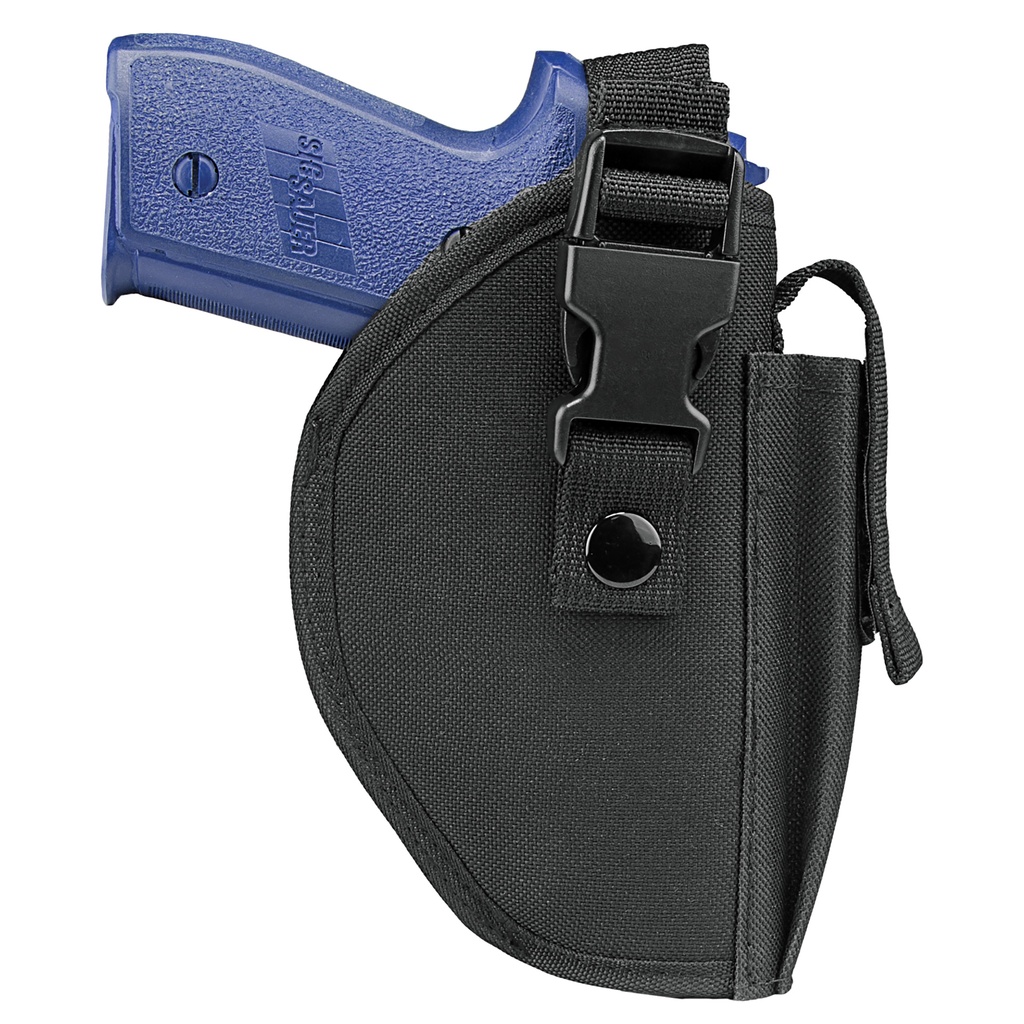
Lockstep Rhythm Belt Holster with Mag Pouch - Black Nylon
14 sold in last 24 hours
When you draw, everything should be exactly where you expect it. The Lockstep Rhythm Belt Holster with Mag Pouch – Black Nylon locks your pistol and a spare double-stack mag onto belts up to 2 inches in a repeatable, training-friendly position. A stiffened body keeps the mouth open for reholstering, while the soft lining protects your slide. The quick-connect buckle and snap strap give you retention you can confirm by feel, making this a straightforward, duty-style holster for range, training, or daily security work.
Lockstep Belt Holster: Simple, Repeatable Carry for Real-World Use
The Lockstep Rhythm Belt Holster with Mag Pouch - Black Nylon is built for people who actually carry: security staff, off-duty professionals, and practical shooters who want a clean, consistent draw and a spare magazine on the belt. This isn’t about looking tactical in photos. It’s about a universal pistol holster that mounts solidly, holds its shape, and keeps your reload exactly where your support hand expects it.
Thread it onto a belt up to 2 inches wide, lock in the quick-connect buckle, and you’ve created a stable, repeatable carry position for your handgun and spare mag. From there, it’s just reps.
Holster Design That Supports Safe, Consistent Carry
A holster doesn’t need a lot of moving parts to work well. It needs predictable retention, a clear draw path, and enough structure that it doesn’t collapse when the pistol comes out. This belt holster checks those boxes with a stiffened outer body and a soft interior lining that protects your slide from constant in-and-out during practice or duty use.
The right-hand outside-the-waistband profile gives you an intuitive, straight-up draw. The body is shaped to accommodate a range of common service-sized and compact pistols, making it a practical choice if you train with more than one handgun or if your work issues different sidearms over time.
Stiffened Body, Soft Lining
The stiffened holster body holds its mouth open when the pistol is drawn, which matters more than people think. A collapsing holster forces you to fight fabric and angle the muzzle toward your own body while reholstering. Here, the structure lets you reholster with less fishing and less muzzle wandering. Inside, a softer lining keeps your slide and finish from being chewed up by rough nylon or exposed hardware.
Quick-Connect Buckle and Snap Retention
The large side-release buckle and snap strap are designed to be confirmed by feel. You don’t have to look down to know the holster is locked onto your belt and the strap is secured over the pistol. Under stress or in low light, that kind of tactile feedback is more valuable than any clever gimmick.
Integrated Mag Pouch: One Belt, Full Rhythm
The defining feature of this belt holster is the integrated magazine pouch riding forward of the pistol. It’s positioned where your support hand naturally falls on the beltline, so your reload process becomes one smooth sequence rather than a search for gear.
The pouch is sized for a double-stack 9mm or .40 magazine, which covers the vast majority of modern duty and defensive pistols. For training, that means you can run draw-and-reload drills without separate carriers shifting around. For work, it means your backup ammo is always in the same place, on the same platform.
Forward-Facing, Fast Access Reload
The mag rides vertically with an open top, ready for a clean index and pull. There’s no fumbling with flaps or complicated closures. You train to get your thumb and index finger on the mag, draw it straight up, and feed the pistol. The pouch’s placement is about minimizing steps and maximizing consistency.
Universal Fit, Consistent Positioning
Because this is a universal pistol holster, you can use it with different handguns while keeping your reload point and draw stroke largely the same. That’s useful if you rotate between a compact and a full-size pistol, or if you’re a trainer or armorer who works with multiple platforms. The holster anchors everything to a single belt position that you can repeat day after day.
Carry Format: Outside-the-Waistband, Duty-Style Practicality
This is an outside-the-waistband belt holster designed for belts up to 2 inches. That sizing is intentional: it fits most duty, instructor, and heavy carry belts as well as many sturdy EDC belts. The belt channel keeps the holster tight to the body, reducing flop and shifting over a long shift or a long day at the range.
Black synthetic nylon keeps the profile low and professional. There’s no high-gloss finish or bright hardware—just matte black components that don’t draw attention and don’t flash under light. The overall look matches common law-enforcement and security gear: functional, unobtrusive, and built to be worn, not admired.
Who This Holster Makes Sense For
- Security guards and patrol staff who need a simple, right-hand belt holster with a spare mag on board.
- Range shooters who want an affordable, universal rig for drills, draw practice, and reload work.
- Trainers and instructors who swap between pistols but want a consistent carry position for demonstrations.
- Prepared civilians who prefer an OWB carry format on a proper belt and don’t want separate mag carriers.
Build Quality and Reliability Under Daily Use
The strength of this belt holster is in its straightforward construction. Reinforced stitching traces the outline of the holster and mag pouch, reducing the chance of seams blowing out when the gear catches on a seatbelt, door frame, or barricade. The synthetic nylon material resists fraying and moisture better than many cheap fabric rigs, and it’s easy to wipe clean after dust, rain, or sweat.
Hardware is low-glare and sized for real hands. The side-release buckle is large enough to manipulate with light gloves, and the snap on the retention strap is a standard metal style you can open and close thousands of times during training without babying it.
What People Ask Before Buying a Stun Gun for Protection
While this product is a belt holster, many buyers looking for self-defense gear are also researching stun guns for personal protection and want clear, honest answers. The same no-hype approach applies whether you’re selecting a holster or a stun gun for self defense.
How effective are stun guns for self defense?
A stun gun for self defense is a contact device: you have to be close enough to press it into an attacker and maintain contact for a few seconds. When a stun gun has enough amperage (current) and is built well, it can cause intense pain, muscle lockups, and a disruption in balance. That can create a window to break contact and escape. What it does not do reliably is instantly “drop” every attacker at a touch, like movies suggest. Effectiveness depends on current, where you make contact (large muscle groups are better), how long you keep contact, and the person’s state (drugs, adrenaline, clothing layers all matter). Think of a stun gun as one tool that can create an opening to escape—not a magic shield.
Does voltage or amperage matter more in a stun gun?
Most self-defense professionals agree: voltage numbers in stun gun marketing are largely theater. Voltage is the pressure that lets electricity arc across a gap. Once you’re in contact, amperage—the amount of current moving through the body—is what actually affects muscles and the nervous system. After a certain point, more advertised “millions of volts” doesn’t make a practical difference in a stun gun for self defense. What matters is a safe but effective current level, solid electrodes with good contact area, a reliable power source, and a form factor you can actually hold onto under stress. If a product screams about voltage but says nothing about build quality, battery life, or contact design, be skeptical.
Is this stun gun legal to carry in my state?
Stun gun laws vary widely. Some states treat a stun gun for self defense much like a knife or other defensive tool; others have restrictions on carry, sales, or where you can bring it (schools, government buildings, certain cities). A few jurisdictions require permits or treat them similarly to firearms. Before you buy, check both state law and local ordinances. Look for terms like “electronic control device,” “conducted energy weapon,” or “stun gun” in your state statutes. If you already carry a firearm in this belt holster, apply the same mindset to a stun gun: know the rules, and when in doubt, verify with up-to-date state resources or an attorney.
Carrying with Confidence: Holster and Stun Gun as a System
Whether you’re running a handgun in this belt holster, a stun gun for personal protection, or both, the principles are the same: secure mounting, repeatable access, and tools you understand under stress. This holster solves the carry part for your pistol and spare magazine, giving you a stable, predictable platform on your belt. If you add a stun gun to your setup, treat it the same way—dedicated carry position, consistent practice, and a realistic understanding of what it can and can’t do.
That’s how you move beyond gear collecting and into practical personal protection: fewer surprises, more repetition, and equipment chosen for reliability instead of hype.