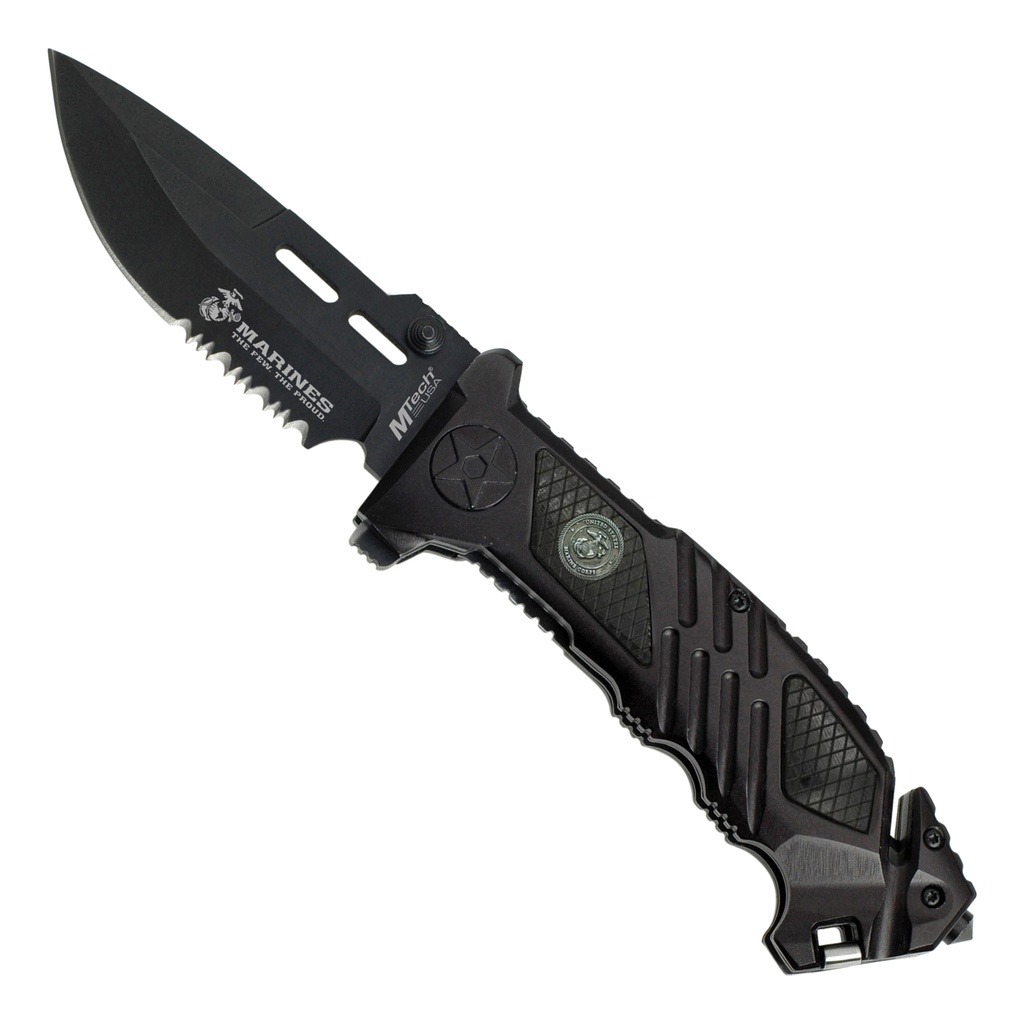
Marine Crest Rapid-Rescue Tactical Knife - Black Pakkawood
12 sold in last 24 hours
Built like a duty tool, this Marine crest spring assisted knife is ready for real-world rapid rescue. The 3.75" black 440 stainless blade with partial serrations handles cutting, prying, and seat belt shredding without drama. A dedicated belt cutter, glass breaker, and deep-carry clip turn this tactical folding knife into quiet backup in your pocket. Black Pakkawood scales with finger grooves give you secure control when adrenaline spikes, while spring assist and liner lock deliver fast, one-handed deployment you can depend on.
What This Marine Crest Tactical Knife Actually Does
The Marine Crest Rapid-Rescue Tactical Knife - Black Pakkawood is built as a real-duty rescue and everyday carry tool, not a display piece. It’s a spring assisted folding knife designed to do three things reliably: cut when you need cutting power, break glass when seconds matter, and shear through webbing or seat belts without fumbling around for the right edge. The Marine branding and blacked-out finish look sharp, but the value is in how this knife works in your hand under stress.
Primary Use: Tactical Rescue Folding Knife You Can Actually Carry
This is a full-size tactical rescue pocket knife with a 3.75-inch blade and 9-inch overall length when open. That puts it in the sweet spot for duty and serious EDC: large enough to give you real leverage on a cut, compact enough to ride in a pocket without feeling like a brick. The assisted opening mechanism and liner lock make it a practical working tool for first responders, security professionals, and anyone who wants a capable rescue-style knife in the car, on a duty belt, or in a pocket.
How the Spring Assisted Mechanism Works in Real Use
Instead of a fully automatic mechanism, this is a spring assisted opening knife. That means you start the opening with the flipper tab or thumb stud, and once you’ve moved the blade a short distance, the internal spring takes over and snaps it into the locked position. The benefit is control: you can still open it deliberately in tight spaces or under stress, but you don’t have to fight a stiff manual pivot.
The liner lock engages behind the tang of the blade, giving a solid lockup for cutting, prying light materials, or driving the serrations through heavy webbing. When it’s time to close, you simply push the liner aside with your thumb and fold the blade back into the handle. It’s simple, predictable, and easy to run one-handed after a little practice.
Blade Design: Built for Work, Not Just Looks
The blade is 440 stainless steel with a matte black finish and a drop point profile. 440 stainless is a practical choice: it resists rust, sharpens easily, and holds an edge well enough for typical EDC and rescue tasks. The drop point gives you a strong spine and a controllable tip, which matters when you’re cutting near skin, clothing, or wires you don’t want to damage.
The edge is partially serrated near the handle. That’s a purposeful decision on a rescue knife. The plain edge section near the tip is ideal for controlled cuts, opening packages, or slicing cord cleanly. The aggressive serrations closer to your hand bite into dense material—seat belts, backpack straps, heavy webbing—and keep cutting even when a smooth edge would start to slip. In a real rescue context, those serrations do the ugly, hard work.
440 Stainless Steel: Practical Edge and Corrosion Resistance
440 stainless is not exotic, but that’s the point. It gives you a corrosion-resistant blade that holds up to sweat, humidity, glove compartments, and daily carry. When it needs attention, you can bring the plain edge back with basic sharpening tools, and the serrations can be maintained with a tapered or round stone. For a tactical rescue knife at this size and weight, 440 is a sane, serviceable choice.
Handle, Grip, and Control Under Stress
The handle uses black Pakkawood scales over a sturdy frame, with finger grooves and textured contours that locate your hand the same way every time. Pakkawood is a stabilized wood composite, which gives you the visual warmth of wood with better resistance to moisture and daily wear.
When adrenaline spikes, fine motor skills degrade. That’s where the handle shaping matters: the finger grooves and contouring let you index your grip by feel, even in low light or with gloves. The Marine crest medallion is more than just decoration—it also provides a tactile point on the handle you can feel as you draw.
Deep-Carry Pocket Clip: Realistic Everyday Carry
The deep-carry pocket clip keeps the knife low and discreet in the pocket, reducing printing and making it more comfortable for all-day wear. Positioned for quick access, it lets you establish a consistent draw stroke from front pocket carry. For duty users, it also works as a backup clipped inside a vest or on a pocket edge where space is limited.
Integrated Rescue Tools: Seat Belt Cutter and Glass Breaker
Two dedicated rescue features turn this from a basic tactical folding knife into a practical rapid-rescue tool. At the butt of the handle, you’ll find a seat belt cutter and a glass breaker.
The seat belt cutter uses a protected, inset blade to slice quickly through webbing. The protection around the edge helps you cut close to a trapped person without exposing them to the full edge of the main blade. In a real crash or entrapment, that design matters—you want fast cutting with a lower risk of accidental injury.
The glass breaker is a hardened tip at the end of the handle. Used correctly—pointed into a corner of automotive side glass with a firm, focused strike—it makes it much easier to shatter a window and create a viable escape route. Practice the motion on inert glass or training aids if available; knowing the angle and force required beforehand drastically reduces hesitation in a real emergency.
Spring Assisted Deployment for Rescue Contexts
In a rescue scenario, speed and certainty beat flash. The assisted opening mechanism, combined with the flipper tab and thumb stud, gives you multiple ways to get the blade into play: index-finger flipper when your thumb is compromised, thumb stud when your grip is awkward or gloved. The important part is consistency—practice drawing from where you actually carry it until the motion is automatic.
Carry Reality: Where This Knife Makes Sense
This Marine Crest tactical knife is sized and built for people who realistically expect to use a knife for problem-solving and potential rescue, not just occasional package opening. Ideal placements include:
- Front pocket as a primary EDC and rescue tool
- Clipped inside a duty vest or uniform pocket for security or law enforcement
- Glove box or door pocket as a dedicated vehicle rescue knife
- Backpack strap or admin pouch as part of a broader emergency kit
At 7.12 ounces, it’s substantial but not unreasonable for a full-size rescue knife. You’ll feel it in lightweight shorts, but in jeans, work pants, or a duty uniform, the weight reads as solid rather than cumbersome.
What People Ask Before Buying a Stun Gun for Protection
How effective are stun guns for self defense?
Stun guns can be effective close-contact tools when used correctly, but it’s important to understand their limits. They are pain-compliance devices that require solid contact on the body and a meaningful contact time (typically several seconds) to disrupt muscle control. They’re not magic distance weapons. For many people, a sturdy knife, flashlight, or layered self-defense plan can be more reliable than depending solely on a stun gun. If you do carry a stun gun for self defense, treat it as one piece of a broader personal protection strategy.
Does voltage or amperage matter more in a stun gun?
Voltage claims on stun guns—especially the multimillion “volt” numbers—are mostly marketing. What matters far more is amperage (current), contact quality, and contact time. Voltage is what helps the charge arc through clothing; current is what actually affects the body. A well-designed stun gun with realistic current output, a solid contact area, and a reliable power source is more meaningful than any “X million volts” printed on the package.
Is this stun gun legal to carry in my state?
Stun gun legality varies by state and sometimes by city. Some states allow stun guns for personal protection with few restrictions; others require permits, limit carry locations, or ban them outright. Before buying or carrying a stun gun for self defense, check your state and local laws, including any restrictions on concealed carry, school zones, government buildings, and interstate travel. When in doubt, verify with current state statutes or a reputable legal resource—laws change, and personal protection gear is only useful if you can carry it legally.
Choosing the Right Tool: Where This Knife Fits in Your Kit
If you’re building a realistic personal protection and emergency-response setup, this Marine Crest Rapid-Rescue Tactical Knife works best as your cutting and rescue tool. Pair it with your choice of defensive options—whether that’s a stun gun for self defense, pepper spray, or a high-output flashlight—and you get coverage across more scenarios. This knife solves problems: cutting seat belts, breaking glass, opening gear, and handling everyday tasks that don’t justify introducing a dedicated self-defense weapon.
Carried consistently, practiced realistically, and maintained simply (keep it clean, lightly oiled at the pivot, and sharpened), it becomes quiet backup you don’t have to think about—until the moment you’re very glad it’s there.
| Blade Length (inches) | 3.75 |
| Overall Length (inches) | 9 |
| Closed Length (inches) | 5 |
| Weight (oz.) | 7.12 |
| Blade Color | Black |
| Blade Finish | Matte |
| Blade Style | Drop Point |
| Blade Edge | Partial-Serrated |
| Blade Material | 440 Stainless Steel |
| Handle Finish | Anodized |
| Handle Material | Pakkawood |
| Theme | None |
| Safety | Seat belt cutter |
| Pocket Clip | Yes |
| Deployment Method | Spring-assisted |
| Lock Type | Liner lock |