Prism Ballistic Assisted EDC Knife - Rainbow Titanium
3 sold in last 24 hours
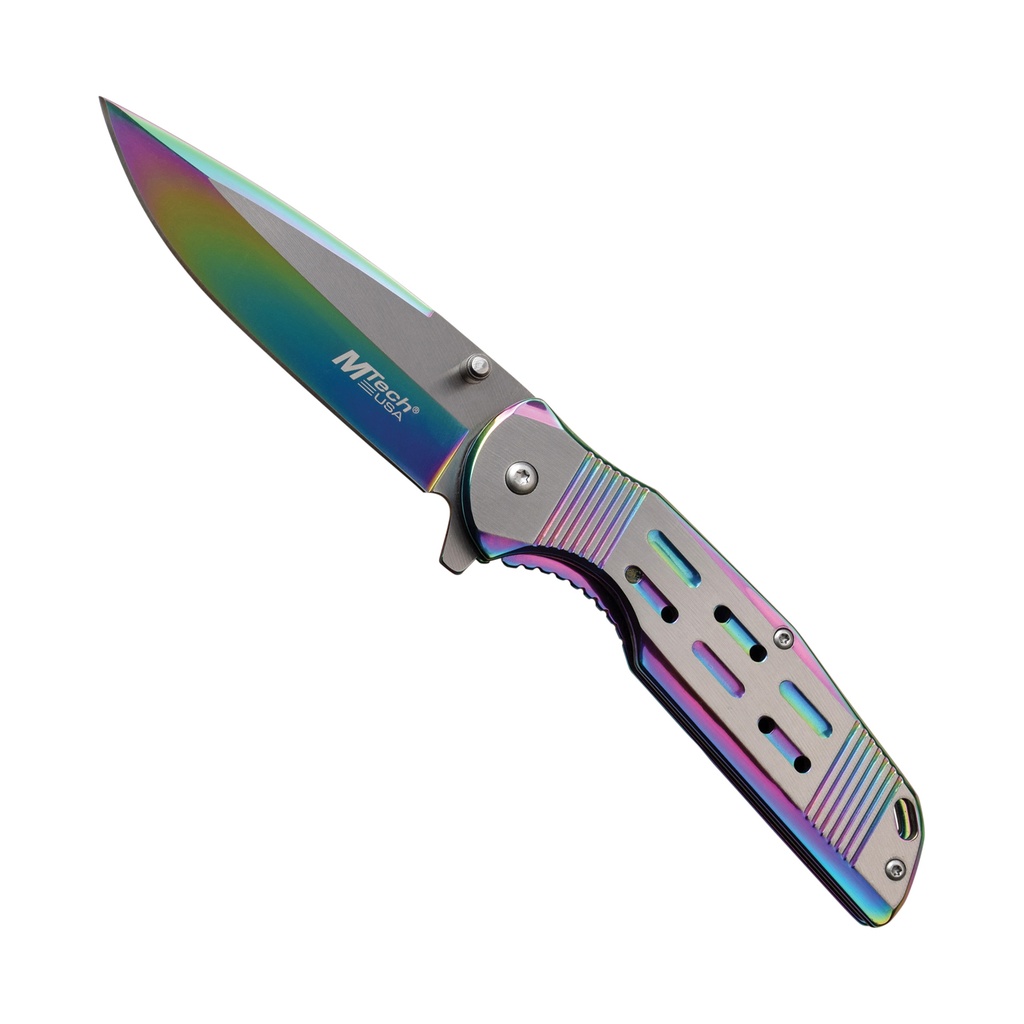
The Prism Ballistic Assisted EDC Knife - Rainbow Titanium blends fast deployment with a bold iridescent look. Its 3.5" 3Cr13 drop point blade opens quickly with a spring-assisted flipper or thumb studs, then locks solidly with a liner lock. A stainless steel handle with milled slots keeps it slim yet durable, while the rainbow titanium-style finish makes it stand out in any pocket dump. Finished with a pocket clip for everyday carry, it’s a modern, eye-catching assisted opener built for real use.
Prism Ballistic Assisted EDC Knife - Rainbow Titanium
The Prism Ballistic Assisted EDC Knife - Rainbow Titanium is built for people who actually use their knives, but don’t mind a little visual flare. Under the rainbow titanium-style finish, you’re still getting a practical, spring-assisted folding knife with a reliable lock, a sensible blade shape, and a pocket-friendly profile suitable for everyday carry.
What This Assisted EDC Knife Actually Does Well
This isn’t a wall-hanger. At 8 inches overall with a 3.5" 3Cr13 stainless blade, it’s sized for real cutting tasks: opening boxes, slicing cord or strap, light utility work, and general EDC chores. The spring-assisted mechanism helps you get the blade into play quickly with either the flipper tab or dual thumb studs, then the liner lock keeps it secure until you deliberately close it.
The stainless steel handle keeps the build solid while the milled slots help reduce bulk and give your fingers purchase. The result is a knife that feels more substantial than a plastic-handled budget folder, but still carries reasonably flat against the pocket thanks to the integrated clip.
How the Spring-Assisted Mechanism Works in Real Use
A good assisted opening knife should be predictable, not surprising. Here, you start the motion either with the flipper tab or a thumb stud. Once you move the blade past a short detent, the internal spring takes over and snaps it fully open. There’s no button to search for and no complicated choreography under stress—just a consistent, repeatable motion.
The liner lock engages automatically when the blade is open. To close, you simply press the lock bar aside with your thumb and fold the blade back into the handle. That combination—assisted deployment and a familiar liner lock—makes this format easy to learn for anyone who has used a basic folding knife.
Blade Design: Drop Point Utility with a Modern Finish
The drop point profile is one of the most practical everyday shapes. You get a controllable tip for detail work and enough belly along the edge for slicing. The plain edge sharpens easily with common stones or pocket sharpeners, and 3Cr13 stainless offers decent corrosion resistance for typical pocket carry and light use.
The satin primary blade faces keep it functional and reduce visual noise where the cutting actually happens, while the rainbow-colored spine gives the knife its distinctive look without compromising edge performance.
Handle and Grip: Stainless Backbone with Iridescent Character
The stainless steel handle provides a rigid frame for the assisted mechanism and liner lock. Milled slots and grooves cut into the scales reduce some weight and offer indexing points for your fingers. Jimping along the exposed liner at the spine gives your thumb better traction when you need to add pressure during a cut.
The rainbow titanium-style finish runs along the handle’s visible surfaces, so the knife reads as iridescent at a glance, yet still feels like a solid metal tool in hand. It’s more “modern urban EDC” than purely tactical, which suits anyone who wants a functional knife that doesn’t disappear into a sea of black handles.
Everyday Carry Reality: How This Knife Rides and Deploys
EDC knives live in real pockets, not on spec sheets. Closed, this knife measures about 4.5", which fits easily in most jeans or work pants without printing too aggressively. The pocket clip keeps it anchored to the edge of your pocket for fast retrieval and helps prevent it from drifting sideways at the bottom of a bag.
Orientation and clip style matter when you’re drawing a knife repeatedly. Once in hand, the flipper tab gives you a consistent index point—your finger finds it almost automatically. That simplicity is a big part of what makes assisted opening knives like this so usable day-to-day: one motion from draw to deployment, with minimal fine-motor demand.
Locking and Safety in Daily Use
The liner lock is a known quantity in the folding knife world because it balances strength and ease of use. When properly engaged, it prevents accidental closure under normal cutting loads. To put the blade away, you use your thumb to move the lock bar aside and then fold the blade closed—no hidden levers or complex multi-step sequences.
As with any assisted opener, normal pocket carry with the blade fully closed and the clip engaged is key. The detent that holds the blade shut, plus the resistance before the spring engages, are what keep it from opening unintentionally in your pocket or bag.
Who This Assisted Opening Knife Suits Best
This spring-assisted EDC knife is a fit for buyers who want a reliable, affordable folder that’s easy to open one-handed and doesn’t look like every other black tactical knife on the market. If your priorities are:
- Quick, one-handed opening with a familiar mechanism
- Decent everyday steel that’s easy to maintain
- A secure liner lock and full stainless handle construction
- A pocket clip for consistent carry
- A distinctive rainbow titanium-style aesthetic
then this build checks the boxes. It’s not a hard-use survival tool or a premium steel collector’s piece; it’s a practical, visually bold assisted opener meant for regular, real-world cutting tasks.
Build Quality Details That Matter Long-Term
With any assisted opening knife, certain design choices tell you more than any marketing line. Here, a few specifics stand out:
- 3Cr13 blade steel — budget-friendly, stainless, easy to sharpen after everyday wear.
- Liner lock construction — a proven locking style used in countless working folders.
- Dual opening options — both flipper and thumb studs give you flexibility based on hand size and preference.
- Full stainless handle — provides a rigid platform for the pivot, spring, and lock, which is important for long-term reliability.
- Jimping and grip cuts — subtle but useful details that improve handling when you’re actually cutting, not just looking at the knife.
These are the elements that determine whether a knife earns permanent pocket rotation, not just how it looks in photos.
What People Ask Before Buying a Stun Gun for Protection
While this product is an assisted opening knife, many practical protection buyers also research stun guns for self defense. The same no-hype approach applies whether you’re choosing an EDC blade or a stun gun for personal protection, so it’s worth clearing up a few common questions.
How effective are stun guns for self defense?
A stun gun for self defense can be effective in very specific conditions: you must make solid contact with the attacker’s body (ideally large muscle groups or torso), maintain that contact for at least 2–3 seconds, and have a unit that delivers enough current to disrupt their voluntary muscle control. Stun guns are pain-compliance tools first; they’re not magic off-switches. They work best as a close-range break-contact option, bought with the understanding that awareness, distance, and movement are still your primary defenses.
Does voltage or amperage matter more in a stun gun?
Voltage gets all the big headlines, but amperage matters more for real effectiveness. Very high voltage mainly helps the stun gun arc through clothing and skin resistance. The actual “stopping power” comes from current (amperage) delivered over time and contact area. Most consumer stun guns operate in a low-amp range by design to avoid being lethal, so build quality, electrode placement, and your ability to maintain contact are more important than any “X million volt” claim on the package.
Is this stun gun legal to carry in my state?
Stun gun legality in the U.S. is state and sometimes city-specific, and those rules change. Some states treat stun guns like other defensive tools, others require permits, and a few restrict or ban them in certain jurisdictions or facilities (schools, government buildings, airports). Before you buy or carry a stun gun for personal protection, check your current state and local laws—ideally from an official state statute site or a recent legal summary—and remember that private property (workplaces, venues) can set their own rules as well.
Carrying with Competence: Knife, Stun Gun, or Both
Whether you’re choosing an assisted opening knife like the Prism Ballistic or a stun gun for self defense, the same principles apply: understand exactly what the tool can and cannot do, practice the draw and deployment until it’s smooth, and carry it in a consistent, repeatable location on your body or in your bag.
This knife gives you a fast-deploying edge for everyday cutting tasks, wrapped in a durable stainless build and a rainbow titanium-style finish that reflects your personal style. Paired with clear-eyed expectations and a bit of practice, it becomes a reliable part of your daily carry—less about drama, more about being calmly prepared.
| Blade Length (inches) | 3.5 |
| Overall Length (inches) | 8 |
| Closed Length (inches) | 4.5 |
| Blade Color | Rainbow |
| Blade Finish | Satin |
| Blade Style | Drop Point |
| Blade Edge | Plain |
| Blade Material | 3Cr13 |
| Handle Finish | Rainbow |
| Handle Material | Stainless Steel |
| Theme | Iridescent |
| Pocket Clip | Yes |
| Deployment Method | Spring-assisted |
| Lock Type | Liner lock |