
Range-Ready Dual Retention Mag Holster - Black Polymer
9 sold in last 24 hours
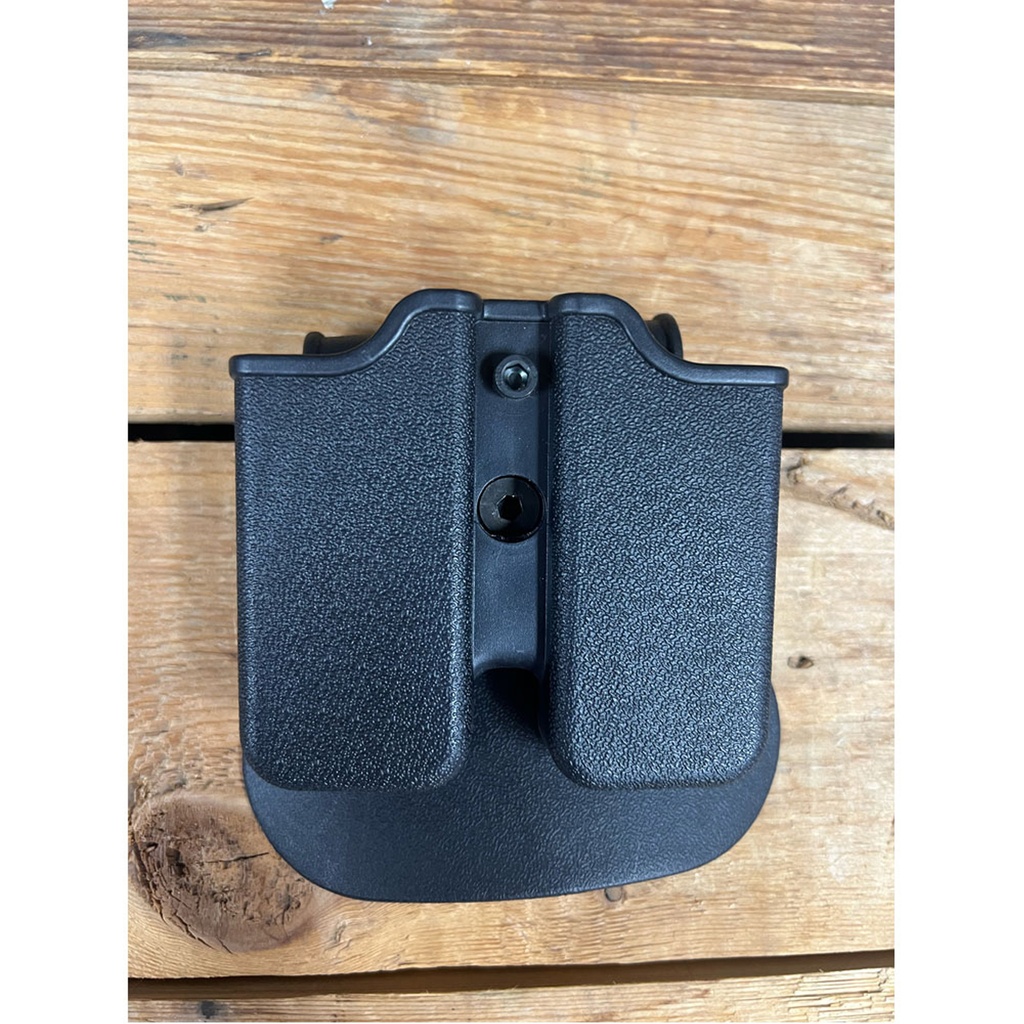
The Range-Ready Dual Retention Mag Holster keeps your 1911 magazines exactly where you want them—secure, accessible, and consistent every draw. The contoured paddle base rides comfortably against the body, while fully adjustable cant and 360° rotation let you fine-tune your setup for range work, duty, or concealed carry support. Compatible with IMI Defense modular platforms, this double mag holster locks in magazines with adjustable retention so you can move, train, or work without worrying about gear shifting or dumping.
What This Double Mag Holster Actually Does for Your Protection Setup
This isn’t a gadget and it isn’t meant to impress on a gear table. The Range-Ready Dual Retention Mag Holster is a simple answer to a real protection problem: if you run a 1911 for personal defense, security work, or duty, you need spare ammunition that stays put until you need it—and comes out cleanly when you go for it.
This double magazine holster is built around reliable, repeatable access. Two side-by-side 1911 mags ride in a rigid polymer body on a contoured paddle mount, with adjustable retention and full 360-degree rotation. It doesn’t try to do everything; it does one job well: keep your reloads consistent under movement and stress.
Why Magazine Management Matters for Self-Defense, Not Just the Gun
In personal protection, people obsess over the pistol and often ignore the support gear. A secure handgun is only half the equation; a solid magazine holster closes the loop. If your spare mags are buried in a pocket, loose in a bag, or shifting on a cheap carrier, you’re betting your self-defense reload on luck.
This double mag holster gives you a stable, predictable place for your 1911 magazines every single time you step out the door, head to the range, or report for a shift. That consistency is what competent self-defense looks like in practice.
Build Details That Make This Mag Holster Reliable
The value of this holster isn’t in tactical buzzwords; it’s in details that matter when you’re actually wearing it and drawing from it.
Rigid Polymer Body with Adjustable Retention
The holster uses a durable polymer shell that holds its shape under pressure, heat, and daily wear. That rigidity is what gives you a clean, repeatable draw stroke. Retention is adjustable via screws, so you can dial in how tightly the holster grips your 1911 magazines—from tighter for duty and training to slightly looser for faster competition-style reloads.
Comfortable Paddle Mount for Daily Carry
The integrated paddle mount is contoured to sit flat and stable against your body. For a lot of practical self-defense users, this is the most flexible setup: easy on and off without re-threading a belt, but still secure enough for range drills, movement, and normal daily activity.
Carry Reality: Configuring This Mag Holster for Self-Defense Use
Gear only helps your personal protection if you can actually live with it day to day. This double mag holster is built for real-world carry, not just flat-range photos.
- 360-Degree Rotation: The magazine carrier can rotate a full 360 degrees, so you can run it vertical, canted forward, or even nearly horizontal depending on your belt height and body shape.
- Fully Adjustable Cant: With a simple Allen key, you set the angle that allows your hand to land naturally on the magazines during a self-defense reload or training drill.
- Low-Profile Twin Pouches: The side-by-side configuration keeps the footprint compact, reducing printing under a light cover garment and making it easier to move, sit, or get in and out of vehicles.
For concealed carriers, this mag holster can ride just forward of the hip on the support side, providing a fast, intuitive grab point for your reloads. For duty or range use, it integrates cleanly with existing IMI Defense modular platforms so your magazines live in the same place across belts and rigs.
How This Double Mag Holster Supports a Complete Protection System
Self-defense instructors talk about systems, not isolated pieces. Your handgun, holster, belt, and mag carrier all have to work together. This double mag holster is designed as a stable link in that chain—especially for those who run a 1911 and care about having enough ammunition on tap.
Because it’s compatible with IMI Defense modular platforms, you can move it between different setups—duty-style rig, training belt, or more discreet carry—without changing how your hand finds your magazines. That kind of consistency is what reduces fumbles when your heart rate is spiking.
Practical Use: Training with the Double Mag Holster
To get real self-defense value from this mag holster, treat it like any other critical piece of protection gear: set it up once, then train with it until your reloads are automatic.
- Set retention: Adjust the screws so you can turn the holster upside down without mags dropping, but still draw them smoothly with a firm tug.
- Lock in a position: Rotate and cant the holster until your support hand naturally lands on the front magazine as you move from a normal standing position.
- Run live or dry reloads: Practice drawing from the same spot on your belt until you don’t have to look at the magazines at all.
The goal is simple: if you ever need a defensive reload, your support hand should know exactly where those 1911 mags are—no searching, no thinking, no adjusting gear.
What People Ask Before Buying a Stun Gun for Protection
Even though this product is a double magazine holster, many people shopping for self-defense gear search broadly for protection tools like a stun gun or a stun gun for self defense. They end up here asking the same core questions about effectiveness, carry, and legality. Let’s address those directly so your overall protection plan is grounded in reality, not marketing.
How effective are stun guns for self defense?
A stun gun can be effective for self defense in very specific conditions: you have to make firm contact with the attacker, usually on bare skin or thin clothing, and maintain that contact for long enough for the current to disrupt their muscle control and pain tolerance. Unlike your firearm and magazine holster, a stun gun is a contact tool, not a distance tool. It can be a useful layer in a personal protection plan, but it does not replace awareness, movement, or solid fundamentals with your primary defensive tools.
Does voltage or amperage matter more in a stun gun?
Most of the big “million volt” stun gun claims are marketing theater. Voltage sounds impressive in ads, but once you are above the minimum voltage needed to arc through clothing, what really matters is amperage and contact time. Amperage is the actual flow of current that affects the body. A well-built stun gun for self defense uses controlled current, decent contact area, and a solid power source to deliver consistent output—not just flashy voltage numbers.
Is this stun gun legal to carry in my state?
Stun gun legality varies widely by state and sometimes even by city. Some places treat a stun gun for personal protection like any other defensive tool with minimal restrictions; others require permits, limit carry locations, or ban them altogether. Before you buy or carry a stun gun, check your state statutes and local ordinances—ideally from an official state website or credible legal summary. The same rule applies to firearms, magazines, and holsters: know your local law before you build your carry setup.
Closing the Loop: A Calm, Competent Protection Setup
A trustworthy self-defense plan isn’t built on any single tool, whether that’s a stun gun, a handgun, or a knife. It’s built on a system you can actually run under stress. For 1911 carriers, this Range-Ready Dual Retention Mag Holster is one of those quiet, unglamorous components that make the whole system work.
It gives your spare ammunition a stable, configurable home. It works with your belt, with modular platforms, and with the way real people move through their day. Set it up once, train with it a little, and you’ve moved one step closer to the kind of calm, informed readiness that matters far more than any headline-level voltage claim.