Ranger Signal Rapid-Response Automatic Knife - Grivory Green
7 sold in last 24 hours
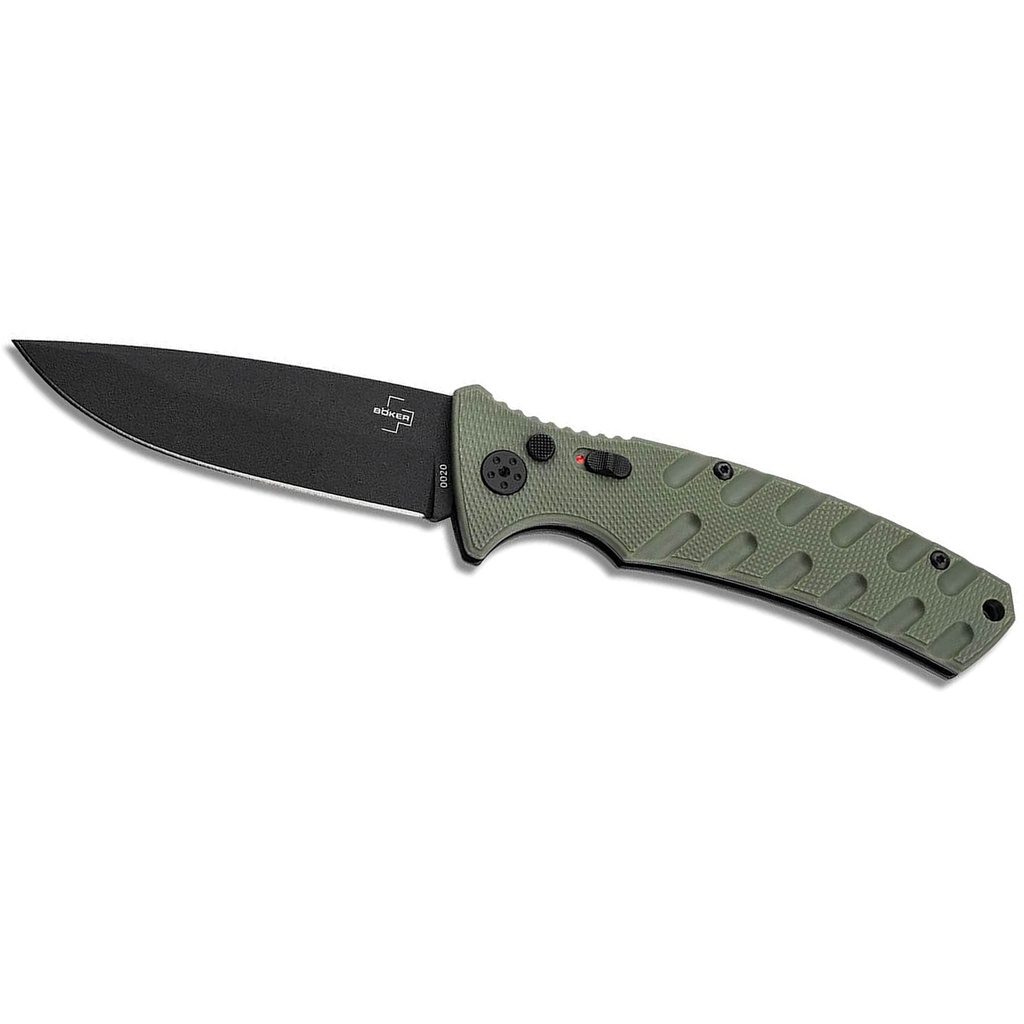
The Ranger Signal Rapid-Response Automatic Knife - Grivory Green is built for the moments you can’t fumble. A D2 drop point in a dark, duty-ready finish fires from a push button, backed by a sliding safety you can trust in a pocket or on a vest. Textured Grivory scales lock into your grip, while the convertible clip and lanyard hole give you options for carry. It’s a straightforward, hard-use automatic designed to open fast, cut clean, and stay put in your hand.
What This Automatic Knife Actually Does When Seconds Matter
The Ranger Signal Rapid-Response Automatic Knife - Grivory Green is built for one job: give you a reliable, one-handed cutting tool the instant you need it. No flipping, no wrist tricks, no hunting for a nail nick. You find the button, press, and the D2 blade is ready to work. It’s a duty-style automatic for people who care less about flash and more about whether the knife will still lock up tight in a year of hard use.
Automatic Knife for Self Defense and Everyday Emergency Use
While this is not a stun gun for self defense, it fills a similar role in a different lane of personal protection: a fast-access tool you can rely on under pressure. For many people—security staff, night-shift workers, outdoors users—an automatic knife is about controlled response. Cutting a seatbelt, clearing clothing from a minor injury, slicing packing straps in a dark loading bay: these are the real use cases. The design keeps that in focus with a quick-deploy button, secure grip, and a safety you can actually manage by feel.
How the Quick-Deploy Automatic Mechanism Works
This is a push-button automatic knife, not an assisted opener and not an out-the-front design. The blade sits folded into the handle, held in place by a button lock. A spring inside the pivot stores energy while the knife is closed. When you press the button intentionally, the lock disengages and the spring drives the 3.62-inch blade into the open position with authority, where it re-locks automatically.
Under stress, this matters. You get:
- Single, clear input: find the button, press, blade is out.
- Positive lock-up: the button lock and steel liners keep the blade from folding back on your fingers in normal use.
- Stable closing: depress the button, guide the blade closed with control—no wrestling a stiff detent.
Blade Steel, Geometry, and Real-World Cutting Performance
The 3.62-inch D2 drop point is chosen for work, not marketing buzzwords. D2 tool steel brings high wear resistance, so the edge holds up through cardboard, straps, light wood, and typical duty tasks without constant sharpening. It’s not stainless in the full sense, but paired with the dark powder coat, it shrugs off normal humidity and pocket carry if you treat it like a tool—wipe it down after wet work, don’t leave it soaking in a trunk.
The blade profile is a practical drop point: enough belly for slicing, a strong tip for controlled piercing, and a spine that transitions cleanly to the point so you can index the blade with your thumb for precision cuts. There’s no unnecessary recurve or showpiece grind to complicate sharpening. A basic stone or guided system will keep it in shape.
Durable Coated Finish for Discreet, Hard Use
The dark, green-tinted powder coat does three things: reduces glare, adds a layer of corrosion resistance over the D2, and visually ties the blade to the ranger green handle for a low-profile, tactical look. It’s meant to be used, not babied—expect honest wear over time where you cut and where the blade meets the liners. That wear is cosmetic, not structural.
Handle, Grip, and Carry: Control Under Stress
An automatic knife is only as useful as your ability to hang onto it. The Grivory handle scales over steel liners give you a balance of rigidity and reduced weight. Grivory is a tough, glass-reinforced polymer used in hard-use gear because it resists impact and temperature swings better than cheap plastics.
Textured Grivory with Guarded Ergonomics
The handle isn’t flat and slick. It has diagonal ridges and a pronounced finger groove with a guard, so when you clamp down on it—wet, gloved, or cold—your hand finds a repeatable position. The steel liners running the length of the handle add stiffness so there’s no flex when you bear down in a cut.
Convertible Clip and Lanyard Options
The convertible pocket clip lets you set the knife up for your preferred side, making deployment more consistent. Add a lanyard through the rear hole if you want an extra retrieval point from a deep pocket or bag. For people who work around machinery, where snag hazards matter, you can leave the lanyard off and still have a secure clip-only carry.
Safety, Control, and Responsible Automatic Carry
Automatic knives raise a fair question: how do you make sure it doesn’t open when you don’t want it to? This design tackles that with a two-layer approach.
- Primary control – the button: the blade only deploys when the button is pressed fully. Normal pocket pressure is rarely enough to trigger it.
- Secondary control – sliding safety: a dedicated safety switch you can set to block the button, with a visual red-dot indicator when it’s in the “ready” position.
Carrying in a pocket or on a vest, you can run safety on or off based on your environment. Walking into a shift or entering a crowded space? Safety on. Working solo at night or in the field where fast access matters more? Safety off, knife still kept secure by the button and clip.
Where This Automatic Knife Fits in Your Protection Setup
This knife is not a stun gun for personal protection, and that distinction is important. A stun gun for self defense is a pain-compliance and disruption tool at contact distance. An automatic knife is fundamentally a cutting tool that can support your overall preparedness: freeing someone from a stuck belt, opening gear rapidly, or handling utility tasks so you’re not improvising with the wrong tool.
For people building a protection-oriented everyday carry kit—flashlight, medical basics, less-lethal option—a reliable automatic knife like this Boker Plus makes sense as the cutting component. It opens with one hand, locks solidly, and rides discreetly until needed.
What People Ask Before Buying a Stun Gun for Protection
Because many shoppers cross-shop between knives and stun guns for self defense, it’s worth addressing the big questions honestly. If you’re trying to decide between a stun gun for self defense and an automatic knife like this, understanding how stun guns actually work will help you build a balanced setup.
How effective are stun guns for self defense?
Stun guns can be effective as a self defense tool when used correctly and with realistic expectations. They are contact-distance devices: you must physically touch the stun gun to the attacker, usually on large muscle groups or areas with good nerve access. Their goal is pain and muscular disruption, not guaranteed knockouts.
Effectiveness depends on three main factors: amperage (current) output, contact time (how long you keep it pressed into the target), and where you touch. A quality stun gun for personal protection with solid current output and a good contact area can create enough pain and confusion to help you break away. They are not magic wands, and they work best when paired with movement, verbal boundaries, and a plan to escape.
Does voltage or amperage matter more in a stun gun?
Voltage is mostly marketing once you’re above the threshold needed to arc through clothing. After that, amperage—the amount of current actually delivered—matters far more for real-world effect. Many “million volt” claims are theater; they sound impressive but don’t tell you how the device performs on contact.
When choosing the best stun gun for personal protection, look for honest manufacturers who discuss output current, contact design, and battery quality rather than just posting inflated voltage numbers. The same way we care about steel type and lock quality on this automatic knife, you should care about real electrical performance and build quality on a stun gun for self defense.
Is this stun gun legal to carry in my state?
Stun gun legality in the U.S. is state- and sometimes city-dependent. Some states treat a stun gun for self defense much like other defensive tools, while others restrict carry, require permits, or limit where you can have one (schools, government buildings, etc.).
The practical approach is:
- Check your state statutes using official government or state legislature sites.
- Look for local (city/county) rules, especially in major metro areas.
- Confirm whether there are age restrictions, permit requirements, or location bans.
Automatic knives, like this Ranger Signal model, are also regulated by state and local law, sometimes separately from stun guns. Before you carry either a stun gun for protection or an automatic knife, verify the rules where you live and where you travel. When in doubt, consult a qualified local attorney or law enforcement agency’s public information resources.
Carrying with Competence: Building a Practical Protection Setup
Whether you choose a stun gun for self defense, an automatic knife like this Boker Plus, or both, the underlying principle is the same: carry what you can deploy under stress, what you’ve actually practiced with, and what’s legal in your area.
The Ranger Signal Rapid-Response Automatic Knife - Grivory Green gives you a dependable, one-handed cutting tool with a clear control layout: push button, sliding safety, textured handle, convertible clip. Add it to a kit that might include a quality stun gun for personal protection, a compact flashlight, and basic medical gear, and you’re moving from vague fear to concrete preparedness.
The goal isn’t to feel invincible; it’s to be honest about what each tool can do and to carry them with the quiet confidence of someone who has thought this through. This knife handles the cutting piece of that equation—fast, secure, and ready when you are.