Reaper Mark Lightning-Deploy OTF Knife - Matte Black
10 sold in last 24 hours
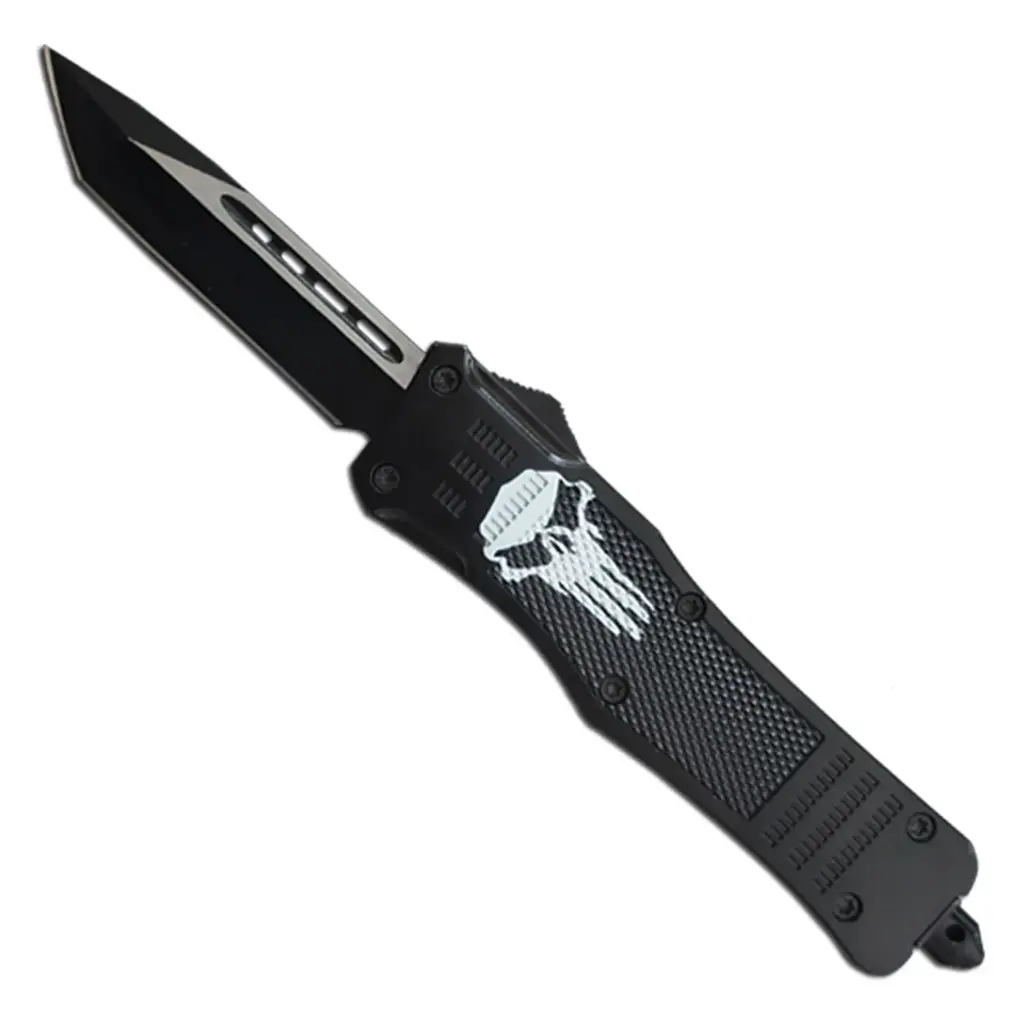
This out-the-front knife is built for people who care more about deployment and control than flashy specs. One solid push on the thumb slide sends the matte black tanto blade out with a clean, mechanical snap, locking ready for work. The skull-marked metal handle adds grip and attitude without bulk, while the low-ride pocket clip and glass-breaker pommel keep it practical. It’s the kind of OTF you carry because it opens fast, feels secure in hand, and disappears in your pocket when you’re off the clock.
What This OTF Knife Actually Does Well
The Reaper Mark Lightning-Deploy OTF Knife - Matte Black isn’t about gimmicks or fantasy specs. It’s a straightforward, dual-action out-the-front knife built for people who want fast deployment, a secure grip, and a blade geometry that tracks straight. The skull-marked handle telegraphs “tactical,” but underneath the styling you get a practical, everyday out-the-front knife you can actually carry and use.
At 9.75 inches overall with a 4-inch matte black American tanto blade, this OTF rides that useful middle ground: large enough for confident control, compact enough to pocket every day. The slide is firm but not brutal, the lock-up is positive, and the knife feels like a tool, not a toy.
How the Dual-Action OTF Mechanism Works
Out-the-front knives have a specific job: get a blade into play quickly with one consistent motion. This knife uses a dual-action mechanism, meaning the same thumb slide both deploys and retracts the blade. No flipping, no two-hand dance, no guessing where the lock is.
Thumb Slide You Can Actually Run Under Stress
The rectangular thumb slide is sized for real use. It’s large enough to find by feel, with defined texture and a clear track. Under stress, you want gross motor movements, not tiny, fussy buttons. Here, you drive the slide forward with the pad of your thumb, feel the spring tension, then the solid “click” as the blade locks open.
Positive Lock-Up and Controlled Retraction
Once deployed, the internal mechanism holds the blade in place with a mechanical lock designed for typical EDC and light tactical tasks. Retraction is equally important: pulling the slide back lets the spring system draw the blade home along the same track. That dual-action cycle makes this OTF predictable and repeatable, which matters more than raw speed when you’re talking about practical use.
Blade Design: Why the American Tanto Matters
The blade is a matte black, stainless steel American tanto with a plain edge. Translation: strong tip geometry up front, a long primary edge for slicing, and a secondary point for controlled piercing work.
- American Tanto Tip: Reinforced point for puncture resistance and focused pressure on harder materials.
- Plain Edge: Easier to maintain a consistent edge; no serrations to snag on cardboard, fabric, or strap.
- Matte Black Finish: Reduces reflections and visual signature; more about discretion than drama.
The blade has slot cutouts that reduce a bit of weight and add a tactical look, but the real value is in the controlled geometry: this is a straight-tracking point with stable tip engagement and predictable slicing performance.
Handle, Grip, and Real-World Carry
The handle is textured metal with a matte black finish and a bold skull emblem. The skull motif is what you notice first, but from a practical standpoint, the important parts are texture, shape, and hardware.
Textured Metal Grip That Actually Bites
The textured panels and angular contours give your fingers clear indexing points. When you draw from the pocket, you can feel where the slide is, where the spine is, and where the edge will land. That tactile feedback helps prevent fumbles and unintentional edge exposure.
Metal handles conduct temperature, so in colder weather it will feel cool in hand. The upside: durability and rigidity. You don’t get flex or hot spots as easily as you might with thin plastic scales under pressure.
Low-Ride Pocket Clip and Glass-Breaker Pommel
The low-ride pocket clip keeps the knife sitting deep in your pocket, reducing its visual profile while still allowing a clean purchase on the handle. It’s set up for tip-down carry, consistent with most OTF designs, putting the slide under your thumb as you draw.
At the base, a pointed pommel functions as a glass breaker and last-ditch impact tool. In vehicle emergencies, that hardened point can help defeat tempered glass more efficiently than striking with the flat of the handle.
What Makes This OTF Knife Reliable
Reliability in an out-the-front knife comes down to three things: consistent deployment, solid lock-up, and hardware that stays tight. This knife uses Torx screws along the handle scales, making maintenance and periodic checking straightforward if you have basic tools.
- Consistent Deployment: The internal spring and track are tuned for repeatable action rather than gimmicky speed.
- Sturdy Hardware: Torx fasteners resist stripping and allow you to snug things back down if you’re a heavy user.
- All-Black Finish: Matte surfaces hide wear better and avoid reflecting light in low-visibility environments.
This isn’t a display piece you leave in a case. It’s designed to be clipped, carried, drawn, and deployed regularly. The skull theme adds attitude; the build keeps it functional.
Carry Reality: Where This OTF Fits In Your Kit
EDC knives earn their place by being there when you need them and staying out of the way when you don’t. With a 5.75-inch closed length, this knife is on the larger side of pocket carry, but the slim profile and low-ride clip make it manageable for jeans, work pants, or a duty-style belt setup.
It makes the most sense as a primary utility/tactical folder for:
- Night shift workers who value fast, one-handed deployment.
- Security or tactical enthusiasts who want a skull-themed OTF with real function.
- EDC carriers who prefer a strong tip and straightforward blade geometry.
If you already carry a smaller slipjoint or multi-tool, this can serve as your rapid-deployment option—the knife you reach for when you don’t want to fight with two-handed opening or tiny thumb studs.
Legal and Practical Context for Out-the-Front Knives
Out-the-front knives occupy different legal space than standard folders in many jurisdictions. Some areas treat OTFs as automatics; others don’t distinguish at all. Before you make this your everyday carry knife, check your state and local laws specifically for automatic or out-the-front knives.
A practical framework:
- Green: States that explicitly allow automatic/OTF knives with minimal restrictions.
- Yellow: States where blade length, intent, or location (schools, government buildings) add conditions.
- Red: States or cities that heavily restrict or ban automatic/OTF designs.
Laws change, and enforcement attitudes vary. If you carry professionally (security, contract work, etc.), align your knife choice with both written policy and local law.
What People Ask Before Buying a Stun Gun for Protection
How effective are stun guns for self defense?
Stun guns don’t work like magic wands, and their real effectiveness has nothing to do with “million volt” marketing claims. A stun gun for self defense relies on sufficient current (amperage), contact time, and target area. Brief contact can create pain and flinch, but not an instant collapse. Longer contact on large muscle groups or nerve-rich areas is more likely to disrupt movement and buy you a window to escape. They’re tools that can help you break contact, not guaranteed fight stoppers.
Does voltage or amperage matter more in a stun gun?
Voltage gets the headlines, but amperage does the work. High voltage is mainly about jumping the gap between the electrodes and getting through clothing. After that, the current (amperage) delivered through that circuit is what affects the body. Real-world stun gun protection comes from controlled, safe amperage levels delivered efficiently, plus how long you can maintain contact. When you’re evaluating a stun gun for self defense, pay more attention to build quality, contact area, and verified current output than to flashy multi-million volt numbers.
Is this stun gun legal to carry in my state?
Stun gun and Taser-style laws vary widely. Some states treat a stun gun for self defense like any other defensive tool, while others restrict carry by age, location, or criminal history, and a few require permits. The smart approach is to check three layers: state law, city or county ordinances, and any workplace or campus policies that apply to you. If you plan to carry a stun gun for personal protection, verify legality from an up-to-date source—ideally a state statute database or a reputable legal summary—before making it part of your daily routine.
Carrying With Competence
Whether you’re choosing an out-the-front knife like the Reaper Mark or researching the best stun gun for personal protection, the same principles apply: understand how the tool works, know what it realistically can and cannot do, and carry it in a way that you can access under stress without fumbling.
This OTF knife gives you fast, one-handed deployment, a strong tanto point, and a secure skull-textured grip in a low-profile matte black package. Pair it with honest knowledge about your other defensive tools—like a carefully chosen stun gun for self defense—and you’re building a calm, prepared, and practical protection setup instead of relying on marketing promises.
| Blade Length (inches) | 4 |
| Overall Length (inches) | 9.75 |
| Closed Length (inches) | 5.75 |
| Blade Color | Black |
| Blade Finish | Matte |
| Blade Style | American Tanto |
| Blade Edge | Plain |
| Blade Material | Stainless Steel |
| Handle Finish | Textured |
| Handle Material | Metal |
| Button Type | Thumb Slide |
| Theme | Punisher Skull |
| Double/Single Action | Dual |
| Pocket Clip | Yes |