Rebel Banner Assisted EDC Knife - Confederate Flag
12 sold in last 24 hours
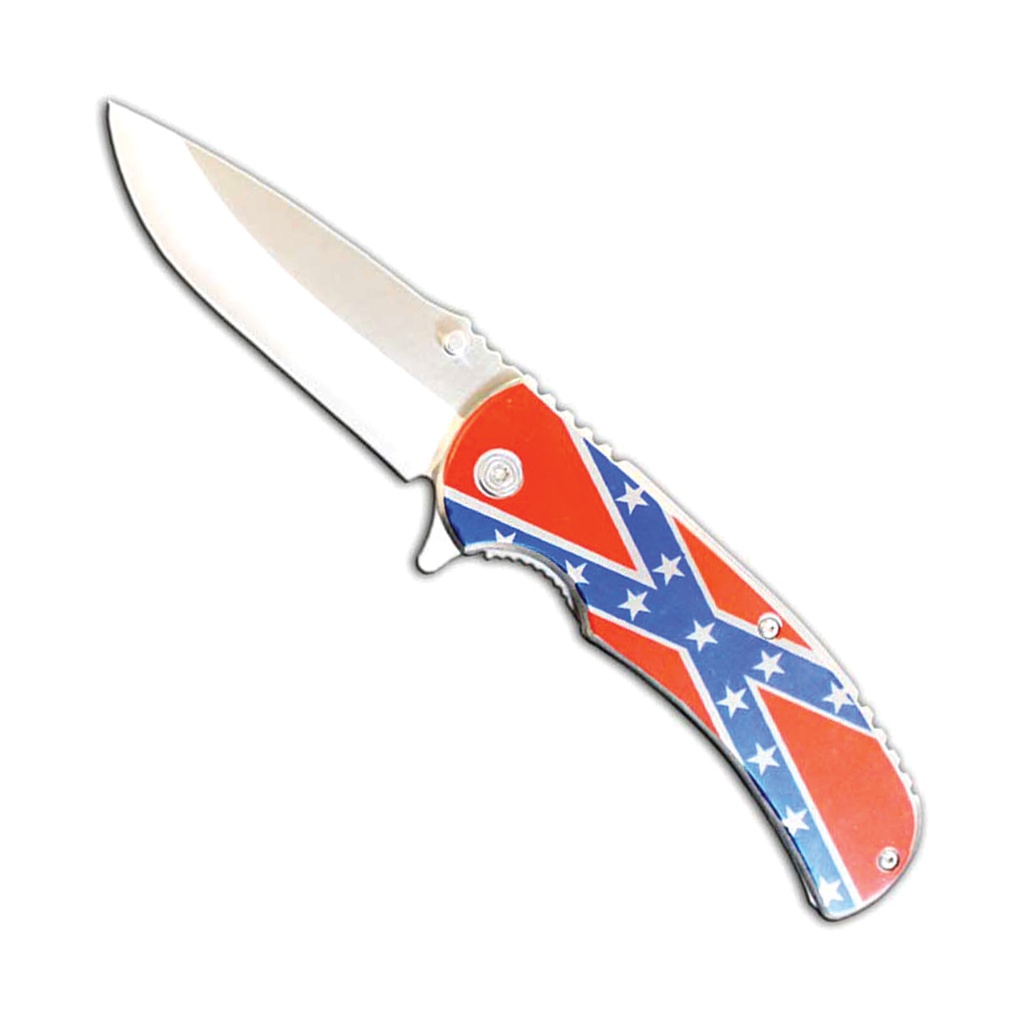
The Rebel Banner Assisted EDC Knife pairs fast spring-assisted opening with a bold Confederate flag handle for buyers who want their everyday blade to make a statement. The 3.5-inch satin drop point blade handles routine cutting, while the flipper tab and liner lock offer simple, one-handed operation. At 4.5 inches closed, it rides easily in a pocket or bag and deploys quickly when needed. This is a budget-friendly assisted-opening knife for users who prioritize Southern-themed styling in a straightforward EDC folder.
What This Knife Actually Is: A Simple Assisted EDC With a Bold Flag Handle
The Rebel Banner Assisted EDC Knife - Confederate Flag is a straightforward assisted opening folding knife built around one clear idea: a loud, unmistakable Confederate flag handle wrapped around a basic, usable everyday blade. It is not a premium tactical tool, and it is not a self-defense stun gun or electrical device. It’s a spring-assisted pocket knife with a statement-making handle theme and a practical drop point blade for light cutting tasks.
Design Overview: Everyday Cutting First, Flag Theme Front and Center
This assisted opening knife runs a 3.5-inch satin-finish drop point blade with a plain edge and simple steel construction. The blade shape is general-purpose: good for opening boxes, cutting cord, light campsite chores, and similar everyday tasks. It closes down to 4.5 inches, making it a compact folder that fits easily in a pocket, gear bag, or glove box.
The defining feature is the handle: glossy metal scales fully printed with the red, blue, and white Confederate flag graphic. The entire visual identity of this knife is built around that flag. If a buyer wants a subdued, low-visibility tool, this is not it. This is for someone who deliberately wants a bright, polarizing design wrapped around a simple assisted-opening blade.
Mechanics: How the Assisted Opening Folder Works
This is an assisted opening knife, not an automatic. That means you start the blade manually, and an internal spring helps complete the opening stroke once you get it moving. On this model, that’s done via a flipper tab and supported by a thumb stud on the blade.
Flipper Tab for One-Hand Opening
The flipper tab protrudes from the spine of the closed knife. With your index finger, you pull back or press on that tab. Once you overcome a small amount of resistance, the assisted mechanism takes over and snaps the blade into the open position. This design gives the user reasonably quick one-hand deployment without the legal complexity of a button-fired automatic knife in many jurisdictions.
Liner Lock for Basic Blade Security
Inside the handle is a liner lock. When the blade opens fully, a springy liner moves into place behind the blade tang, holding it open during use. To close the knife, you push the liner lock sideways with your thumb and fold the blade back into the handle. Liner locks are common on budget EDC folders and, when made correctly, provide adequate security for typical light cutting. As with any liner lock, this knife is not meant to be pried with, hammered on, or abused as a tool.
Carry Reality: Where This Knife Fits in Everyday Use
At 4.5 inches closed and 8 inches overall, this assisted opening knife lands in the typical pocket knife size range. It is compact enough for jacket or bag carry and light everyday tasks. There is no visible pocket clip on the handle, which changes how it rides day to day.
No Pocket Clip: Drop-In Carry Only
Without a clip, this knife is best carried loose in a pocket, small pouch, or bag compartment. That’s fine for casual users who don’t need rapid, repeat access through a shift. It does mean it’s not optimized as a dedicated duty or work knife, where a secure, consistent clip position is usually preferred for fast deployment and retention.
For glove box, toolbox, tackle box, or general around-the-house carry, the lack of a clip isn’t a major drawback. For someone who wants a primary work EDC on a belt or the edge of a pocket, you may want to pair this with a sheath, pouch, or consider a clipped alternative.
Build and Use: What This Knife Does Well (and What It Doesn't)
This Rebel Banner assisted folder is built as an entry-level, themed EDC knife. The plain-edge drop point blade in basic steel will handle routine cutting: packing tape, cardboard, light cord, plastic wrap, and similar day-to-day materials. The glossy metal handle with finger groove and basic jimping gives a bit of control, though it’s designed more for looks than hard use.
Where it does not excel is heavy-duty or professional environments that demand high-end steels, aggressive texturing, corrosion resistance, or extended cutting performance. If you’re a contractor, first responder, or field worker who lives with a knife in hand all day, this is better suited as a backup or themed novelty rather than your primary tool.
Not a Stun Gun: Clarifying Function for Self-Defense Shoppers
Because many personal protection buyers browse knives and stun guns in the same categories, it’s worth stating clearly: this product is not a stun gun for self defense. There is no electrical component, no voltage, no amperage, and no shock capability. It is a mechanical assisted opening knife.
For buyers strictly looking for non-lethal self-defense tools, a stun gun or pepper spray is often a better fit. Stun guns work by delivering electrical current through contact points, using amperage and contact time—not big voltage marketing numbers—to disrupt muscle control or pain compliance at very close range. This knife, by contrast, is a bladed tool and carries a completely different legal and ethical profile for self-defense use.
If your primary goal is personal protection without escalating to lethal force, you should evaluate purpose-built self-defense tools (stun gun, pepper spray, or dedicated impact tools) with honest specs about current, build quality, safety mechanisms, and carry format. This Rebel Banner knife can be part of a broader everyday carry setup, but it should be understood first as a cutting tool with a strong visual theme.
What People Ask Before Buying a Stun Gun for Protection
Shoppers comparing knives and electrical self-defense devices often have recurring questions. While this particular product is not a stun gun, these answers address the practical issues people care about when they do choose a stun gun for personal protection.
How effective are stun guns for self defense?
Stun guns can be effective for self defense in very specific conditions: close range, firm contact, and enough contact time to let current do its job. They are pain-compliance or disruption tools, not magic "one touch and they drop" devices. Build quality, amperage, contact area, and battery condition matter far more than the “million volts” printed on packaging. In practice, a well-made stun gun is best treated as a close-range escape tool: you use it to create a window to break contact and get to safety, not to "win a fight" or control a determined attacker indefinitely.
Does voltage or amperage matter more in a stun gun?
Amperage matters more. Voltage is mostly marketing once it’s high enough to arc across clothing and skin. The real work is done by current (amperage) over time. A stun gun with realistic, well-regulated current output, solid contact points, and a reliable battery is more meaningful than any "10 million volt" claim. Think of voltage as the push that gets electricity started; amperage is the amount of electricity actually flowing through the target. Responsible stun gun descriptions will talk about current, contact time, and build quality rather than leaning solely on inflated voltage numbers.
Is this stun gun legal to carry in my state?
Laws vary by state, and sometimes by city or county. Some states treat stun guns and TASER-type devices as regular defensive tools with minimal restrictions; others require permits, restrict carry in public, or ban them outright. Before buying or carrying any stun gun for self defense, check your state statutes and local ordinances, and remember that separate rules often apply to schools, government buildings, and airports. Also note that laws for knives, such as this Rebel Banner Assisted EDC Knife - Confederate Flag, may follow a different set of rules for blade length, assisted opening mechanisms, and carry locations.
Practical Takeaway: Where This Knife Fits in Your Gear Setup
The Rebel Banner Assisted EDC Knife - Confederate Flag belongs in the category of budget, themed everyday carry knives. Its strengths are straightforward: an easily understood assisted opening mechanism, a usable 3.5-inch drop point blade for basic cutting, and a handle that clearly advertises Southern-themed identity. Its limitations are also clear: no pocket clip, basic materials, and a design focused more on appearance than hard-duty performance.
If you want a low-cost assisted opening folder that makes a loud visual statement, this fits the role. If your priority is serious personal protection, especially non-lethal, this knife should sit alongside more purpose-built tools like a well-chosen stun gun or pepper spray—not replace them. Understanding that distinction lets you build a carry setup that matches your actual needs: a dependable cutting tool where a blade makes sense, and honest, data-backed defensive tools where self-defense is the goal.
| Blade Length (inches) | 3.5 |
| Overall Length (inches) | 8 |
| Closed Length (inches) | 4.5 |
| Blade Color | Silver |
| Blade Finish | Satin |
| Blade Style | Drop Point |
| Blade Edge | Plain |
| Blade Material | Steel |
| Handle Finish | Glossy |
| Handle Material | Metal |
| Theme | Confederate Flag |
| Pocket Clip | No |
| Deployment Method | Flipper tab |
| Lock Type | Liner lock |