Semper Ready Marine Rescue Knife - Silver Aluminum
10 sold in last 24 hours
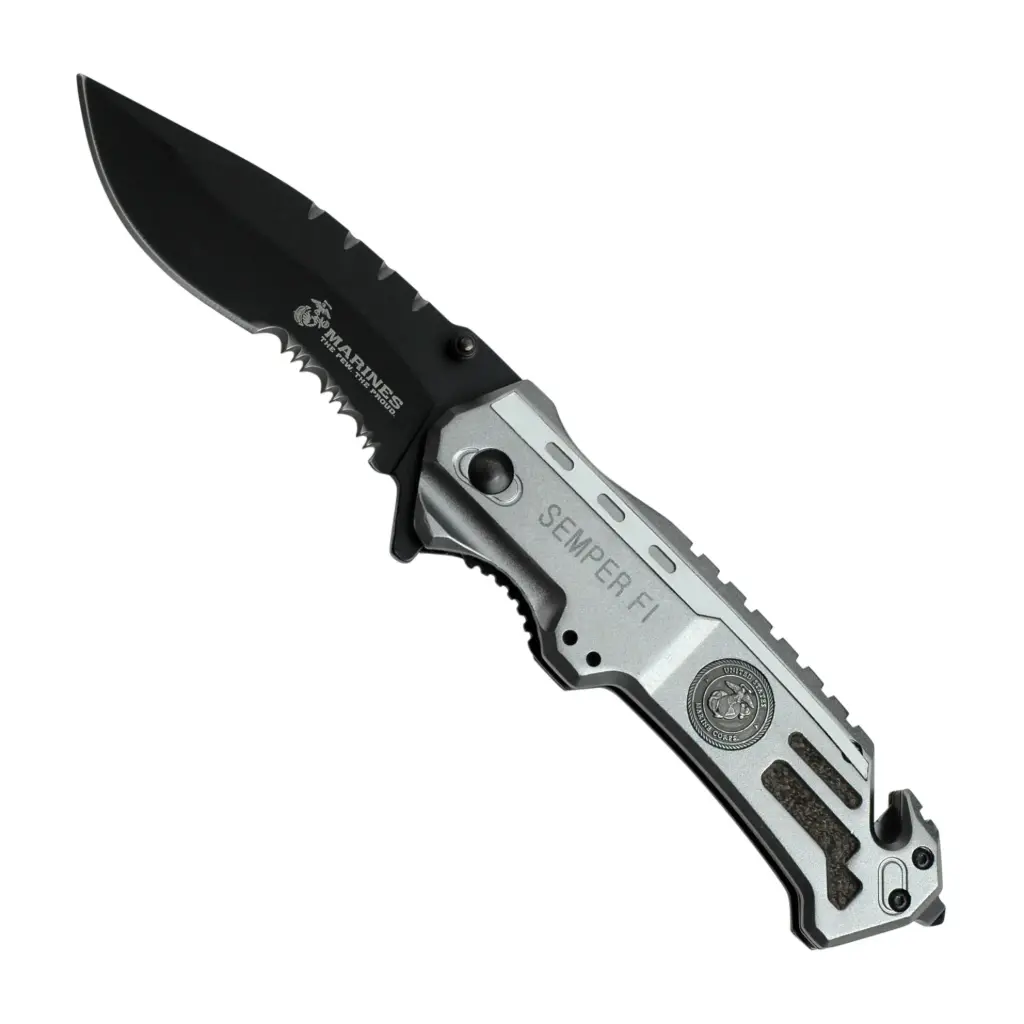
This assisted opening rescue knife is built like backup you can trust. A 440 stainless, partially serrated drop-point blade snaps open with one hand via flipper or thumb stud, ready for cutting through webbing, rope, or daily tasks. The anodized aluminum handle carries a Marine medallion, SEMPER FI engraving, integrated seat belt cutter, and glass breaker. At 8.375 inches open and 6.75 ounces, it balances authority with pocketable comfort—duty-inspired gear for anyone who wants Marine-grade readiness in their everyday carry.
What This Marine Rescue Knife Actually Does
The Semper Ready Marine Rescue Knife - Silver Aluminum is built for the moment when you don’t have time to wonder whether your gear will work. This is a spring-assisted rescue knife with a 440 stainless steel blade, integrated seat belt cutter, and glass breaker, designed to turn chaos into a sequence of simple actions: access, open, cut, and get out. It’s not decorative USMC branding on a cheap folder—it’s a duty-style tool with real-world rescue features.
Why This Assisted Rescue Knife Belongs in Your Everyday Carry
Most people carry a knife for opening boxes and cutting cord. This assisted opening rescue knife adds something extra: it’s built around emergencies. The partially serrated drop-point blade bites through seat belts, nylon, and tough material more aggressively than a plain edge. The dedicated seat belt cutter lets you work in tight spaces near skin without having to expose a full blade. The glass breaker at the butt is there for one job—shattering tempered glass when you don’t have another way out.
At 8.375 inches open and 6.75 ounces, it has enough size and weight to feel solid under stress, but it’s still realistic to carry clipped in a pocket or on a duty belt.
How the Spring-Assisted Mechanism Works Under Stress
This is a spring-assisted opening knife, not a fully automatic. That matters for both reliability and legality. You start the opening with either the flipper tab or thumb stud; once you move the blade a short distance, the internal spring takes over and snaps it into lockup. Under stress, that means:
- One-handed opening: You don’t need two hands or a fancy wrist flick—just find the flipper or stud and press.
- Predictable action: The spring does the same thing every time, which is exactly what you want in an emergency tool.
- Positive lockup: The liner lock engages behind the tang of the blade, giving you a stable cutting platform until you intentionally close it.
The jimping on the spine gives your thumb a positive anchor, so when you bear down on a stubborn strap or heavy material, you’re not sliding forward onto the edge.
Build Quality and Materials You Can Actually Trust
440 Stainless Blade with Real-World Edge Performance
The blade is 440 stainless steel, a workhorse steel that holds an edge respectably and is easy to touch up. For a rescue-style knife, that’s what you want—steel you can resharpen without specialized equipment. The black matte finish cuts glare and adds corrosion resistance, especially important if it rides in a car, on a boat, or on a duty belt in all weather.
The partially serrated edge is a deliberate choice: the plain edge section handles clean cuts on cardboard, tape, or food, while the serrations chew through fibrous materials like seat belts, rope, and webbing more efficiently. In a rescue context, those serrations can save seconds.
Anodized Aluminum Handle with Duty-Grade Features
The handle is anodized aluminum, giving you a rigid, impact-resistant frame without excess weight. The silver and black two-tone finish visually anchors the USMC medallion and SEMPER FI engraving, but the real value is in the ergonomics and tool integration:
- Textured inlay: Provides grip reference even when your hands are wet or gloved.
- Exposed backspacer with jimping: Adds rigidity and additional traction for your palm.
- Pocket clip: Keeps the knife oriented the same way every time you reach for it, which is crucial under stress.
The glass breaker is positioned at the butt of the handle so you can reverse your grip and drive it into side or rear auto glass in a single, decisive motion.
Real-World Rescue and Everyday Carry Use
This Marine rescue knife is at its best in two roles: emergency tool and everyday carry blade.
- Emergency tool: Keep it clipped in a consistent place—driver’s visor, MOLLE panel, duty belt, or inside pocket. In a collision or rollover scenario, the sequence is simple: draw, open with the flipper, cut the belt with the dedicated cutter or blade, then use the glass breaker to exit through a side window if necessary.
- Everyday carry: For daily life, it behaves like a solid assisted opening pocket knife. Boxes, cord, packaging, and general utility tasks are straightforward, and the USMC theme makes it a natural fit for Marines, veterans, supporters, and anyone who respects that ethos of being ready.
The key is consistency: carry it in the same spot, orient it the same way, and practice opening and closing it until it’s automatic. That’s how you turn a good tool into real preparedness.
What People Ask Before Buying a Stun Gun for Protection
How effective are stun guns for self defense?
A stun gun for self defense works by delivering an electrical shock through direct contact, aiming to disrupt muscle control and create a pain response. Its effectiveness depends less on high-voltage marketing numbers and more on current (amperage), contact time, and where you make contact. A well-built stun gun used decisively on large muscle groups for several seconds can create an opportunity to escape. It is not a magic “one-touch knockout” device, and you still need awareness, distance management, and an exit plan.
Does voltage or amperage matter more in a stun gun?
Voltage gets all the marketing attention, but amperage is what actually drives effect in a stun gun for self defense. Voltage is the pressure that pushes electricity across the air gap between the electrodes; you need enough to arc, but anything beyond that is mostly spec-sheet theater. Amperage is the amount of current flowing through the body once contact is made—that’s what determines pain, muscle disruption, and how quickly someone is likely to disengage. When you evaluate the best stun gun for personal protection, look for honest amperage data, solid contact probes, and a reputable build quality instead of chasing “million volt” claims.
Is this stun gun legal to carry in my state?
Stun gun legality varies widely by state and sometimes by city. Some states treat a stun gun for self defense similarly to other defensive tools with minimal restrictions; others require permits, limit where you can carry, or ban certain models outright. Before you buy what you consider the best stun gun to carry, check your state statutes and any local ordinances—search by your state name plus “stun gun laws” and verify from an official government or law enforcement site. Also consider where you’ll actually carry it: workplaces, schools, federal buildings, and aircraft often have stricter rules regardless of state law.
Why Pair a Rescue Knife with a Stun Gun for Personal Protection
If you already carry or are considering a stun gun for personal protection, a rescue knife like this fills a different, complementary role. A stun gun for self defense is focused on human threats at arm’s length; this Marine rescue knife is focused on problem-solving: cutting restraints, freeing yourself or others from seat belts, and breaking glass to escape. In a realistic self-defense or accident scenario, being able to solve the environment problem (trapped in a vehicle, blocked by glass, tangled in webbing) can matter as much as having a deterrent tool.
Think of it as building a small, coherent protection system: the stun gun handles immediate human aggression at contact distance, while this assisted opening rescue knife handles critical tasks that let you move, exit, and assist others.
Carrying with Competence: Turning Gear into a Plan
Preparedness is less about owning a lot of tools and more about knowing exactly what each tool is for and how you’ll use it. This Marine-themed rescue knife gives you a fast-deploying blade, seat belt cutter, and glass breaker in one compact package. Pair that with a carefully chosen stun gun for self defense, and you have both an environmental problem-solver and a dedicated personal protection option.
Pick a consistent carry location, practice drawing and opening the knife until it’s boring, and if you add a stun gun for personal protection, train the same way—safe handling, activation, and deactivation until you can do it under stress. That combination of honest gear and honest practice is what turns everyday carry into real-world readiness.