Shadow Groom Covert Comb Knife - Black
7 sold in last 24 hours
The Shadow Groom Covert Comb Knife looks like a plain matte black comb until you separate the halves. Inside is a rigid 4.25-inch blade form and a skull‑crusher pommel for emergency impact or glass breaking. The ABS construction keeps it light and low‑profile, riding naturally in a pocket, bag, or dopp kit. Use it as a normal fine‑tooth comb day to day; keep it in reserve as a discreet last‑ditch self‑defense option when you’d rather not advertise that you’re carrying anything at all.
What the Shadow Groom Covert Comb Knife Actually Does
The Shadow Groom Covert Comb Knife - Black is built for one thing: giving you a discreet, last‑ditch self‑defense option that lives where a comb belongs. Closed, it looks and behaves like a normal matte black grooming comb. Open, it becomes a rigid, dagger‑style blade form with a skull‑crusher pommel you can drive into bone or glass.
This isn’t a primary fighting knife or a movie prop. It’s a backup edge that hides in plain sight—on a vanity, in a dopp kit, in a pocket organizer or glove box—so you have something with structure and reach if a bad situation finds you when you’re otherwise unarmed.
How This Hidden Comb Knife Works in Practice
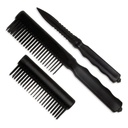
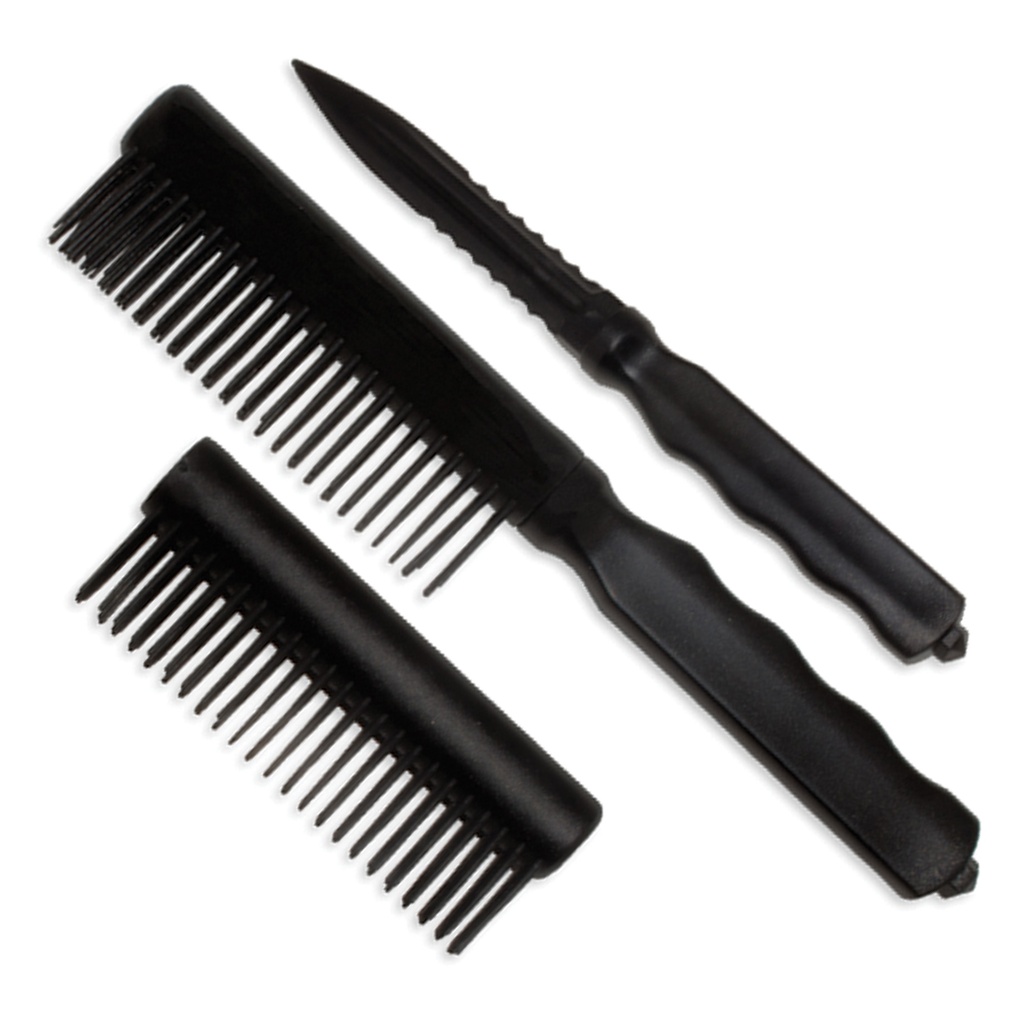
The Shadow Groom breaks down into two parts: the comb sheath and the internal blade handle. To anyone watching, you’re just holding or using a comb. When you separate the halves, the comb section comes away as a cover, revealing a slim, rigid blade form with finger grooves and a pointed pommel.
The internal piece isn’t a delicate letter opener. The ABS body runs the full 6.25-inch length with a 4.25-inch internal blade profile. That gives you enough reach to target bony landmarks (nose, jawline, collarbone, hand) or deliver concentrated strikes with the skull‑crusher.
Build Quality Details That Matter for Self Defense
Rigid ABS Construction and Everyday Camouflage
The matte black ABS shell does two jobs. First, it blends in. It looks like the kind of disposable comb you’d get at a drugstore—nothing shiny, nothing tactical, nothing that screams “weapon.” Second, it keeps everything rigid enough to be useful. A self‑defense tool that flexes and folds under pressure is dead weight; this one keeps its structure under grip and impact.
The fine‑tooth comb section is fully functional. You can actually use it to tidy hair or beard, which is part of the camouflage. The more normal it looks in your daily routine, the less anyone thinks twice about it living in your pocket, bag, or console.
Textured Grip and Skull‑Crusher Pommel
Once the comb sheath is removed, the handle section presents finger grooves and texture. Under adrenaline, fine motor skills go away. You want something your hand can index and clamp around quickly without thinking—this does that better than a slick plastic spike or improvised object.
The pointed skull‑crusher pommel is more than a visual detail. Used correctly, it focuses force into a small area for strikes to bony targets or for emergency glass breaking. In a self‑defense context, that means you don’t have to cut to create pain and disengagement; a hammering grip and repeated strikes with the pommel can be enough to break contact and move.
Carry Reality: Where This Comb Knife Actually Fits
Real self‑defense tools only help if you actually carry them. The Shadow Groom Covert Comb Knife is designed to live where a comb belongs, so it doesn’t compete with your main knife or primary defensive option—it complements them.
- Pants pocket: Rides like a normal comb. Easy to forget it’s there until you need it.
- Backpack or messenger bag: Drops into an organizer pocket, looking like simple grooming gear.
- Dopp kit or gym bag: Fits naturally among toothbrushes, razors, and travel items.
- Vehicle console or door pocket: Looks like something you’d keep for appearances, not protection.
For self defense, that matters. A tool that attracts no attention is easier to keep close in places where overt blades or obvious weapons would draw questions or be left at home.
Using a Hidden Comb Knife as a Self-Defense Tool
If you think of this as a full‑fledged fighting knife, you’ll be disappointed. If you think of it as an emergency problem‑solver when you have nothing else, it makes sense.
- Primary role: Create pain and hesitation so you can escape.
- Targets: Hands reaching for you, face, neck line, or bony areas like shins and collarbone.
- Grip: Either saber grip (thumb on spine) for more control, or hammer grip when space is tight.
- Motion: Short, repeated jabs or hammering strikes rather than big, sweeping cuts.
A self‑defense instructor would describe this as a tertiary option: not your first plan, not a stand‑up fight tool, but something that can make a bigger person let go long enough for you to move. Its real advantage is that it can be present in low‑profile environments where you wouldn’t, or couldn’t, carry anything more obvious.
What People Ask Before Buying a Stun Gun for Protection
How effective are stun guns for self defense?
Stun guns for self defense work by delivering electrical current through direct contact, creating pain, muscle contraction, and sometimes temporary disorientation. Their effectiveness depends less on advertised voltage and more on amperage (current), contact time, and where you apply it—soft tissue and nerve‑rich areas respond more strongly than thick clothing or heavy gear. A stun gun shines as a close‑range tool to break grips and buy space, not as a magic “one touch and they drop” solution. Used with realistic expectations and good targeting, they can be a solid part of a personal protection plan, especially where lethal options aren’t appropriate or allowed.
Does voltage or amperage matter more in a stun gun?
Voltage sells boxes; amperage does the work. Almost every “millions of volts” claim you see is marketing theater. Once you’re above what’s needed to arc across clothing, extra voltage doesn’t suddenly make a stun gun more effective for self defense. What actually matters is current (amperage), how well the probes maintain contact, and how long that contact lasts. A well‑built stun gun with realistic current output and solid construction will outperform a flimsy, “10 million volt” gadget every time. When you’re choosing the best stun gun for personal protection, prioritize build quality, ergonomics, safety switches, and reliable power over the biggest voltage number on the package.
Is this stun gun legal to carry in my state?
Stun gun laws are highly state‑ and sometimes city‑specific. Some states treat stun guns for personal protection as ordinary defensive tools with minimal restrictions; others require permits, restrict carry in certain locations, or ban them entirely. Before you buy or carry any stun gun for self defense, check three levels: state law (often under weapons or electronic control devices), local ordinances for your city or county, and any rules for places you frequent (workplaces, campuses, venues). Laws also change, so verify with current state statutes or an attorney rather than relying on outdated charts. When in doubt, err on the side of conservative carry and documentation.
Legal and Practical Notes for the Shadow Groom Covert Comb Knife
Because this is a concealed blade disguised as a grooming tool, some jurisdictions may treat it differently than a standard pocket knife. That can matter more than overall length alone. Before carrying it as part of your self‑defense kit, check:
- Local knife length limits and whether concealed blades are restricted.
- Rules on disguised or novelty weapons, which some areas regulate separately.
- Specific no‑weapon zones such as schools, government buildings, and certain workplaces.
Legality isn’t just about what you can buy; it’s about what you can lawfully carry and use in your daily environments. Treat this the way you would any concealed defensive tool: know the rules where you live and travel.
Carrying With Purpose: Being Realistically Prepared
The value of the Shadow Groom Covert Comb Knife isn’t in pretending it makes you invincible. Its value is in quiet, realistic preparedness. You get a grooming tool that belongs wherever you carry it—and a small, rigid, controllable edge you can access quickly if you ever need to make someone let go so you can step away.
If you already carry a primary defensive tool, this is a low‑profile backup. If you can’t carry anything obvious due to dress code or environment, it’s a way to keep an option close without advertising it. Combine it with awareness, basic self‑defense training, and an exit plan, and it becomes one more layer in a calm, practical protection strategy.
| Blade Length (inches) | 4.25 |
| Overall Length (inches) | 6.25 |
| Closed Length (inches) | 6.25 |
| Blade Color | Black |
| Handle Finish | Matte |
| Concealed Length (inches) | 6.25 |
| Concealment Type | Comb |