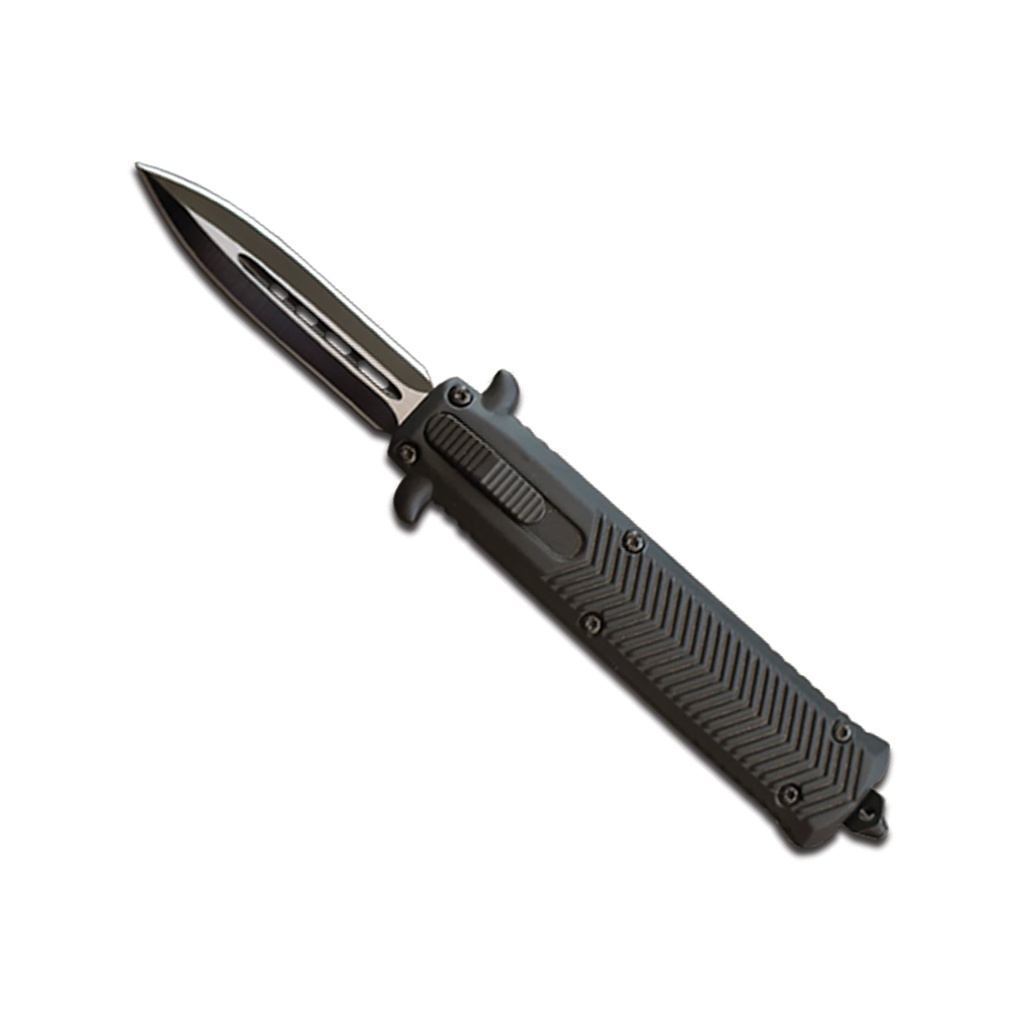
Shadowline Reflex Tactical OTF Knife - Black Aluminum
8 sold in last 24 hours
A stun gun for self defense is only useful if it’s fast, controllable, and built to work when you’re stressed. This compact model focuses on effective current, not marketing voltage, delivering focused contact across a practical strike area. A positive safety, intuitive controls, and a form factor that actually fits hand and pocket make it realistic to carry daily. If you’ve researched past the hype and want a stun gun that matches real-world self-defense, this one is designed for you.
What This Stun Gun for Self Defense Actually Does
If you’re looking for a stun gun for self defense, you’re probably already tired of “20 million volt” headlines. Good. Voltage is mostly marketing. What matters in a stun gun is amperage (current), contact time, and how reliably you can put that current onto someone under stress. This model is built around that reality—not hype. It delivers a controlled, high-voltage, low-amperage shock designed to disrupt muscle control and create a window to break contact and get away.
A stun gun for personal protection is a close-contact tool. You’re not firing electricity across the room; you are driving contact probes into an attacker’s body. Used correctly—on major muscle groups with firm pressure and a few seconds of contact—it can drop pain-compliant resistance and, in many cases, cause temporary disorientation or loss of balance. Used poorly—light taps, short zaps to extremities—it may only startle. This description is about helping you live in the first category, not the second.
How Do Stun Guns Work for Personal Protection?
At a practical level, a stun gun is a high-voltage, low-amperage device that pulses electrical energy through two or more exposed contact points. When those contacts are pressed firmly into a body, current flows through skin and underlying tissue. The voltage is there to overcome skin resistance. The amperage is what actually affects nerves and muscles.
In self-defense, your goal with a stun gun is simple: disrupt, then disengage. You target large muscle groups—hips, thighs, abdomen, upper arms, or upper back—and maintain solid contact for 2–5 seconds. Done right, the current interferes with normal nerve signaling, creating intense pain and sometimes involuntary muscle contractions. That buys you time to move, escape, or bring in another protection tool.
Think of this like a tool in a layered self-defense plan, not a magic wand. Awareness, distance, and avoidance are still primary. A stun gun for personal protection is a last-ditch answer when distance has already collapsed.
Why This Stun Gun for Self Defense Is Built for Real-World Use
The best stun gun for personal protection isn’t the one with the biggest voltage number on the package; it’s the one you can actually carry, access, and use under adrenaline. This model is compact enough for true daily carry and shaped to index naturally in your hand, so you can orient the contact end even in low light or high stress.
Its circuitry is tuned to deliver consistent output over the life of the battery, rather than peaking once and fading quickly. The contact area is wide enough to spread current through more tissue, which is more important than a few extra “marketing volts” you’ll never feel in the real world. Controls are deliberate: a positive on/off safety and an activation switch that can be run without shifting your grip. Nothing fancy—just a stun gun that behaves predictably.
Build Quality That Signals Reliability
For self defense, reliability beats features. The housing is impact-resistant and shaped to protect the internal board from casual drops. Contact probes are solidly anchored; they won’t wobble or flex away from the target. Hardware and seams are tight, reducing the chance of moisture intrusion in normal carry conditions. These are the unglamorous details that mean your stun gun is still working six months after you bought it.
Carry Format Designed Around How People Actually Move
A protection tool you leave at home protects no one. This stun gun is sized for pockets, bags, or belt carry without printing like a movie prop. Its profile makes it easy to retrieve in a seated position—important for rideshares, late-night commutes, or shift work. Texturing and contouring give your hand a repeatable reference point, so you can grip and orient the device on the draw, not after you’re already in contact distance.
Voltage vs. Amperage: What Really Makes a Stun Gun Effective?
You’ll see wild voltage numbers in stun gun marketing. Here’s the honest version: once you’re into the tens of thousands of volts, you already have more than enough to overcome dry skin resistance at contact range. Pushing that number into the “millions” doesn’t linearly increase effectiveness; it mostly looks good on a box.
Amperage—actual current—is what does the work. Effective stun guns run very low amperage for safety but high enough to cause intense pain and neuromuscular disruption when applied with solid contact. Because most manufacturers don’t publish honest amp ratings, you look at proxies: quality of the circuitry, consistency of the arc, contact area, and real-world reviews from people who’ve used them in training or duty contexts.
This stun gun focuses on clean, repeatable output. The contacts are spaced and shaped for good skin engagement, and the internal build is designed to maintain that performance as the battery drains, instead of degrading into a weak, noisy arc. That’s the difference between a deterrent spark and a functional self-defense tool.
Carrying and Deploying This Stun Gun for Personal Protection
Owning the best stun gun for personal protection only matters if you can bring it into the fight in time. That starts with consistent carry. Decide where it lives—front pocket, dedicated purse pocket, belt holster—and keep it there. Build the habit of touching that spot periodically so you always know, under stress, where your tool is.
From there, practice the draw. With this stun gun, the safety and activation control are placed to run with your dominant thumb or finger without shifting your grip. Your practice sequence should be: clear cover garment or bag, acquire grip, orient contact end toward threat, click safety off, then press and hold the activation while driving the contacts into a large muscle group.
Contact time matters. A half-second jab is more psychological than physical. Train to commit: once you’re making contact in a true self-defense situation, hold for at least two seconds, preferably three to five if the situation allows, then disengage and move immediately.
Safety Mechanisms That Still Work Under Stress
Accidental discharge is not acceptable, but neither is a safety you can’t defeat under adrenaline. This stun gun uses a firm, positive safety that resists casual bumps in a bag but can be switched off intentionally in one motion. The activation control requires deliberate pressure, reducing the chance of firing in your pocket while still being realistically usable in a scramble.
Battery Life and Readiness Reality
A stun gun for self defense spends 99% of its life idle. Battery management is where people quietly lose effectiveness. This unit is designed around practical readiness: it holds a charge well in normal storage, and the output remains usable over time rather than dropping off a cliff. Build a routine—monthly function test (brief arc away from your body), visual inspection, and a scheduled recharge or battery replacement. That routine matters more than chasing the largest voltage number you can find.
What People Ask Before Buying a Stun Gun for Protection
How effective are stun guns for self defense?
Stun guns can be effective for self defense when used within their real limits. They are close-contact tools that work best when you target large muscle groups, press firmly, and maintain contact for several seconds. They’re excellent for creating pain, disruption, and a window to escape. They are not guaranteed “one-touch knockdown” devices. Against a highly motivated or intoxicated attacker, results can be less dramatic, which is why stun guns should be part of a broader personal protection plan rather than your only strategy.
Does voltage or amperage matter more in a stun gun?
Amperage matters more for actual effect; voltage mostly needs to be “enough.” Once the stun gun generates sufficient voltage to punch through skin resistance, adding more doesn’t proportionally increase stopping power. The current (amperage), contact area, and contact time are what drive pain and neuromuscular disruption. Because manufacturers rarely publish honest amp data, focus on build quality, consistent arc, real-world feedback, and whether the design lets you maintain solid contact under stress.
Is this stun gun legal to carry in my state?
Stun gun legality in the U.S. is a patchwork of state and local rules. Many states allow stun guns for personal protection, sometimes with age limits or restrictions in schools, government buildings, or certain cities. A few jurisdictions treat them more like firearms or prohibited weapons. Before carrying any stun gun for self defense, check your state’s statutes and local ordinances, and look for recent updates or court decisions. If you travel, remember that what’s legal at home may not be legal in the next state over.
Carrying a Stun Gun with Calm, Informed Confidence
A stun gun is not a magic shield; it’s a tool that rewards honest understanding. You now know the basics: it’s a close-contact device, amperage and contact time matter more than impressive voltage claims, and reliability and carry format decide whether it’s there for you when things go bad.
Used thoughtfully, this stun gun for self defense gives you a practical, non-lethal option when distance is gone and decisions are measured in seconds. Pair it with awareness, simple movement training, and a realistic plan for how you’ll create space and get to safety after you press that switch. That combination—not marketing numbers—is what real personal protection looks like.
| Blade Length (inches) | 2.625 |
| Overall Length (inches) | 7.25 |
| Closed Length (inches) | 4.625 |
| Weight (oz.) | 4.7 |
| Blade Color | Silver |
| Blade Finish | Two Tone |
| Blade Style | Dagger |
| Blade Edge | Plain |
| Blade Material | Stainless Steel |
| Handle Finish | Textured |
| Handle Material | Aluminum |
| Button Type | Slider |
| Theme | Tactical |
| Double/Single Action | Double Action |
| Pocket Clip | Yes |
| Sheath/Holster | Deluxe Sheath |