Shinobi Lineage Combat Sai Set - Black Leather
14 sold in last 24 hours
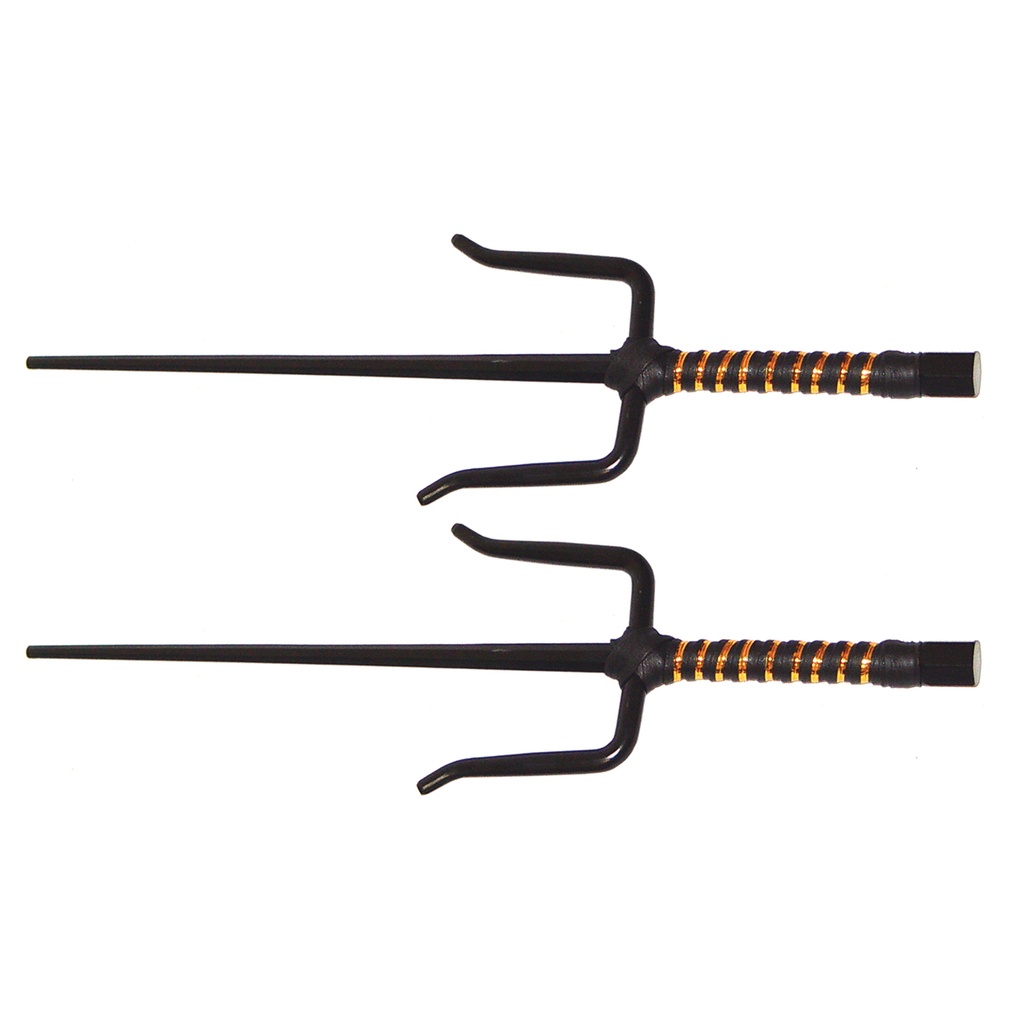
The Shinobi Heritage Sai Pair channels classic Okinawan lines through a modern, blacked‑out silhouette. Each 19.5-inch all‑metal sai balances cleanly in the hand, with a leather‑wrapped grip and gold‑tone bands that lock into your palm and catch the light on display. The compact side prongs and tapered central tine make this set equally at home in a dojo rack or collector’s case—minimalist, focused, and ready for traditional forms or modern kata work.
What the Shinobi Heritage Sai Pair Actually Is
The Shinobi Heritage Sai Pair - Black Leather is a traditional Okinawan sai set, updated with a modern, blacked‑out finish for martial artists and collectors who care about balance, feel, and control. At 19.5 inches each, these are full‑size metal sai designed for kata, drilling, and display—not casual cosplay toys and not sharpened blades. They give you the authentic three‑prong form, solid weight, and wrapped grip you expect from a serious practice or demonstration weapon.
Design Breakdown: Traditional Sai Form with Modern Black Finish
These are classic three‑prong sai: a straight central tine with a tapered tip, flanked by two curved side prongs that angle slightly outward. The all‑metal construction gives consistent weight from pommel to tip, so spins, blocks, and transitions feel predictable. The modern black finish keeps reflections down and visually leans into the shinobi aesthetic, while the gold‑tone bands over the black leather grip add a subtle focal point that looks clean on a rack or wall mount.
Leather-Wrapped Grip for Secure Handling
The handle is wrapped in black leather, then finished with gold‑tone spiral bands. In use, that wrap matters more than looks: it gives traction for sweaty hands in a dojo setting and a bit of cushion when you’re drilling longer sessions. The wrap also helps you index your grip quickly—your hand finds the same placement each time you pick up the sai, which is essential for consistent form.
Balanced for Kata, Drills, and Demonstration
At 19.5 inches, this sai pair sits in the traditional length range, giving you enough reach for extended techniques without feeling unwieldy. Because the set is all metal, balance is predictable from piece to piece. That symmetry is useful if you’re training paired patterns, switching hands, or working with mirrored kata, and it also makes the pair read cleanly and professionally in demos or photo and video work.
How These Sai Are Used in Training and Practice
Sai are impact and control weapons, not cutting weapons. The Shinobi Heritage Sai Pair follows that lineage. The central prong is blunt and tapered, built for thrusting into practice targets, striking padded surfaces, and learning traditional applications without edge management. The side prongs are shaped for trapping and redirecting—ideal if you’re practicing traditional bunkai or working weapon‑against‑weapon drills under supervision.
If you train in kobudo or a style that integrates classical weapons, this sai pair is suited for:
- Kata practice: Working through established forms with consistent weight and length.
- Blocking and trapping drills: Using the side prongs to catch and control simulated strikes.
- Demonstrations: The black finish and gold accents read clearly from a distance.
- Display: As a collector’s or dojo wall piece that still feels like a working tool.
Build Quality That Matters in Real Use
For a practice or display sai set, reliability is less about electronics or edge retention and more about structural integrity and feel. This pair uses an all‑metal construction with a continuous central shaft from pommel to tip, which is what you want for impact training. There are no folding parts, no hinges to loosen, and no gimmicks—just a straightforward, rigid build designed to survive repeated handling and controlled practice strikes.
All-Metal Construction and Faceted Pommel
The full metal build gives the sai a solid, predictable weight and reduces flex under load. The faceted pommel caps not only finish the design visually, they also provide a firm end point for reverse grips, spinning techniques, and traditional flipping motions. You’re not fighting a hollow or toy‑like feel; each piece feels like a unified tool.
Modern Black Finish for Stealth and Display
The modern black coating serves two practical roles. First, it cuts glare under bright dojo lights or in outdoor demos, so your focus stays on technique rather than reflection. Second, it emphasizes the form of the weapon rather than flashy shine, which helps instructors and observers see alignment, angles, and posture more clearly while you work through forms.
Carry, Storage, and Training Context
Unlike a compact self‑defense item, a full‑length sai pair is not something you drop into a pocket. These are typically transported in a gear bag, weapons case, or carried by hand between home and training space. If you’re a student, that means planning how you’ll bring them to class—usually wrapped, sheathed, or in a dedicated weapons bag to avoid damage and unwanted attention.
For display, the all‑black metal and gold accents work well on:
- Wall racks: Horizontal or angled mounts show off the symmetry and grip detailing.
- Dojo displays: As part of a traditional weapons collection that still looks modern.
- Collector shelves or cases: The subdued black finish pairs easily with other pieces.
What People Ask Before Buying a Stun Gun for Protection
Even though this product is a sai pair and not a stun gun for self defense, many buyers researching martial arts weapons also explore non‑lethal protection tools. The following answers address common stun gun protection questions so you can make informed choices across your whole self‑defense setup.
How effective are stun guns for self defense?
A stun gun for self defense is a close‑contact tool, not a magic off‑switch. Its effectiveness depends on three things: where you make contact, how long you maintain that contact, and the device’s amperage output. A good stun gun can cause pain, muscle contraction, and a disruption in someone’s ability to continue an attack—but only if you can reach them and stay connected for a few seconds. It works best as part of a broader protection plan that includes awareness, distance management, and basic movement skills, not as your only line of defense.
Does voltage or amperage matter more in a stun gun?
Voltage is what arcs through the air; amperage is what actually does work in the body. Those “millions of volts” claims are mostly marketing. Once voltage is high enough to jump a small gap, more voltage doesn’t translate to more real‑world stopping power. For a stun gun for self defense, amperage, contact time, and contact area are what matter. A well‑designed unit with moderate voltage and solid current, driven by a reliable power source and good electrode design, is more useful than a cheap “10 million volt” device with weak internals.
Is this stun gun legal to carry in my state?
Stun gun and conducted energy weapon laws vary widely by state and sometimes by city. Some places treat a stun gun for self defense like any other personal protection tool, while others restrict sales, carry, or where you can bring it (schools, government buildings, certain events). Before you buy or carry, check your state statutes and local ordinances, and look for terms like “electronic control device,” “stun gun,” or “Taser‑type device.” When in doubt, confirm with up‑to‑date legal resources or local authorities so your protection plan doesn’t accidentally put you on the wrong side of the law.
Practical Empowerment: Choosing and Using Your Training Tools
The Shinobi Heritage Sai Pair - Black Leather is for the buyer who wants a traditional sai set that feels honest in the hand—solid, balanced, and built for real practice or serious display. It doesn’t pretend to be a self‑defense shortcut, and it doesn’t hide behind gimmicks. Paired with accurate knowledge about how actual protection tools like a stun gun for self defense really work, it lets you separate training, collection, and personal protection into clear lanes.
That clarity is the point: train with purpose, carry with understanding, and choose each tool—whether it’s a classic sai or the best stun gun for personal protection—for what it actually does, not what the marketing promises. When you do that, your gear becomes part of a calm, informed protection plan instead of a box of hopeful guesses.