Spectral Control Rapid-Deploy EDC Knife - Purple
5 sold in last 24 hours
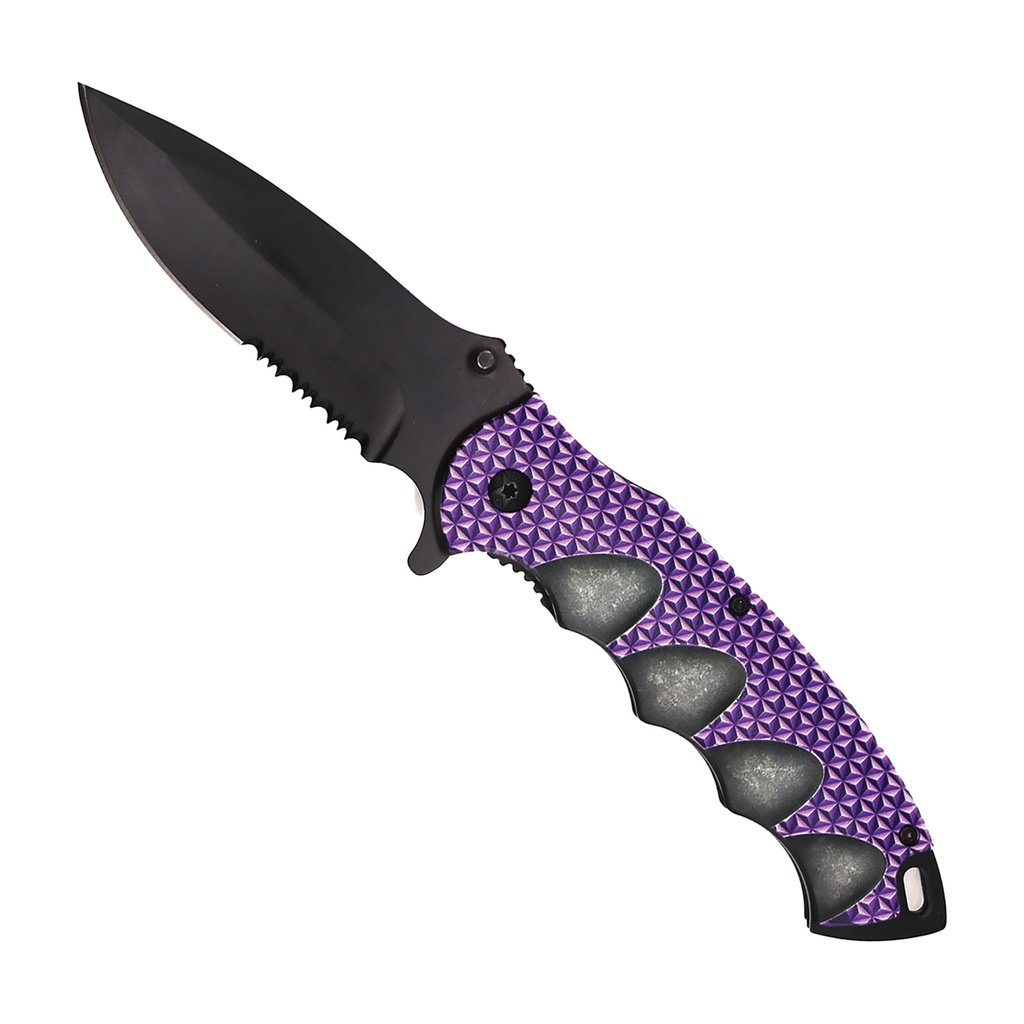
This assisted opening knife is built like good self-defense gear should be: quick, predictable, and secure in the hand. The 3D-textured purple ABS handle locks into your grip, while the 3.5-inch black stainless blade combines a slicing edge with practical serrations for strap and cord. Spring-assisted deployment, flipper and thumb stud options, and a liner lock give you fast access with confident lockup. It’s a modern, tactical-leaning EDC companion that carries light, rides deep, and works when you actually need it.
What This Knife Actually Does for Everyday Protection
This is a spring-assisted EDC knife designed for the same reality you’d buy a stun gun for self defense to handle: late walks to the car, night shifts, and the odd situation that just doesn’t feel right. It isn’t a magic shield, just like a stun gun isn’t—but it is a fast-deploying cutting tool that stays in your hand, opens predictably, and cuts cleanly when you need it to.
Think of it as one part of a practical personal protection setup. Where a stun gun for personal protection focuses on close-contact electrical disruption, this knife focuses on controlled cutting, utility, and confident handling. The design choices—blade shape, serrations, textured grip, spring assist—are all there to make it usable under stress, not just attractive in photos.
How This Quick-Start Design Compares to a Stun Gun for Self Defense
People researching the best stun gun for personal protection are usually asking the same underlying question: “What can I carry that actually helps when things go bad?” They’re tired of seeing “10 million volts” plastered everywhere with no explanation. The same skepticism should apply to knives. Ignore the hype. Focus on deployment, control, and reliability.
With a stun gun for self defense, what matters is amperage (current), contact time, and whether you can maintain a grip long enough to do anything. With this knife, what matters is whether you can get it open fast, keep it in your hand, and make deliberate cuts instead of fumbling.
- Spring-assisted deployment: Reduces the fine-motor skill demand when your hands are shaking.
- 3D-textured handle: Gives you friction and indexing so you know where the blade is pointing without looking.
- Partial serrations: Bite into strap, cord, or clothing where a plain edge might slide.
The honest parallel to a stun gun for personal protection is this: both tools are only as effective as your ability to bring them into play quickly and control them under stress. This knife is built to support that reality.
How Stun Guns Actually Work (And Why Voltage Claims Are Mostly Noise)
If you’re comparing this knife with a stun gun for self defense, you deserve accurate information about how stun guns work. The loudest marketing is usually the least useful—especially when it comes to voltage numbers.
A stun gun sends a high-voltage, low-amperage electrical charge across two or more contact points. The voltage is mostly there to jump the gap through clothing and skin oils. The amperage—the current—is what actually affects muscle and nerve function. It takes surprisingly little current, properly delivered, to disrupt someone’s ability to coordinate movement.
Three things determine whether a stun gun for personal protection will help you:
- Amperage and contact area: More honest current and solid contact points beat any “million volt” headline.
- Contact time: A brief zap is mostly pain and startle. Several seconds of continuous contact is where you see real muscular disruption.
- Positioning: Targeting large muscle groups (hips, thighs, torso) is more effective than poking randomly at limbs.
A practical buyer should treat voltage like marketing theater. When choosing the best stun gun for personal protection, look for honest amperage specs, a sturdy body, a grip you can actually hold under stress, and controls that you can operate in the dark. The same logic applies to this knife: ignore flash, care about function.
Why This Knife Works as a Real-World Carry Tool
Whether your main tool is a stun gun for self defense or a blade, your everyday carry lives or dies by how often you actually keep it on you. This knife is built to be carried—not worshipped in a drawer.
Build Quality You Can Feel
- 3.5-inch matte black stainless blade: Long enough for real work, compact enough for pocket carry.
- Drop point profile: A versatile shape that handles piercing, slicing, and controlled cuts without being fragile.
- Partial serrations: Give you aggressive cutting on webbing, rope, or zip ties while leaving a clean plain edge toward the tip.
- Liner lock mechanism: A proven, simple lock style that gives a solid click into place so you know it’s secure.
Carry Format and Deployment Under Stress
- Pocket clip: Keeps the knife in a consistent orientation so you can find it by feel, just like you’d stage a stun gun for personal protection in a specific pocket or holster.
- Spring-assisted opening: The blade wants to open once you nudge it, which matters when adrenaline steals your fine motor skills.
- Flipper tab and thumb stud: Two opening options mean you’re not stuck if one grip feels awkward in a tight space.
- Finger grooves and 3D texture: The handle is shaped to lock into your hand, decreasing the chance of slipping forward onto the blade.
In the same way you’d choose the best stun gun to carry based on control placement and grip texture, you choose a knife like this because it feels predictable. Under stress, “predictable” beats “impressive” every time.
Integrating a Knife with Stun Gun Personal Protection
Most self-defense professionals will tell you the same thing: gear is an extension of awareness, not a replacement. A stun gun for self defense, a knife, and basic verbal boundary skills together give you options across distance and context.
This knife fits into that layered approach:
- Utility first: Daily tasks—opening boxes, cutting rope, trimming material—build familiarity so you’re not learning the tool for the first time in a crisis.
- Backup tool: If your primary is a stun gun for personal protection, a knife gives you a non-electronic, non-battery-dependent option that still cuts seatbelts, clothing, or binding materials.
- Non-theatrical profile: The purple handle and modern styling read more like modern EDC than overtly aggressive hardware, which can matter in workplace or urban environments.
Nothing here is about bravado. It’s about calmly building a small set of tools that are easy to carry, reliable when you need them, and understood well enough that you won’t fumble in the dark.
What People Ask Before Buying a Stun Gun for Protection
How effective are stun guns for self defense?
Stun guns can be effective as close-contact disruption tools when used correctly. They don’t knock people across the room—that’s movie physics. In reality, a solid stun gun for self defense can cause intense pain, muscular disruption, and a break in the attacker’s momentum if you:
- Maintain firm contact for several seconds on a large muscle group.
- Have a secure grip so the device doesn’t get stripped from your hand.
- Pair the tool with basic movement—angle off, create distance, and leave.
Think of a stun gun for personal protection as a tool that buys you a window to escape, not a guarantee that someone will instantly collapse.
Does voltage or amperage matter more in a stun gun?
Amperage matters more. Voltage gets the marketing headlines, but in a real stun gun for self defense, voltage mainly helps the current arc through clothing and skin. The current—measured in amps or milliamp ranges—is what affects nerves and muscles.
When you’re choosing the best stun gun for personal protection, prioritize:
- Honest amperage specs over inflated “million volt” numbers.
- Quality contacts and solid construction so the current actually gets delivered.
- A grip and safety switch layout you can manage without looking.
This is the same mindset you use choosing a knife: ignore overblown claims, look at build, ergonomics, and real-world usability.
Is this stun gun legal to carry in my state?
Stun gun legality is highly state- and sometimes city-specific. Some areas treat a stun gun for personal protection as an allowed defensive tool with age restrictions; others require permits, or restrict carry in certain locations like schools or government buildings. A few municipalities still ban civilian stun guns outright.
Before you buy the best stun gun to carry for your situation, check:
- Your state statutes on “electronic control devices” or “stun guns.”
- Local city or county ordinances—large cities often add their own rules.
- Any workplace or campus policies if you’ll be carrying there.
The same legal-awareness habit should apply to knives: know your local blade-length limits, concealed carry rules, and any restrictions on assisted-opening mechanisms.
Carrying With Competence: Putting It All Together
Whether you ultimately choose a stun gun for self defense, this rapid-deploy EDC knife, or both, the goal is the same: calm, informed readiness. No bravado, no panic—just tools you understand and can access quickly.
This knife earns a place in that setup by being:
- Fast to deploy without complicated mechanics.
- Secure in hand thanks to its geometric texture and finger grooves.
- Useful every day, which keeps your familiarity high.
Layer it with a well-chosen stun gun for personal protection, some basic situational awareness, and a simple plan—where you park, how you walk, who you call—and you’ve moved from hoping you’ll be safe to taking practical, specific steps toward it.
| Blade Length (inches) | 3.5 |
| Overall Length (inches) | 8.5 |
| Closed Length (inches) | 5 |
| Blade Color | Black |
| Blade Finish | Matte |
| Blade Style | Drop Point |
| Blade Edge | Partial-Serrated |
| Blade Material | Stainless Steel |
| Handle Material | ABS |
| Theme | Futuristic |
| Pocket Clip | Yes |
| Deployment Method | Spring-assisted |
| Lock Type | Liner lock |