Tactical Vortex Push-Button EDC Knife - Blue Damascus Black
10 sold in last 24 hours
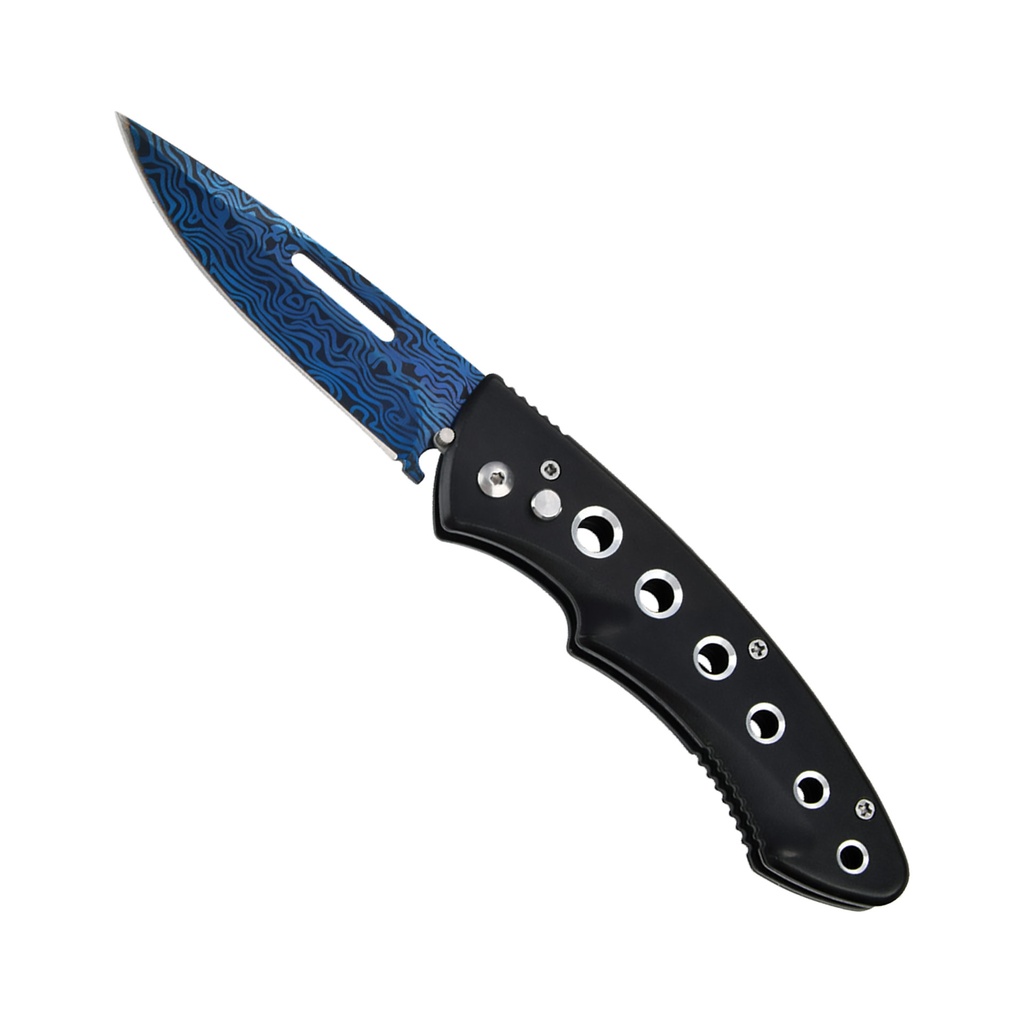
The Tactical Vortex Push-Button EDC Knife pairs a blue Damascus-style drop point blade with a stripped-down black aluminum handle for a modern tactical look that actually works. At 8 inches overall with a 3.25-inch plain edge, it balances pocket carry with real cutting utility. Push-button automatic deployment and a top safety give you fast action with controlled handling, while the circular cutouts and jimping keep weight manageable and grip secure for everyday use.
What This Automatic Knife Actually Does For Everyday Carry
The Tactical Vortex Push-Button EDC Knife is built as a working automatic knife first and a display piece second. The blue Damascus-style blade draws attention, but underneath the pattern you still get a practical drop point profile, a plain cutting edge, and fast, repeatable push-button deployment. This is an automatic you can actually carry, open one-handed, and put to work without babying it.
Automatic Knife Design Built Around Real Use
From a practical standpoint, this knife lives in the space between tactical style and everyday utility. Closed, it’s compact enough at 4.75 inches to disappear in a pocket. Open, the 3.25-inch blade gives you enough reach for box duty, cord cutting, light camp tasks, and general daily use without feeling overbuilt or awkward.
The push-button automatic mechanism lets you deploy the blade with a single deliberate press. That matters more than showy marketing: under stress or with gloves on, a clear, consistent activation point is what keeps an automatic knife usable. The top-mounted safety lets you lock the button out when you drop it into a pocket or bag so it stays secure in carry and only fires when you intend it to.
Blade Profile: Drop Point Damascus-Style Steel That Actually Cuts
The centerpiece is the blue Damascus-style etched blade. The patterning is what you see first, but the underlying geometry is what makes it a solid EDC blade. A drop point profile means a strong tip, a useful belly for slicing, and a straight section for controlled push cuts.
The plain edge is intentionally simple: easier to sharpen, easier to maintain, and more predictable in daily cutting tasks than an aggressive serration pattern. Steel construction and a consistent grind give you a cutting edge that holds up to cardboard, plastic straps, and light utility without needing constant touch-ups. The elongated oval cutout in the blade is cosmetic here more than functional (the button does the work), but it does reduce a bit of weight forward of the pivot.
Practical Blade Length for Pocket and Work
At 3.25 inches, the blade lands in the practical middle ground for an everyday carry automatic knife. Long enough to give you reach and leverage; short enough to ride comfortably in most pockets and to stay within common size limits in many jurisdictions where automatics are allowed. It makes more sense for real EDC than oversized statement pieces that rarely leave a drawer.
Handle, Ergonomics, and Everyday Control
The handle is matte black aluminum with a series of circular cutouts that do two real things: they reduce weight and they give your fingers reference points when you grip the knife. The overall curve of the handle lets it sit naturally in the hand, so you get a secure hold without needing an aggressive, hand-shredding texture.
Silver hardware stands out visually but also signals how the knife is put together: conventional screw construction means it can be tightened, cleaned, and maintained instead of being a sealed throwaway. Jimping along the spine near the handle gives your thumb a traction point for controlled cuts, and additional jimping at the butt improves grip when drawing or adjusting in hand.
Safety Switch and Button Layout for Confident Carry
The button is placed where your thumb naturally lands, which matters when you’re not looking at the knife. The top-mounted safety can be flicked on or off with the same hand you’re holding the knife in, giving you a simple sequence: draw, thumb off the safety, press the button, and you’re cutting. That combination of deliberate safety and straightforward deployment is what makes this automatic comfortable to carry daily instead of just occasionally.
Pocket Clip and Carry Format
A pocket clip anchors the knife in a consistent position so you know exactly where it sits when you reach for it. For most people, that’s front-pocket carry, clipped to the seam; for others, it might live in a work apron or bag organizer. The 4.09-ounce weight is substantial enough to feel solid but not so heavy that it drags a pocket down. The flat sides and rounded edges reduce printing and snagging on fabric.
Build Quality and Reliability Where It Counts
An automatic knife is only useful if it fires cleanly and locks up solid every time. The Tactical Vortex Push-Button EDC Knife uses a spring-driven mechanism paired with a conventional pivot, giving it a crisp, decisive opening when you press the button. The lockup is designed to feel positive, so you aren’t wondering if the blade is fully engaged during a cut.
Aluminum handles keep the frame rigid without excess bulk, and steel hardware keeps the pivot and body screws threaded securely. That means less flex in the handle under load, fewer alignment issues at the blade, and more consistent deployment over time. For someone actually carrying the knife, that mechanical consistency is far more important than any cosmetic flourish.
Where an Automatic Knife Fits in Everyday Preparedness
This knife is not a stun gun or an electrical self-defense tool; it’s a mechanical daily-carry blade meant for cutting, opening, and utility tasks. For many people, a reliable automatic knife is part of a broader preparedness setup: it handles the day-to-day cutting jobs while other dedicated tools (flashlight, first-aid kit, or a lawful self-defense device) fill their own roles.
If you’re used to manual folders, the main difference with this automatic is how quickly it transitions from pocket to ready. That speed is most useful when your other hand is occupied, when you’re wearing gloves, or when you work in conditions where fumbling with a thumb stud or nail nick is less than ideal.
What People Ask Before Buying a Stun Gun for Protection
Even though this product is an automatic knife, many buyers shopping for personal protection gear also research stun guns and other non-lethal options. These are the core questions they usually ask when evaluating a stun gun for self defense, and the same practical, hype-free mindset you’d use choosing this knife applies there as well.
How effective are stun guns for self defense?
A stun gun for self defense can be effective as a close-contact disruption tool, not a magic "fight stopper." It works by delivering electrical current through probes or contact points into muscle and nerve tissue, causing pain and sometimes temporary loss of muscular control. In real use, effectiveness depends on three things: placement (reaching major muscle groups or sensitive areas), contact time (often several continuous seconds), and the amperage and circuit design, not just a large voltage number on the package. They are best seen as part of a layered personal protection plan, not the only answer.
Does voltage or amperage matter more in a stun gun?
Voltage gets the marketing headlines, but amperage and circuit design are what matter more in a stun gun. Voltage is essentially the pressure that helps the current jump a gap or pass through clothing; once contact is made, it’s the current (amperage), contact area, and how long you maintain contact that determine how much the stun gun disrupts muscle and nerve function. Extremely high "million volt" claims are mostly theater; look instead for a reputable manufacturer, a solid contact design, and realistic guidance on how to use the device effectively.
Is this stun gun legal to carry in my state?
Stun gun legality in the United States is highly state- and city-specific. Some states generally allow stun guns for personal protection with few restrictions; others require permits, limit where they can be carried, or ban them in certain jurisdictions or for certain individuals. Before buying any stun gun for self defense, check your state statutes and, if you live in a large city, local ordinances as well. The same applies to automatic knives like this one: understand blade length rules, automatic knife regulations, and any location-based restrictions where you live and work.
Carrying With Competence: Knife Today, Options Tomorrow
If you’re building out a practical personal protection and preparedness setup, this automatic knife fills the cutting-tool role with a good balance of reliability, one-handed deployment, and pocketable size. The blue Damascus-style finish gives it character, but the real value lies in the mechanics: consistent push-button action, a usable blade geometry, a safety you can trust, and a carry format that disappears until you need it.
Apply the same clear-eyed, data-first thinking you’d use to choose a stun gun for protection: ignore marketing flash, focus on function, and choose gear you can carry comfortably and operate under stress. That’s how you end up not just owning tools, but actually being prepared to use them.
| Blade Length (inches) | 3.25 |
| Overall Length (inches) | 8 |
| Closed Length (inches) | 4.75 |
| Weight (oz.) | 4.09 |
| Blade Color | Blue |
| Blade Finish | Etch |
| Blade Style | Drop Point |
| Blade Edge | Plain |
| Blade Material | Steel |
| Handle Finish | Matte |
| Handle Material | Aluminum |
| Button Type | Button |
| Theme | Blue Damascus |
| Safety | Safety Switch |
| Pocket Clip | Yes |