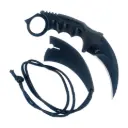
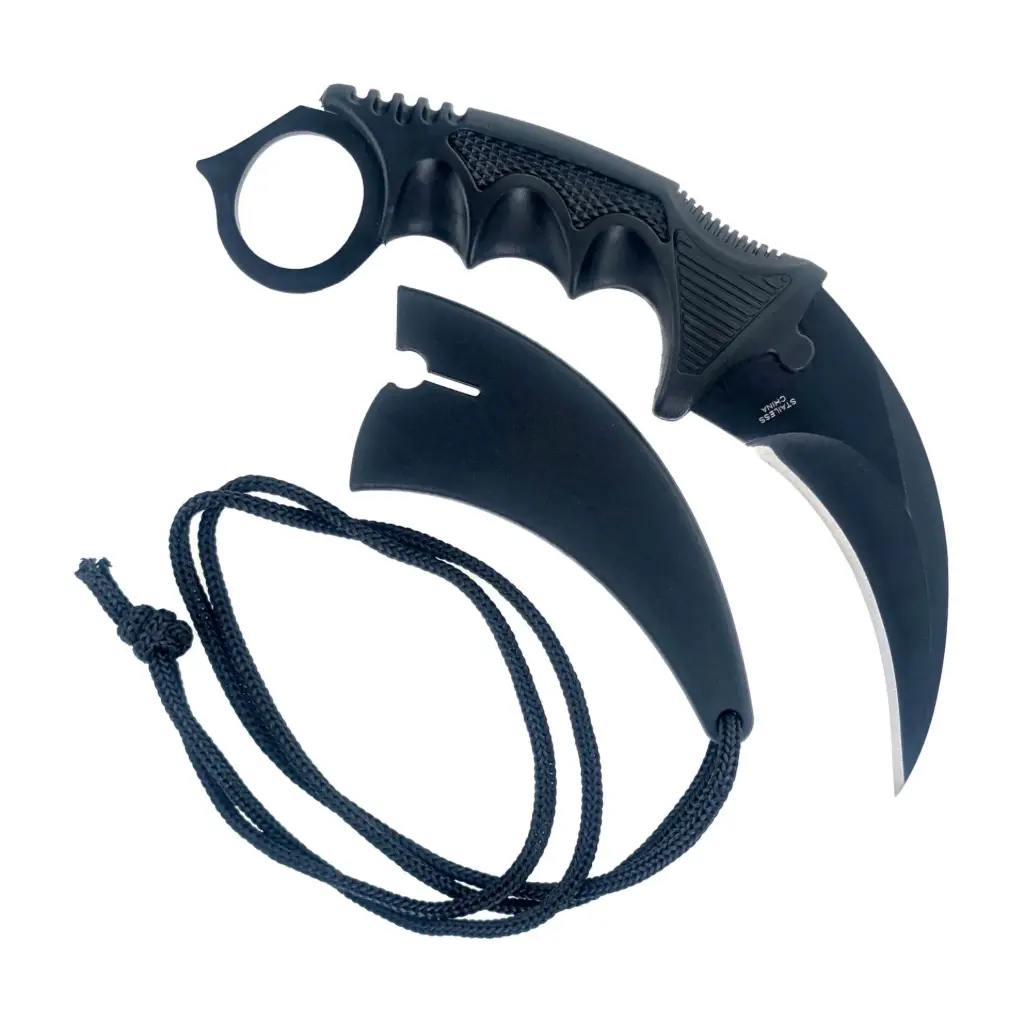
Midnight Talon Ring-Retention Karambit Neck Knife - Black
3 sold in last 24 hours
This karambit neck knife is built for low-profile control, not show. The ring-retention handle locks your grip, while the curved talon blade bites through cord, packaging, and light materials with minimal effort. Lightweight and flat, it rides in a hard sheath on a neck lanyard so it’s always where you expect it. Textured scales and jimping give you traction even with wet hands. Compact, predictable, and easy to index by feel—this is a knife you wear, not bury in a pocket.
What This Karambit Neck Knife Actually Does for You
The Midnight Talon Ring-Retention Karambit Neck Knife - Black is built for one thing: controlled, repeatable cutting from a position you can access under stress. It’s not a movie prop or a fantasy blade. It’s a compact, fixed karambit you wear around your neck so it’s in the same place every time you reach for it.
The hawkbill-style blade gives you bite and draw-cut power on cord, packaging, strap, or light materials. The finger ring anchors your grip so you’re less likely to drop it if your hands are wet, cold, or shaking. It’s a simple, purpose-driven tool designed for people who want predictable access and solid retention in a very small footprint.
How a Karambit Neck Knife Works in Real Use
A karambit is defined by three features: the curved “talon” blade, the finger ring, and an ergonomics-first handle that favors hooking and pulling cuts over long slicing strokes. This neck knife keeps all three in a compact, fixed-blade format with a rigid sheath and lanyard.
Instead of living loose in a pocket or bag, it hangs at the centerline, under a shirt or light layer. That means:
- You always know where it is, regardless of what pants, belt, or bag you’re using.
- You can index it by feel through clothing, then draw it along the same path every time.
- The sheath provides positive retention so it doesn’t slip free until you deliberately pull.
In a self-defense context, the ring helps keep the knife in your hand if you’re bumped, grabbed, or startled. In daily use, the same design just means fewer drops and a more secure, locked-in grip when you’re cutting cord, tape, or packaging in awkward positions.
Build Details That Make This Neck Knife Reliable
Full-Profile Fixed Blade with Talon Curve
The fixed karambit-style hawkbill blade avoids the failure points of folders—there are no pivots or locks to gum up, no moving parts to misalign. The pronounced curve concentrates cutting pressure into a smaller contact area, so it bites aggressively when you pull through material instead of having to “saw” as much.
The all-black finish is more than just aesthetics: a matte, non-reflective surface keeps glare down and helps the knife stay visually discreet under clothing or in low light. That suits both everyday carry and low-profile personal protection roles.
Ring-Retention Handle and Textured Grip
The ring-retention handle is what gives this knife its name. You slip your index or little finger through the ring (depending on preferred grip), then wrap the remaining fingers into the grooved handle. This does two practical things:
- Improves retention if your grip is compromised or someone bumps into you.
- Gives you a fixed reference point so the blade orientation is consistent in the hand.
Textured grip panels and finger grooves add friction and indexing. The result is a handle that feels intuitive from the first draw, even if you’re not a karambit specialist. Jimping along the spine and near the ring provides additional thumb traction for controlled, close-in cutting.
Carry Reality: Neck Sheath and Discreet Everyday Use
This is a neck knife first and foremost. The included hard plastic sheath is molded to the knife’s shape, covering the edge and point while letting the ring and handle remain easy to grab. A black neck cord threads the sheath so it hangs flat against the chest.
Neck carry has specific advantages:
- Consistency: Same place, same orientation, regardless of clothing.
- Access when seated: Easier to reach than a pocket knife when you’re driving or sitting.
- Concealment: Disappears under a t-shirt or light jacket while staying accessible.
Draw is simple: hook a finger through the ring, pull straight down or at a slight angle, and the sheath releases while staying on the cord. With a little dry practice (no rushing, no drama), you can make that draw predictable and smooth.
Why Choose This Karambit Neck Knife for Personal Protection
If you’re looking at small blades for personal protection, format matters just as much as steel. A tool you can’t reach quickly, or can’t hold securely, isn’t doing you much good. This karambit leans into three strengths that matter under stress:
- Retention: The ring and textured handle reduce the odds of dropping the knife.
- Access: Neck carry puts it in a consistent, central location.
- Control: The curved blade and jimping favor short, controlled cuts over wild swings.
Nothing about this design turns you into an instant fighter. What it does is narrow the gap between “I own a knife” and “I can actually get to and hold my knife” when you’re under pressure. For many buyers—security staff, night-shift workers, or people who simply want a discreet backup cutting tool—that reliability is the real value.
What People Ask Before Buying a Stun Gun for Protection
How effective are stun guns for self defense?
Stun guns can be effective personal protection tools when used at very close range with firm contact and enough time on target. Their job is not to throw someone across a room; it’s to create intense pain and muscular disruption at the contact points. The key factors are amperage (current), contact time, and where you place the device. In reality, they’re best seen as one part of a broader self-defense plan that also includes awareness, movement, and verbal boundary-setting.
Does voltage or amperage matter more in a stun gun?
Voltage gets all the marketing headlines—“millions of volts”—but it’s mostly theater once you’re past the threshold needed to arc through clothing. Amperage, paired with contact time and contact area, is what actually affects how a stun gun feels and how disruptive it is. Think of voltage as the pressure that pushes the current across the gap, and amperage as the amount of current doing the work. A realistically rated, well-built stun gun with solid current and reliable contacts will outperform a flimsy “10 million volt” gadget every time.
Is this stun gun legal to carry in my state?
Stun gun legality in the United States is highly state- and sometimes city-specific. Some states allow stun guns with minimal restriction; others require permits, limit where you can carry them, or restrict certain models. A few local jurisdictions layer on their own rules. Before you buy, check your state statutes and any local ordinances for terms like “electronic control device,” “conducted energy weapon,” or “stun gun.” When in doubt, consult up-to-date legal resources or an attorney rather than relying on hearsay or old forum posts.
Carrying with Competence: Making This Tool Part of Your Routine
Whether you’re choosing this karambit neck knife for utility, backup self-defense, or both, the difference between “owning gear” and “having a usable tool” is routine. That means:
- Setting the cord length so the knife hangs where your hand naturally falls.
- Practicing a slow, safe draw and re-sheath until it’s smooth and boring.
- Understanding your local laws around concealed and open carry of fixed blades.
The goal isn’t to feel like an action hero; it’s to feel calmly prepared. A simple, fixed karambit worn at the centerline and a clear understanding of what it can and cannot do give you that grounded confidence. You’re not relying on marketing claims—you’re relying on predictable access, solid retention, and your own practiced familiarity with the tool.
| Blade Color | Black |
| Handle Finish | Matte |
| Concealment Type | Neck |