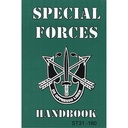
Green Beret Crest Tactical Field Handbook - Olive
12 sold in last 24 hours
The Green Beret Crest Tactical Field Handbook - Olive is a compact Special Forces-style manual built for real-world uncertainty, not coffee-table display. Survival basics, communications, first aid, and unconventional operations are laid out like a field checklist—clear, direct, and easy to find under stress. The low‑vis olive cover and Green Beret crest make it at home in a ruck, glove box, or range bag. It’s the quiet reference you reach for when you need the next right move, not more guesswork.
What the Green Beret Crest Tactical Field Handbook Actually Is
The Green Beret Crest Tactical Field Handbook - Olive is not a stunt prop or a generic "survival book." It’s a compact, Special Forces-style field reference designed to live where the weather is bad, the comms are shaky, and the plan just changed. Think of it as a quiet professional in print: direct, structured, and built to be used, not admired.
Where a typical coffee-table manual entertains, this handbook focuses on what you need to do next—survival basics, communications, first aid, and unconventional operations—laid out in a way you can access quickly under pressure.
Built Like a Real Field Manual, Not a Novelty
Everything about this tactical handbook is patterned after real military references. The olive cover keeps reflections down and visual profile low in the field, while the Special Forces crest signals the serious, no‑nonsense content inside. The layout is dense but organized: sectioned information you can flip to fast instead of long storytelling that burns time.
Low-Visibility, Field-Ready Exterior
The subdued olive cover isn’t just an aesthetic choice. In the field, shiny or high‑contrast covers are easy to spot, easy to lose, and easy to damage. The muted tone does three things well: it doesn’t flash light, it blends with most outdoor gear, and it still stands out just enough inside a ruck, go-bag, or vehicle compartment when you need to grab it quickly.
Clear, Purpose-Driven Interior Structure
This handbook follows a military-style organization: survival, communications, first aid, and unconventional operations are broken into direct, practical segments. You’re not reading for entertainment; you’re scanning for a specific action—how to signal, how to stabilize an injury, how to move without drawing attention. The structure supports that kind of fast, purposeful use.
How This Tactical Handbook Works in Real Use
Unlike a stun gun for self defense, which is a single-moment defensive tool, this handbook is about decisions made before, during, and after a problem. It doesn’t "save you" on its own—it gives you frameworks, checklists, and procedures that make you more competent when conditions turn against you.
Used properly, it becomes part of your personal protection system: you study it in calm moments, mark key sections, and keep it where you can reach it. Under stress, you’re not trying to learn from scratch. You’re confirming steps, refreshing a protocol, or checking a detail before acting.
Why Serious Personal Protection Buyers Still Carry Books
In a world of apps and videos, a printed tactical handbook might look outdated—until batteries die, networks drop, or you’re working in a light discipline environment where glowing screens are a liability. Serious protection planning is layered: you might carry a stun gun for self defense, a blade, medical gear, backup comms, and reference material. This handbook is the quiet layer that doesn’t fail when technology does.
From Survival Basics to Unconventional Problems
Coverage ranges from core survival (shelter, water, fire, navigation) to communications, first aid, and more specialized topics usually reserved for field manuals. That range matters. Real incidents rarely stay in a single category—you may move from a basic survival problem to a medical issue, then into signaling or movement decisions. Having all of that in one compact volume beats trying to remember which video you watched a year ago.
Train First, Reference Under Stress
The best way to use any personal protection tool—whether it’s a stun gun, medical kit, or field guide—is to train with it before you need it. This handbook rewards that approach. Read it, tag pages, run small drills based on its guidance, and treat it as a reinforcement tool rather than a last‑second teacher. Under stress, that combination of prior practice plus a trusted reference dramatically improves your odds of making solid decisions.
Integrating This Handbook Into Your Protection Setup
If you’re already thinking seriously about self defense and personal protection, you probably have gear picked out: maybe a stun gun for personal protection, maybe pepper spray, maybe a trauma kit. The question becomes: how do you make all of that work together in real conditions?
This is where a compact, structured handbook matters. It helps you think through scenarios beyond the single moment of a confrontation: route planning, signaling options, what to do if help is delayed, how to stabilize injuries, and how to manage risk over hours or days, not seconds.
What People Ask Before Buying a Stun Gun for Protection
Even when they’re buying a book like this one, practical buyers almost always ask about tools like a stun gun for self defense at the same time. These are the core questions that come up—and the same plainspoken, no‑hype approach applies.
How effective are stun guns for self defense?
Stun guns can be effective, but only within their limits. They are close-contact tools: you must physically touch an attacker with the contact points and maintain contact for at least a second or two for meaningful effect. Used well, with solid targeting (large muscle groups) and immediate follow‑up—escape, movement to safety, or escalation to another option—they can disrupt an assault and buy you time.
They are not magic wands. Factors like clothing thickness, the person’s physiology, and your ability to maintain contact under stress all matter. A stun gun works best as one layer in a broader protection plan, not as your only answer.
Does voltage or amperage matter more in a stun gun?
Voltage sells; amperage stops. Those "5 million volt" or "X million volt" claims are mostly marketing. Voltage is the pressure that lets electricity arc across a gap or through clothing. Once you have enough voltage to bridge that gap, adding more doesn’t linearly increase stopping power.
Amperage—the actual current delivered through the body—is what affects muscles and nervous system. Along with current, contact time, contact area, and build quality matter more than headline numbers. A well-built stun gun with solid current, good contact probes, and a reliable power source is more useful than a cheap "million volt" toy that fails when you need it.
Is this stun gun legal to carry in my state?
Stun gun laws are state- and sometimes city-specific, and they change. In many U.S. states, civilian possession of a stun gun for personal protection is legal with few restrictions. Others require permits, limit carry locations (schools, government buildings, etc.), or prohibit certain models.
The practical approach is simple: check your current state statutes and any local ordinances before you buy. Look specifically for terms like "stun gun," "electronic control device," or "conducted energy weapon." If you’re unsure, consult an attorney or local law enforcement policy information—not random forum posts. The same disciplined, fact‑first mindset that makes this Special Forces-style handbook valuable should guide your legal research too.
Carrying Knowledge Like You Carry Tools
Whether you ever add a stun gun for self defense to your kit or not, the core of personal protection is informed decision‑making under stress. The Green Beret Crest Tactical Field Handbook - Olive gives you a compact, structured way to build that competence: you learn procedures now, you refresh them periodically, and you have a tough, low‑profile reference ready when conditions shift.
No drama, no inflated promises—just a practical manual that fits alongside your other protection tools and helps you think like the people who train for worst‑case scenarios for a living. Slide it into your pack, glove box, or duty bag, and you’re no longer relying on memory alone when it matters.